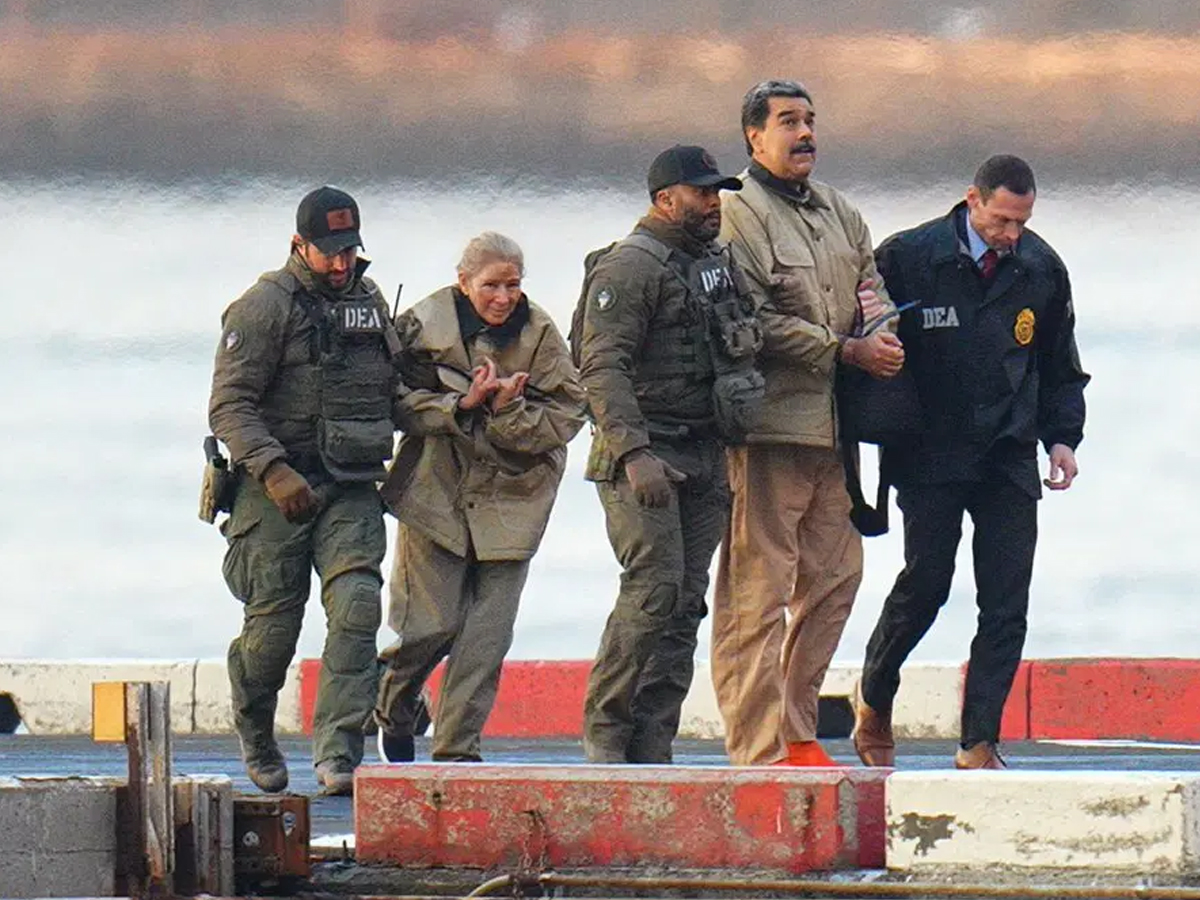
The geopolitical tremors that began in the early hours of January 3, 2026, have sent a clear message to the world: the era of Westphalian sovereignty—the principle that nation-states have exclusive authority over their own territory—is under a state of total siege. With the execution of ‘Operation Absolute Resolve,’ the United States has not only apprehended a sitting head of state, Nicolás Maduro, but has also dismantled the fragile architecture of international diplomacy that has governed the post-Cold War world.
What the White House describes as a ‘liberation of the Venezuelan people’ and a ‘necessary strike against narco-terrorism’ is being viewed by a significant portion of the global community as an act of naked aggression. As Caracas smolders and the international community fractures, we analyze the profound implications of this unprecedented military intervention.
A Breach of the Sacred: The Unlawful Nature of the Intervention
The fundamental bedrock of the United Nations Charter is Article 2(4), which prohibits the “threat or use of force against the territorial integrity or political independence of any state.” By launching a unilateral surgical strike to arrest President Maduro, the U.S. has bypassed the UN Security Council entirely, invoking a controversial interpretation of “Universal Jurisdiction” and “Self-Defense” against non-traditional threats like narco-trafficking.
Legal experts argue that while the Maduro regime faced legitimate accusations of human rights abuses and democratic erosion, these do not grant a foreign power the legal right to invade. The U.S. justification—linking the Venezuelan state to the “Tren de Aragua” criminal organization and accusing it of ‘chemical warfare’ via fentanyl trafficking—remains thin under the scrutiny of international law. By acting as judge, jury, and executioner, Washington has set a dangerous precedent: if a superpower deems a foreign leader a ‘criminal,’ it can bypass diplomacy and resort to abduction.
The Collision of Giants: Russia and China’s Response
The reaction from the Kremlin and Beijing has been swift and predictably fierce. For Russia, Venezuela was its most strategic foothold in the Western Hemisphere. The reported casualties among Russian military ‘advisors’ during the U.S. strike have brought the two nuclear superpowers closer to a direct kinetic confrontation than at any point since the Cuban Missile Crisis. Moscow has characterized the attack as ‘state-sponsored kidnapping’ and ‘neo-colonialism of the worst kind.’ Meanwhile, China, which has invested over $60 billion in Venezuela’s infrastructure and oil sectors, sees the intervention as a direct threat to its energy security. Beijing’s response has focused on the ‘sanctity of sovereignty,’ fearing that the U.S. is testing a new doctrine of ‘Regime Change 2.0’ that could eventually be applied to other nations resisting Western hegemony. This intervention has effectively killed any hope of a ‘thaw’ in U.S.-China or U.S.-Russia relations, cementing a new Tri-Polar Cold War where Latin America is once again a primary chessboard.
The Economic Aftershock: Oil, Debt, and the Global Market
Venezuela sits atop the world’s largest proven oil reserves—estimated at 303 billion barrels. The immediate aftermath of the military action saw Brent Crude prices spike by 15% in a single day, as uncertainty gripped the Caribbean shipping lanes. However, the hidden economic narrative is even more complex. The U.S. Treasury has already begun discussions about ‘restructuring’ Venezuela’s massive sovereign debt, much of which is owed to China and Russia. By installing a pro-Western transitional government, the U.S. aims to:
Direct Resource Access: Re-integrate American oil giants like Chevron and ExxonMobil into the Orinoco Belt.
Debt Erasure: Potentially default on or deprioritize debts owed to “adversarial” nations under the guise of “illegitimate odious debt” incurred by the Maduro regime.
While this may eventually lead to a surge in global oil supply, the short-term volatility is a nightmare for developing economies that rely on stable energy prices.
The Indian Position: A Tightropme Walk of Strategic Autonomy
For India, the crisis in Venezuela is a test of its ‘Strategic Autonomy,’ New Delhi’s position is uniquely multifaceted, reflecting its status as a rising global power with ties to both the West and the Global South.
The Energy Factor: India has historically been a major refiner of Venezuelan heavy crude. The sanctions of the previous years already strained this relationship. If the U.S. intervention leads to a stable, albeit puppet, government that resumes exports, India stands to benefit from cheaper, diversified energy sources. However, the current price volatility caused by the conflict is an immediate inflationary threat to the Indian economy.
The Diplomatic Dilemma: The Ministry of Ex ternal Affairs (MEA) has issued a carefully worded statement calling for ‘restraint’ and the ‘peaceful resolution of disputes through dialogue.’ India cannot openly support a unilateral invasion because it violates the very principles of sovereignty that India champions at the UN. Yet, India cannot afford to alienate Washington, a critical partner in countering Chinese expansionism in the Indo-Pacific.
Voice of the Global South: As a leader of the Global South, India is under pressure from nations in Africa and South America to condemn the ‘imperialist’ nature of the attack. India’s silence or moderate stance is being watched closely as a barometer of whether it will prioritize its ‘great power’ ambitions with the U.S. or its moral leadership of the developing world.
The Human Cost and the ‘Monroe Doctrine’ Revived
Beyond the high-level politics, the humanitarian situation in Caracas is dire. The collapse of the existing administrative structure has led to a power vacuum. While some celebrate the end of Maduro’s authoritarianism, many fear that the U.S. ‘occupation’ will be indefinite. This move effectively revives the Monroe Doctrine—the 19th-century policy that declared the Americas as the U.S. sphere of influence. By removing a leader it disliked, Washington has told the world that the ‘Rules-Based International Order’ is only applicable when it suits the interests of the rule-maker.
A World Without Rules?
The arrest of Nicolás Maduro on American soil marks a point of no return. We are entering a phase of international relations where ‘Legitimacy’ is defined by military capability rather than democratic consensus or international law. If the U.S. succeeds in transforming Venezuela into a stable, pro-Western democracy, it may claim a moral victory. However, the cost of that victory is the destruction of the UN’s credibility. The world is now watching a dangerous experiment: can a superpower forcefully export ‘democracy’ while simultaneously incinerating the laws that protect the sovereignty of all nations?
As the 21st century progresses, ‘Operation Absolute Resolve’ will likely be remembered not as a triumph of justice, but as the moment the world realized that in the game of global power, the only real law is the one backed by the barrel of a gun.
[Sudhir S. Raval is Consulting Editor at ITV Network]