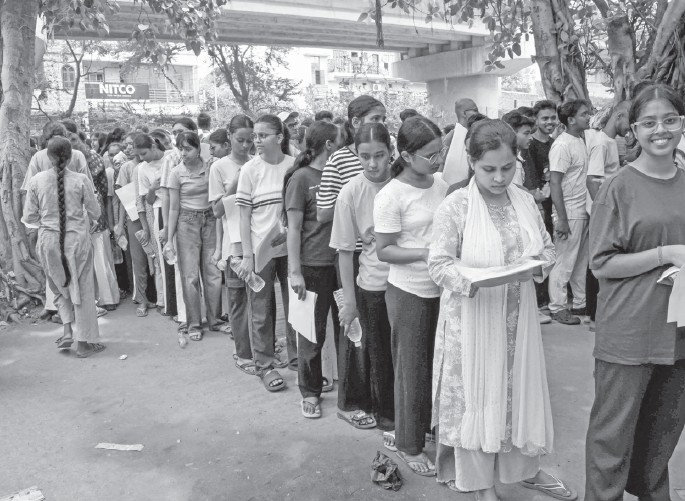
National exams are gateways to opportunities for lakhs of young people. In the large-scale logistics of a rapidly growing country, systems such as these will be subject to some level of friction. However, how an institution responds to errors or problems — whether they are systemic or individual — determines its overall resilience and ability to serve the needs of its stakeholders.
A case study about a NEET-2026 test-taker who was allocated an exam centre in Abu Dhabi after choosing one in Nagpur provides insight into the difference between legitimate administrative failure and manufactured political panic. Healthy democracies thrive on positive dialogue. However, less than 48 hours prior to a critical re-examination test date on June 21st, several politicians chose to elevate an isolated problem concerning the allocation of the exam location of a single test-taker — which had yet to be confirmed by facts — to raise anxiety among millions of students.
Upon closer inspection of the facts, a more realistic picture emerges. Digital records maintained by the NTA show a singular, constant user access pattern. The use of Nagpur-based IP addresses and the candidate’s credentials was logged into the system showing the candidate changed his choice of city manually from Nagpur to Abu Dhabi.
The mere fact that an alteration has been made to a web log does not establish evidence of manipulation on the part of the test-taker. The possible reasons for the changes include: misuse of a commonly used device; unauthorized use of the test taker’s login credentials; or an error resulting from misinterpretation of the user interface. However, it can be demonstrated through the digital logs that there was a legitimate user based event. It was not a random technical glitch created by the NTA to impede the ability of Indian students to complete their exams. It is critical to distinguish these two types of events (institutional glitches and local user based errors), because each type represents a unique category of event.
Because one single instance may not adequately represent institutional failure, after the reopening of the correction window, 3.2 lakh plus candidates corrected their personal information; and 99.5 percent of all candidates received their preferred examination centre. This 99.5% success rate represents a strong indication of institutional competency. Therefore, ignoring this substantial body of evidence to declare systemic collapse is an unfounded myth created to cultivate distrust and cynicism towards the systems which provide democratic opportunity throughout India.
However, within the context of national examinations, where the stakes are high, public confidence can only be built upon two pillars: low error-rates and visible forms of active redressal. Even isolated incidents are important.
It is here that the institutional response merits praise. A traditional bureaucratic entity may have relied on the rule book to dismiss a candidate for making an informal last-minute request. Rather, as part of a “student first” philosophy, government officials contacted the father directly and manually relocated the test centre back to Nagpur. The issue was rectified, and redress was made publicly available so that the test-taker did not miss taking his exam.
Therefore, organisations that are resilient enough to withstand various types of errors should not be defined by the fact that no errors occur within their operational framework; instead, they should be defined by their ability to respond quickly to errors while cynical opportunists attempt to characterise these issues as examples of national malaise.
Going forward, we need to expect that there will be a comprehensive set of standards that governs how public discourse proceeds. Public figures have a Dharma—a moral obligation—to consult with the appropriate agency to validate allegations before declaring an incident involving an individual candidate as symptomatic of institutional dysfunction.
Our students are not shadows whose lives are adversely impacted by manufactured outrage; they are the future of Bharat, and, therefore, they are deserving of assurance, clarification and truth-based honesty. It is essential that we safeguard our national institutions from the ill