
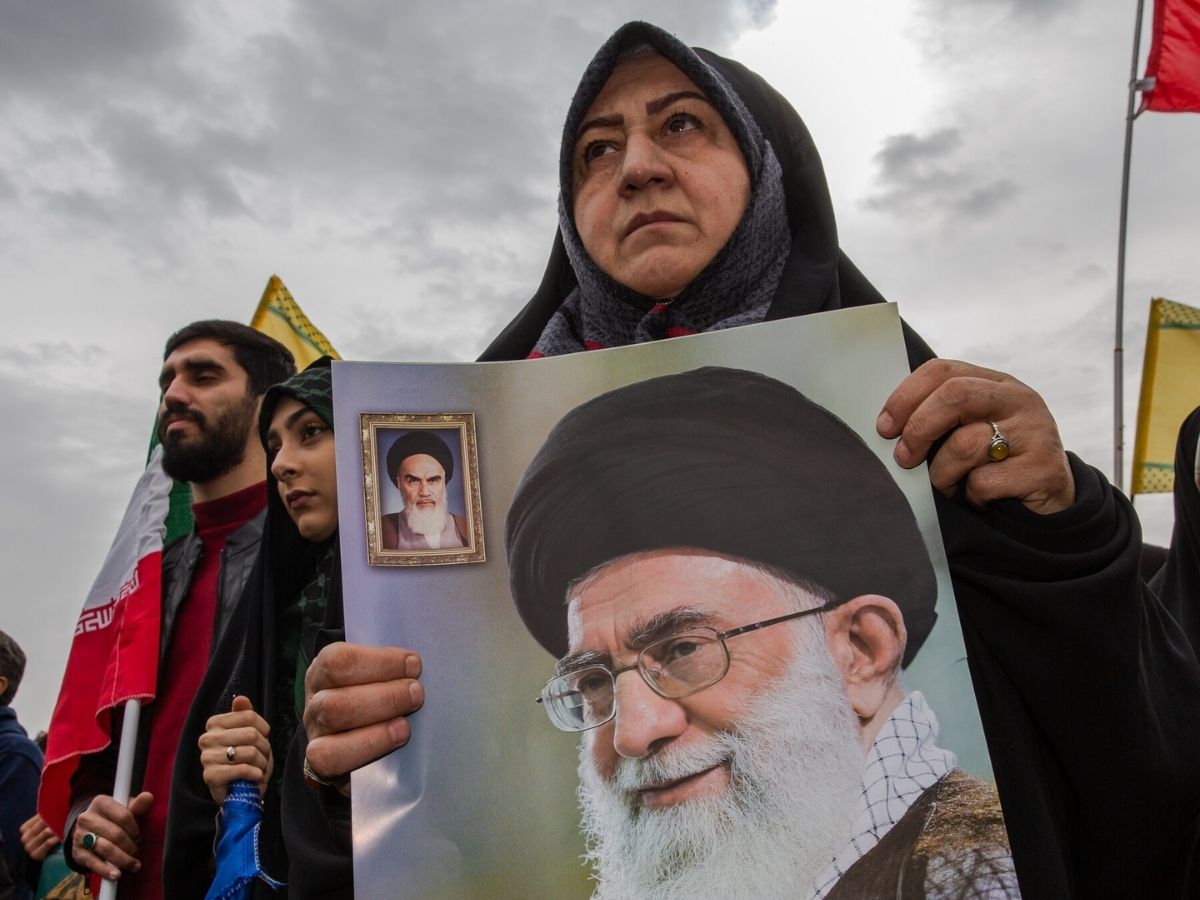
The United States and Israel opened their war on Iran this weekend with a sudden strike on its longtime supreme leader, Ayatollah Ali Khamenei. While the war as a whole has been broadly denounced as illegal by critics who point to its lack of authorization from Congress or the United Nations Security Council, the ayatollah’s killing raises particular legal questions.
It is extraordinarily rare for a country to deliberately and openly kill the leader of another sovereign nation — even during legally uncontested wars. As a result, the question has rarely come up. A very rare precedent of sorts came in March 2003, when the Bush administration tried to kill Saddam Hussein on the cusp of the Iraq war, a conflict Congress had authorized — but that airstrike missed its target. Khamenei’s assassination represents a new stage in the erosion of the international norm against assassination. This norm has long been understood as part of a broader framework protecting sovereignty and prohibiting the use of force outside armed conflict.
Under international law, the killing of a state official outside an armed conflict will almost invariably violate the prohibition on the use of force, state sovereignty, and/or international human rights law. The directly targeted killing of foreign adversaries, once rejected as beyond the pale, has become a prominent issue in debates over U.S. security policy. The shortsighted policies driving the US’s so-called “global war on terror” were undermining the norm and risked spilling over to justify the killing of state officials. In the wake of Khamenei’s assassination, this statement no longer seems to hold true.
A gradual acceptance of assassination
The norm’s erosion was already visible in the January 2020 killing of Qassem Soleimani. The Trump administration initially invoked self-defence and imminence, before shifting to claims that Soleimani had “American blood on his hands”. International reactions were limited: a joint statement by France, Germany, and the United Kingdom focused on regional stability without directly condemning (or indeed mentioning) the killing. Subsequent cases reinforced this pattern. The Biden administration justified the 2022 killing of Ayman al-Zawahiri with the assertion that “justice has been delivered”, without any articulation of its compatibility with International Law.
This apparent acceptance of assassination as a tool of statecraft rests on two interrelated mechanisms: routinisation and legitimation. With the US adoption of the practice, now strategically renamed “targeted killings”, assassination became increasingly routinised as a tool of statecraft.
The assassination of Ali Khamenei differs from the killings of the past two decades insofar as sitting heads of state have historically occupied a distinct normative category. When states plotted against foreign leaders during the Cold War (for instance, the US repeatedly attempted to assassinate Fidel Castro), they always did so covertly and rarely acknowledged responsibility when exposed. In later decades, when the US targeted foreign leaders such as Muammar Gaddafi and Saddam Hussein, it was careful to claim that their deaths would have been an inadvertent consequence of a strike undertaken in selfdefence. Such was the stigma against targeting heads of state that, as late as 2022, some authors argued that the norm erosion triggered by targeted killings would remain “compartmentalised” to the targeting of nonstate actors.
Today, both democratic and authoritarian states employ it, and targets have expanded beyond suspected terrorists to include scientists, political opponents, bloggers, journalists, state officials, and sitting heads of state during armed conflict. Alongside covert poisoning and car bombs, methods have evolved to include drone strikes and AI-assisted targeting. The practice now spans objectives of counterterrorism, deterrence, regime security, and strategic signalling. What was once treated as an exceptional and contested measure has been bureaucratised and normalised as a tool of policy within selfproclaimed liberal democracies such as the United States and Israel. The definitional move from “assassination” to “targeted killing” facilitated this process by situating such operations within the vocabulary of armed conflict after 9/11.
Undeclared USIran Conflict
It may seem that the US and the Middle East are currently embarking on yet another forever war. But the truth is that this is just the latest instalment of an undeclared military conflict between the two nations that has been ongoing since the 1980s. For Americans, the war began in 1979, when Iranian students seized the US embassy in Tehran and held 52 diplomats hostage for 444 days. For Iranians, it began with US support for the Shah and its subsequent backing of Iraq throughout the 1980-1988 Iran-Iraq war. The conflict has claimed many civilian lives. On July 3 1988, the US warship Vincennes downed Iran Air Flight 655, a civilian flight bound for Dubai. The USS Vincennes misidentified the Airbus as a military aircraft and shot it down, killing all 290 people on board. More recently, on 28 February 2026, a US-Israeli missile hit a girls’ school in southern Iran, killing over 150 civilians, most of them children. Iran also shot down Ukraine International Airlines Flight 752 on January 8, 2020. The Islamic Revolutionary Guard Corps mistook the civilian plane for a US military flight, and fired two surface-to-air missiles that killed all 176 passengers, mostly Iranian civilians.
Prohibition of aggression as a Jus Cogens norm
One of the first jus cogens norms identified by the International Law Commission (‘ILC’) is aggression. Although there is a lack of consensus on the prohibition of the use of force as a jus cogens norm, aggression has garnered acceptance as a jus cogens norm. The UNGA defines aggression as “the use of armed force by a State against the sovereignty, territorial integrity or political independence of another State, or in any other manner inconsistent with the Charter of the United Nations.” Although it replicates the provision on the use of force under Article 2(4) of the UN Charter. This distinction is pronounced in the ILC Draft Conclusions on the identification and legal consequences of peremptory norms of general international law (jus cogens), which prefers aggression over aggression in its non-exhaustive list.
United States Aggression And Limits Of Self-Defence
The U.S reckons preemptive strike falls within the ambit of self-defence. However, I argue that this defence is untenable as self-defence cannot justify the acts of aggression. First, the UNGA Resolution 3314 lays down a list of acts that constitute aggression. Specifically Article 3(d) of the resolution reads, “An attack by the armed forces of a State on the land, sea or air forces, or marine and air fleets of another State”. The U.S. B-2 bomber dropped bombs over the nuclear sites in Fordow, Natanz and Isfahan. Trump claims the strikes “completely…obliterated” Iran’s nuclear enrichment facilities. According to the Secretary of Defence Pete Hegseth, the attack has ‘obliterated Iran’s nuclear ambition.’ Therefore, these air attacks unambiguously constitute aggression. The rationale behind these attacks and coercive diplomacy is to thwart the Uranium enrichment and curb the regional hegemony of Iran. However, this legally does not entitle the U.S. to commit aggression. As the UNGA resolution highlights, “[N]o consideration of whatever nature, whether political, economic, military or otherwise, may serve as a justification for aggression.” Therefore, self-defence cannot be a ground to justify aggression because it is immune to exceptions.
Second, on several occasions, the International Court of Justice (‘ICJ’) had the opportunity to interpret self-defence for acts of aggression. In the Nicaragua case (1986), the United States tried to deploy collective self-defence for Nicaragua’s alleged acts of aggression against El Salvador, Honduras and Costa Rica. However, the U.S. failed to fulfil the requirement of selfdefence, as the ICJ observed, “The declaration and the request of El Salvador made publicly for the first time in August 1984, do not support the contention that in 1981 there was an armed attack capable of serving as a legal foundation for United States activities which began in the second half of that year.”
Law Still Matters
If the international community remains silent following actions surrounding the murder of Ali Khamenei, silence risks becoming complicity. Normalising preventive war weakens the post-1945 rules-based order and encourages nuclear proliferation as vulnerable states seek survival through deterrence. The consequences may include escalating arms races, erosion of diplomacy and heightened risk of confrontation among nuclear powers.
Accountability mechanisms still exist — independent investigations, international legal proceedings, diplomatic pressure and multilateral restraint. The issue is not punishment alone but preservation of global order. When force replaces law as the organising principle of international politics, instability becomes permanent. Silence, in such moments, is not neutrality. Silence becomes participation in the crime.
Dr.S.Krishnan is an Associate Professor in Seedling School of Law and Governance, Jaipur National University, Jaipur. Mr. Ankit Gajraj is 1st year student of BBALLB (H) in Seedling School of Law and Governance, Jaipur National University, Jaipur. Ms. Honey Raj is 1st year student of BBALLB (H) in Seedling School of Law and Governance, Jaipur National University, Jaipur.