
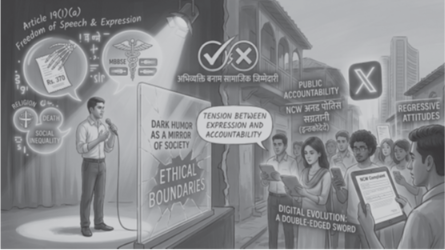
The recent controversies surrounding the “Rs. 370 biryani remark” during comedian Pranit More’s stand-up comedy show and the subsequent backlash against MBBS student Sejal Pawar have struck a raw nerve across our cultural landscape. Much of the public discourse has fixated on the immediate fallout, largely revolving around whether the remarks crossed into misogyny and dark humour, or if they merited severe professional consequences. Yet, viewing these incidents in a vacuum risks missing the forest for the trees. The true gravity of the situation lies not merely in the glibness of what was uttered, but in how these statements pulled back the curtain on deeper, unaddressed societal anxieties. Humour has always occupied a unique space in society. It entertains, provokes thought, challenges authority, and often exposes uncomfortable truths. Among its many forms, dark humour remains the most controversial. By making jokes about sensitive subjects such as death, poverty, illness, religion, gender, or social inequality, dark humour tests the boundaries of public tolerance and legal protection. Recent debates surrounding the so-called “Rs 370 Biryani” and “MBBS” jokes have reignited questions about the limits of humour in a democratic society. Are such jokes merely expressions of creativity and free speech, or do they cross ethical and constitutional boundaries?
Dark Humour as a mirror of society
The Rs. 370 biryani controversy was never fundamentally about the cost of a meal. Instead, the public backlash stemmed from a deeper discomfort with what the remark laid bare: a stark, transactional view of courtship that reduces human connection to a crude quid pro quo, where financial expenditure is erroneously viewed as a down payment on intimacy. While such regressive attitudes are typically relegated to hushed whispers within certain viduals into public spaces, particularly online. Society now evaluates not only professional competence but also personal expression. This digital evolution ultimately acts as a doubleedged sword. On one hand, heightened public accountability can effectively discourage toxic mindsets and foster more responsible public conduct. On the other hand, it risks fueling a hyperpunitive culture where a single, ill-advised utterance is permanently weaponized as an individual’s defining trait. pockets of society, the true flashpoint occurred when this unvarnished entitlement was casually articulated in front of a live audience.
In another case of the medical joke, the controversy deepened when a woman doctor, who appeared in the video, issued an apology following heavy social media backlash regarding a “male corpse” remark made during the exchange. During her set, Dr. Sejal Pawar, an MBBS student from Mumbai she joked about comparing the anatomy and genitalia of deceased male patients (cadavers) with her colleagues. This sparked immense outrage for disrespecting bodies donated to medical science. As the clip gained traction, the outrage moved from comment sections to formal complaints. In this sense, both incidents served less as instruments of entertainment and more as uncomfortable social mirrors. They reflected unsettling facets of our culture that many would prefer to believe are anomalies, yet which clearly continue to fester beneath the surface of polite society.
Why it matters
Whether this leads to a landmark legal precedent on artistic freedom or simply results in more cautious stage scripts remains to be seen. However, it is clear that the days of comedy existing in a vacuum are over. For not only to serious political discourse but also to artistic expression, satire, parody, and comedy. Freedom of expression in India is not absolute. Article 19(2) permits the State to impose reasonable restrictions in the interests of: Public order, Decency and morality, Defamation, Contempt of court, Sovereignty and integrity of India, Security of the State, Friendly relations with foreign States, Incitement to an offence The critical question is whether a controversial joke merely causes offence or actually falls within one of these constitutional exceptions. The Supreme Court of India has repeatedly emphasized that freedom of expression includes views that may shock, offend, or often relies on exaggeration, irony, and provocation. If every offensive joke were prohibited, comedians and artists would find it difficult to engage in meaningful social commentary. The judiciary has generally recognized that satire plays an important role in questioning social norms and exposing contradictions within society. Therefore, dark humour enjoys constitutional protection as long as it remains within the framework of law.
The social responsibility of comedians
While the Constitution protects speech, ethical considerations remain important. Freedom and responsibility are not mutually exclusive concepts. Comedians and content. The “biryani” row speaks to a broader, ongoing friction between creative expression and public accountability. In recent years, we have seen a pattern: comedy sets are increasingly being dissected by the National Commission for Women and police forces, often prompted by viral snippets that lack the full context of a live performance. This creates a chilling effect on the industry, where performers must now weigh the potential for a police case against the risk of an audience not “getting” the joke. Professional identities increasingly accompany indiboth the performer and the participant, the cost of going viral has proven to be significantly higher than a simple round of heckling.
Constitutional Protection of Humour
The Indian Constitution protects freedom of speech and expression under Article 19(1)(a). This right extends disturb certain sections of society. For legal action to be justified, there must be a demonstrable connection between the speech and one of the grounds specified under Article 19(2). Democracy thrives when diverse viewpoints, including unpopular ones, are allowed to circulate freely. Humour, by its very nature, creators possess significant influence, particularly in the digital era. A joke reaching millions of viewers can shape perceptions and attitudes. Consequently, many argue that creators should exercise sensitivity when dealing with subjects involving marginalized communities, mental health, disability, or historical trauma. This does not mean that all controversial humour should be avoided. Rather, it suggests that creators should be aware of the potential consequences of their work. Although legal protection is broad, ethical boundaries remain a matter of social debate.
Dark humour may become problematic when: It deliberately targets vulnerable individuals. It promotes hatred or prejudice. It dehumanizes communities. It mocks victims of tragedy without any broader purpose. It reinforces harmful stereotypes.
Context is crucial. The same joke may be perceived differently depending on the speaker, audience, intent, and circumstances. The challenge lies in preserving artistic freedom without encouraging unnecessary cruelty or dehumanization.
Judicial approach to Humour and satire
Indian courts have generally adopted a cautious approach when dealing with artistic and comedic expression. The judiciary has repeatedly emphasized that constitutional freedoms must be interpreted broadly. Courts have often recognized that literature, films, cartoons, and comedy may contain elements that some audiences dislike. Judicial decisions suggest that speech should not be restricted merely because it is unpopular or controversial. Instead, restrictions must satisfy constitutional standards and demonstrate a legitimate connection to public interests protected under Article 19(2). This approach reflects the understanding that democracy requires tolerance of diverse viewpoints, including those expressed through humour.
Way ahead
The controversy surrounding the Rs 370 Biryani and MBBS jokes highlights the continuing tension between freedom of expression and social sensitivity. In a constitutional democracy, humour—including dark humour—deserves substantial protection under Article 19(1)(a). The right to free speech would be meaningless if it protected only popular, agreeable, and uncontroversial opinions. At the same time, freedom carries ethical responsibilities. While the law may permit offensive jokes, society is entitled to debate their appropriateness and impact. The proper response to controversial humour is often criticism, discussion, and counter-speech rather than censorship. Ultimately, the distinction between dark humour and crossing the line depends on context, intent, and effect. A mature democratic society must be capable of tolerating uncomfortable jokes while remaining vigilant against speech that genuinely promotes hatred, discrimination, or violence. The Rs 370 Biryani and MBBS controversy therefore serves as a reminder that the strength of free expression lies not in protecting only what is agreeable, but in safeguarding the freedom to express ideas that challenge, provoke, and occasionally offend—so long as they remain within the constitutional framework of law.
*Dr.S.Krishnan is an Academician and Experienced Journalist based in Jaipur.