
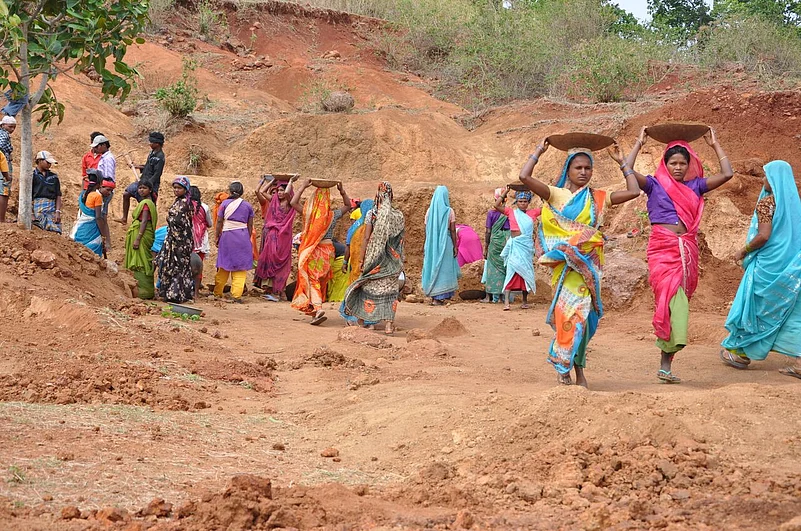
India’s villages stand at an inflection point. For two decades the Mahatma Gandhi National Rural Employment Guarantee Act (MGNREGA) provided a social-security floor and an important cash flow to millions of rural households. Now the Centre has signalled a significant policy reset: a consolidated, statutory programme widely discussed under names such as the Viksit Bharat Guarantee for Rozgar and Ajeevika Mission (Gramin) that aims to broaden the mandate from pure wage employment toward durable livelihood creation and asset building.
If designed and executed well, this pivot can move rural India from fragile day-wage dependence to resilient, diversified household incomes. The promise is simple but ambitious: combine guaranteed wage work with targeted investments that convert short-term wages into ongoing earnings through assets, skills, credit linkages and local enterprise.
Early reporting suggests the new design will retain the guarantee of a set number of workdays for eligible households, while layering in stricter accountability (penalties for delayed wage payments), better supervisory funding and modern monitoring tools like geo-tagging for real-time transparency. These operational improvements are essential; delayed pay and opaque implementation have long eroded trust and reduced the scheme’s poverty alleviation impact.
But policy architecture alone won’t create sustainable incomes. To translate workdays into enduring earnings, three transformations are required at scale: (1) asset-centric work that creates productive capital, (2) convergence with village-level finance and self-help groups to convert assets into enterprises, and (3) plug-and-play market linkages that turn production into predictable demand. Here’s how these can be realised in practice.
FROM DIGGING CANALS TO CREATING INCOME ASSETS
Historically, much rural employment focused on public works with ephemeral benefits. The new approach must prioritise asset creation: check dams, farm ponds, small irrigation systems, soil-health bunds, agro-forestry plots, and value-adding community infrastructure (cold storage, primary processing units). When project selection is driven by village economic diagnostics—mapping local resources, crop cycles and micro-industries—a single season’s labour converts into a multi-season revenue stream. For instance, a farm pond built through a community work program can enable two extra crop cycles or serve as a fishery, creating recurring revenue for participating households.
FINANCE AND SHG FEDERATIONS AS THE BRIDGE TO ENTERPRISE
Access to timely, inexpensive credit and business development support is essential to convert assets into micro-enterprises. The government’s encouragement of state-level jeevika-style institutions and federations (models that have given Bihar’s JEEVIKA notable reach among rural women) points to a workable pathway: federated Self-Help Groups (SHGs) as the institutional interface for credit, training and market aggregation. State experiments from JEEVIKA in Bihar to Rajeevika in Rajasthan show how federations can mobilise savings, simplify credit access and incubate community enterprises. Integrating the new national Rozgar/Ajeevika programme with such federations reduces leakages and builds entrepreneurship at the grassroots.
SKILL STACKS, MICRO-ENTERPRISES AND DEMAND LINKAGES
Villagers need short, modular skilling tied to market demand: post-harvest handling, natural fibre processing, low-capex food processing, solar pump servicing, digital record-keeping for farmers, and local logistics. Coupling 3-6 week skill modules with seed grants or equipment support (through targeted components such as Satat Jeevikoparjan Yojana style asset transfers) can create microenterprises that graduate families off wage dependence and into enterprise income.
The state can fast-track demand by anchoring procurement: mandating 10-20% sourcing for government programmes (mid-day meals, public procurement, construction inputs) from village enterprises and SHG federations.
WHAT THIS MEANS FOR VILLAGERS — PRACTICAL ROUTES TO INCOME
- Guaranteed wages convert into co-funded investments: When part of a work credit is converted into a community asset or a matched savings account, villagers acquire a stake that produces returns beyond the day’s pay. For example, labour towards a community rice-drying yard should come with an allocation of machine-use credits to SHGs, who then run the yard as a microenterprise.
- SHG membership becomes the entry ticket to finance and markets: Households that join SHGs gain access to pooled savings, simplified credit, business training and digital payment rails. Federations can aggregate produce (e.g., millets, cotton, processed snacks) to meet bulk buyers and e-commerce channels, multiplying income per household.
- Skill + asset + market = sustainable microenterprise: Short training in say, seed grading or low-temperature drying + a subsidised dryer (an asset) + a guaranteed procurement buyer (school meals, local supermarkets, D2C platforms) creates a viable small business. Scale this across clusters and the village economy diversifies.
ROLE OF TECHNOLOGY, TRANSPARENCY AND ACCOUNTABILITY
Geo-tagging of works, digital muster rolls and mobile wage payments reduce corruption and speed payments. Public dashboards that track project progress and finances empower gram sabhas and local media to hold the system accountable and encourage better quality projects. A small but vital reform is timely penalties for delayed wages and better supervisory funding—both increase the value of the programme to households and strengthen implementation.
CONVERGENCE AND THE PRIVATE SECTOR: A PRAGMATIC PARTNERSHIP
Startups, local millers, agri-processors and platform companies can plug into this ecosystem not as extractors but as demand anchors and skill partners. The government can incentivise local procurement by offering margin support for initial contracts, or by easing compliance pathways for SHG-run entities. Public procurement quotas and market linkages help scale village enterprises rapidly into viable suppliers to nearby towns and cities.
A SPECIAL EMPHASIS ON WOMEN AND YOUTH MULTIPLIES IMPACT
When program design centres women through Federations, dedicated finance windows (as seen in state Jeevika models) and skill tracks for women-led enterprises, household incomes stabilise and social outcomes improve. Youth can be absorbed as local technicians, last-mile aggregators, and digital facilitators (payment agents, data collection), reversing rural brain drain.
THE CONDITIONS FOR SUCCESS — AND RISKS TO AVOID
This policy pivot can succeed if three conditions are met: (1) real decentralisation of project choice to gram sabhas backed by technical appraisal; (2) predictable finance and timely wage payments; and (3) market linkages that turn assets into revenue. Risks include substituting headline re-branding for real reform, weak monitoring that lets poor assets proliferate, and top-heavy execution that sidelines local institutions. Vigilant civil society, transparent data, and performance-linked supervisory funding are counterweights to these risks.
CONCLUSION — FROM GUARANTEED WORK TO GUARANTEED LIVELIHOODS
Modi government’s re-orientation from a pure employment guarantee to an integrated Rozgar and Ajeevika mission is a thoughtful step in the right direction. If the policy hard-wires asset creation, federated finance (SHGs), skill stacks and market linkages—and backs these with technology and timely payments—millions of rural households can graduate from precarious wages to resilient incomes. The challenge is execution: turning macro-ambition into village-level realities. As mentors, entrepreneurs and policy practitioners, our task is to support that translation—with practical incubation, market access and accountable delivery—so that India’s villages become not just sites of survival, but engines of sustainable prosperity.
Jaiprakash is the mentor in Startup India & AIM India, author and a blogger.