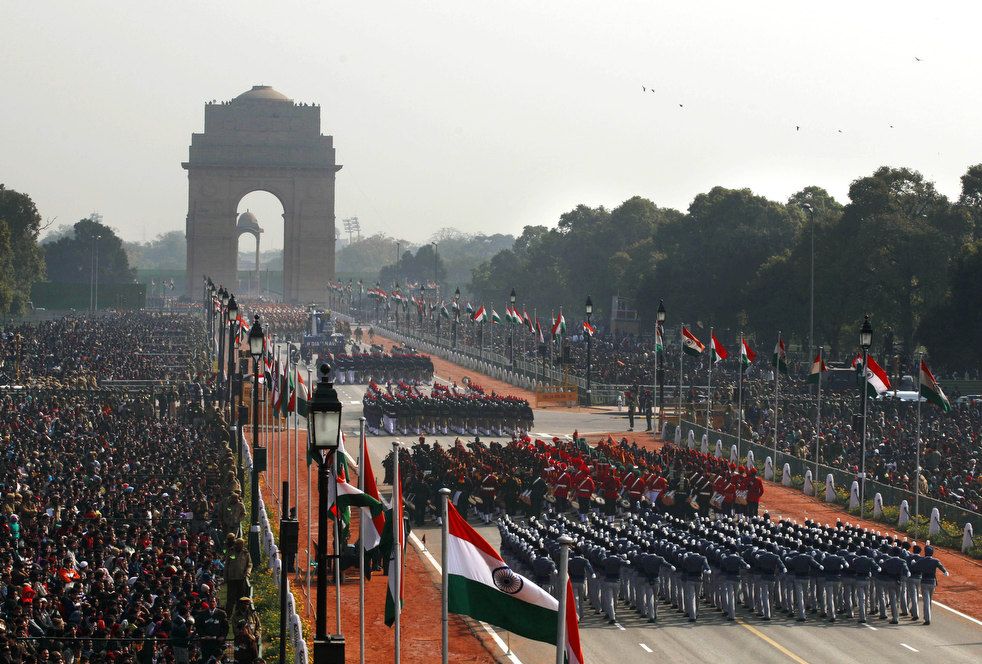
On 26 January, Bharat is joyfully celebrating the 77th year of its Republic. On 26 January 1950, Bharat brought its Constitution into force. This 76-year journey of Bharat has been full of challenges, yet it stands as the story of a successful democracy. A significant contribution to this success has been made by the Constitution of Bharat. The Constitution was dedicated to the nation by the Constituent Assembly on 26 November 1949. At that time, we reaffirmed our resolve to remain committed to delivering social, economic, and political justice through a democratic system. While following our respective faiths and beliefs, we pledged to preserve the unity and integrity of the nation through a spirit of fraternity. Referring to the distinctive features of our Constitution, African leader Nelson Mandela observed that “India’s Constitution has served as an inspiration for several emerging democracies, including South Africa, as it has taught respect within diversity.” On the occasion of this Republic Day celebration, it is incumbent upon “We, the People of Bharat” to remain vigilant toward future challenges, overcome them with determination, and fulfill the Hon’ble Prime Minister’s vision of a Developed Bharat.
The Hon’ble Prime Minister, Shri Narendra Modi, in his call for the Panch Pran, has urged the people of Bharat to free themselves from all forms of slavery. Over time, certain foreign scholars, through a systematic approach, sought to instill a sense of inferiority within Bharat’s society regarding our institutions, history, great personalities, and cultural heritage. As a consequence, sections of our society became afflicted with a sense of self-doubt and diminished self-esteem. Today, the nation finds itself in a state of uncertainty over fundamental questions: What constitutes the foundation of our nation, and upon which values should we chart our future course? Bharat is perhaps the only country in the world known by two names—Bharat and India. This duality itself has been a source of seven ideological and logical debates. In this context, Dr. S. Radhakrishnan, in his address to the Constituent Assembly, observed, “Nationality depends upon the way of life that we have followed from time immemorial.” This way of life is the distinctive possession of this country. Shrimad Bhagwat Vidura warned: “In a state of confusion, the king, the people, and the entire nation meet their ruin.” Therefore, on the auspicious occasion of Republic Day, let us recall the glory of Bharat, dispel all uncertainty, and resolve to awaken society by anchoring ourselves firmly in our cultural values.
In his address from the Red Fort on 15 August, Prime Minister Narendra Modi expressed concern over the changing demographic patterns in the country. We have already witnessed the partition of Bharat, which occurred as a consequence of demographic imbalance. Even today, through a systematic and multi-pronged approach, efforts are being made to reshape Bharat’s demographic composition on religious lines. The consequences of a declining Hindu population can be observed through the daily incidents taking place in Pakistan and Bangladesh. Countries such as Egypt, Turkey, Iran, Lebanon, and Kosovo also stand as examples where ancient civilizations and cultures have diminished or disappeared due to demographic changes. Based on such historical experiences, the renowned sociologist Auguste Comte famously observed that “Demography is Destiny.” It is, therefore, incumbent upon we, the people of Bharat, to recognize these emerging threats and actively participate in safeguarding democracy by supporting the identification and lawful action against illegal foreign infiltrators through the principles of “Detect, Delete, and Deport.”
Due to Bharat’s growing strength and rising global stature, several foreign powers, foreign-influenced individuals, and institutions appear increasingly unsettled. This unease has led to continuous attempts to discredit Bharat’s constitutionally recognized institutions and systems. Allegations raised against the Election Commission of Bharat and Electronic Voting Machines (EVMs), institutions widely respected and praised internationally, efforts to create confusion and social unrest by misrepresenting the Citizenship Amendment Act (CAA), claims about changing the Constitution or abolishing reservations, and incidents carried out in the name of the farmers’ movement are all vivid examples of this trend. It is also alleged that similar forces played a role in movements that led to the replacement of elected governments in Sri Lanka, Bangladesh, and Nepal. Under the pretext of “Gen Z”, such forces are believed to be nurturing similar ambitions in Bharat as well. On 26 November 1949, Dr. B. R. Ambedkar, in his final address to the Constituent Assembly, warned against what he termed the “Grammar of Anarchy.” He cautioned that such so-called mass movements represented an attempt to use propaganda as a weapon against democratic governance. In Bharat, several foreign-funded non-governmental organisations (NGOs) are believed to be actively involved in fostering such disorder. For those who observe how global dominance is pursued through engineered conflicts, anomalgations and economic imperialism, the answer for Bharat lies in becoming strong, secure, and developed on the foundations of self-reliance and indigenous capacity.
Many scholars influenced by Western and communist ideologies view Bharat not as a single nation but as a collection of multiple nations. Granting theoretical legitimacy to divisions based on North-South, Aryan-Dravidian, tribal-urban, Dalit-Hindu, and similar classifications has long been the objective of such groups. Those who claim to promote so-called equality by drawing upon urban Naxalism and armed insurgency have, in reality, always harboured dreams of Bharat’s disintegration. Bharat has always been one nation, its culture is unified, and it is through Unity in Diversity, that we have experienced true oneness. From Kanyakumari to the Himalayas, we are one. Due to a lack of realization of this fundamental truth, self-serving, ill-informed, and power-hungry political leadership has, at times, indulged in divisive rhetoric. The initiative launched by Prime Minister Shri Narendra Modi, “Ek Bharat, Shreshtha Bharat”, reinforces this lived experience of unity among the people of Bharat. The Kashi-Tamil Sangamam stands as a vivid and inspiring example of this spirit. It is now incumbent upon we, the people of Bharat, to make a sincere and successful effort to help millions of fellow citizens realise this enduring truth of national unity.
The Government of Bharat has resolved to free the country from Naxalism by 31 March 2026. Since 2014, more than 2,000 Naxalites have been neutralised, and over 2,000 have surrendered, reaffirming their faith in the Constitution of Bharat. It is the responsibility of all citizens of Bharat to support development and rehabilitation efforts in Naxal-affected regions and thereby contribute to the Hon’ble Prime Minister Shri Narendra Modi’s vision of a Naxalism-free Bharat. Radical forces across various regions are engaging in multiple conspiracies under the guise of portraying themselves as victims, ostensibly to preserve their identity. Incidents such as opposition to Makara Sankranti in Bangladesh, demands for a separate land in Texas, USA, and conspiracies involving religious conversions and so-called “love jihad” are being witnessed in India as well as in other parts of the world. Under the pretext of protesting specific incidents, large-scale street demonstrations are being organised with the intent of creating fear and unrest within society. Challenging law and order and the judicial system is increasingly becoming a pattern of behaviour for certain groups. For all those who think and act in the interest of the nation, this trend is a matter of serious concern.
For meaningful participation of the common citizen in a democratic system, freedom from dynastic politics and integrity in the implementation of economic policies must guide our conduct and decision-making. The success of governments should be measured by development and the well-being of society, rather than being assessed on the basis of caste or regional considerations. This approach will foster an internal social environment rooted in mutual harmony, goodwill, and fraternity. On this occasion of Republic Day, it is the duty of all of us, the people of Bharat, to uphold constitutional values, remain vigilant in the face of challenges, and faithfully discharge our civic duties.
(Shivprakash is the National Joint General Secretary (Organisation) of the Bharatiya Janata Party.)