
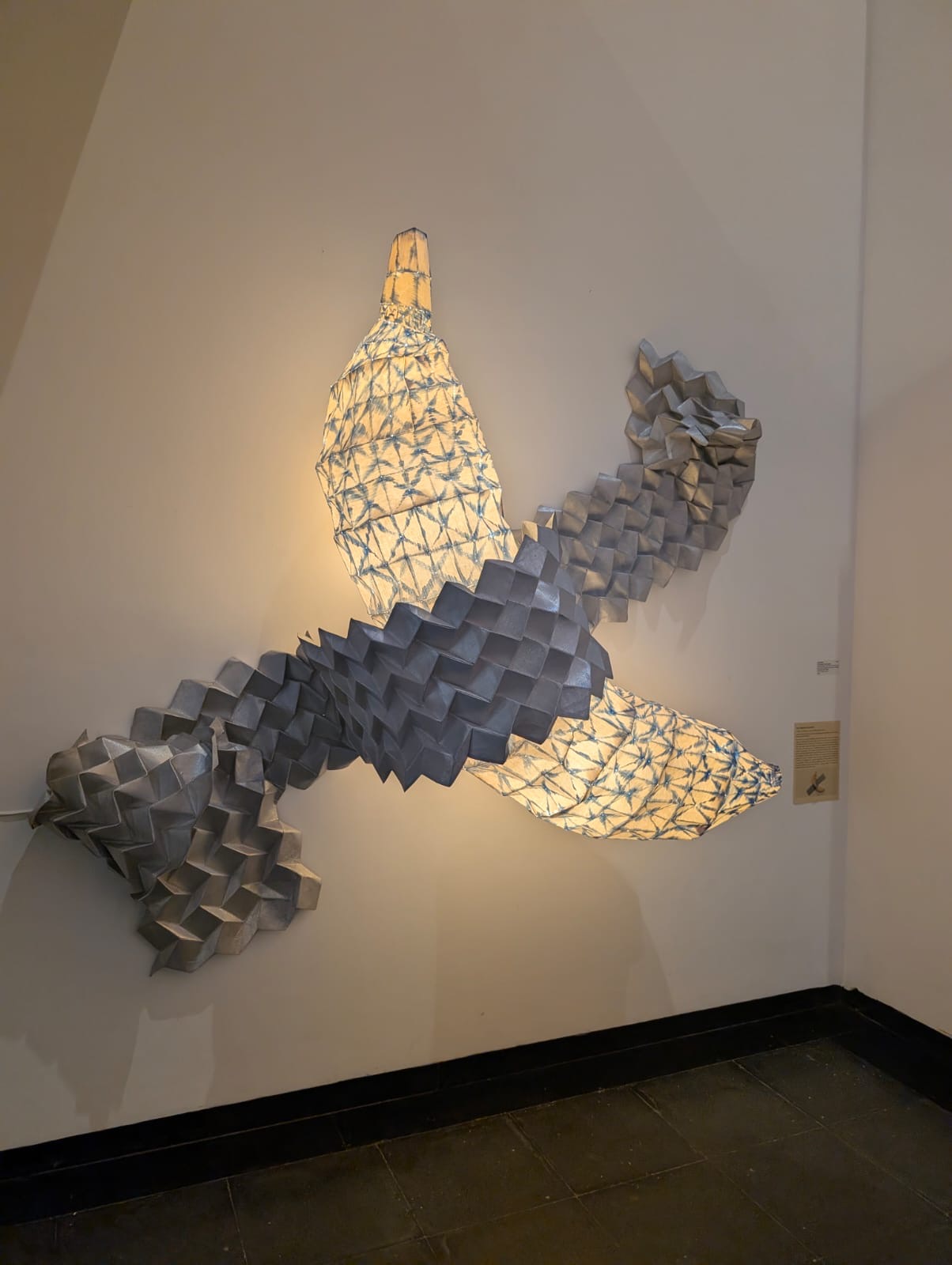
New Delhi: When banana taped to a wall, a conceptual artwork titled Comedian by Italian artist Maurizio Cattelan went viral on social media, it sparked mixed reactions and revived a familiar question: what makes something art? ‘The tragedy of the comedian’ is a fresh take on the ‘Comedian’ by Ankon Mitra where artist reimagines Cattelan’s work through Shibori, a traditional Japanese resist-dyeing technique that creates intricate patterns by folding, twisting, pleating, stitching or binding fabric. The work is made on dupion silk and French cordon cards. The contrast is deliberate. Where Cattelan’s banana became a provocative statement about the idea of art, Mitra’s version draws attention to the act of making—the technical skill, patience and labour that go into creating an artwork. Curator Georgina Maddox says Mitra is responding to Comedian by reclaiming the importance of technical skill and the labour involved in making something beautiful. But Mitra’s banana is only one part of a larger conversation that took place at Urban
Traditional, an exhibition presented by Ochre Art and curated by Maddox, brought together ten contemporary artists who explored this question through practices rooted in, and informed by, India’s diverse visual and cultural traditions. Featuring Ankon Mitra, Avijit Mukherjee, Anirul ,Hiral Bhagat, Manisha Agrawal, Madhu Kuruva, Priya Janghu, Sangam Vankhade, Srini Chowdhury and Vasundhara Tiwari Broota, the exhibition showcased varied approaches to making, drawing from references that range from miniature painting, stepwells and oral lore to calligraphy, wall hangings, paper scrolls, chandeliers and graffiti. While Mitra’s is reclaiming art, Avijit Mukherjee painted ‘Water in Cloud’ using humour to examine another contemporary tension: the relationship between humans and nature. In ‘Water in Cloud’, Mukherjee draws on the visual language of miniature painting while introducing a distinctly contemporary sensibility.
His work imagines a world in which human intervention has encroached upon nature’s space. If Mukherjee looks at nature’s struggle to reclaim space from humans, Vasundhara Tiwari Broota turns her attention to another defining feature of contemporary life in ‘Exhale’: the struggle of people during Covid and how people were navigating their lives with all news floating around both facts and fabricated. The negotiation between inherited forms and contemporary realities becomes particularly visible in Priya Janghu’s sculpture, which uses bronze and stainless steel bolts to explore women’s relationship with prescribed ideas of domesticity. ‘The inspiration behind it is that the female figure is seemingly breaking free from the prescribed boundaries of domesticity; she is donning high heels and assuming a confident posture of a contemporary city girl and the sculpture also embodies movement from enclosure towards self-fashioning and autonomy. That’s and through this figure I like to add how urban and tradition can coexist in the same space’, says Jangu.