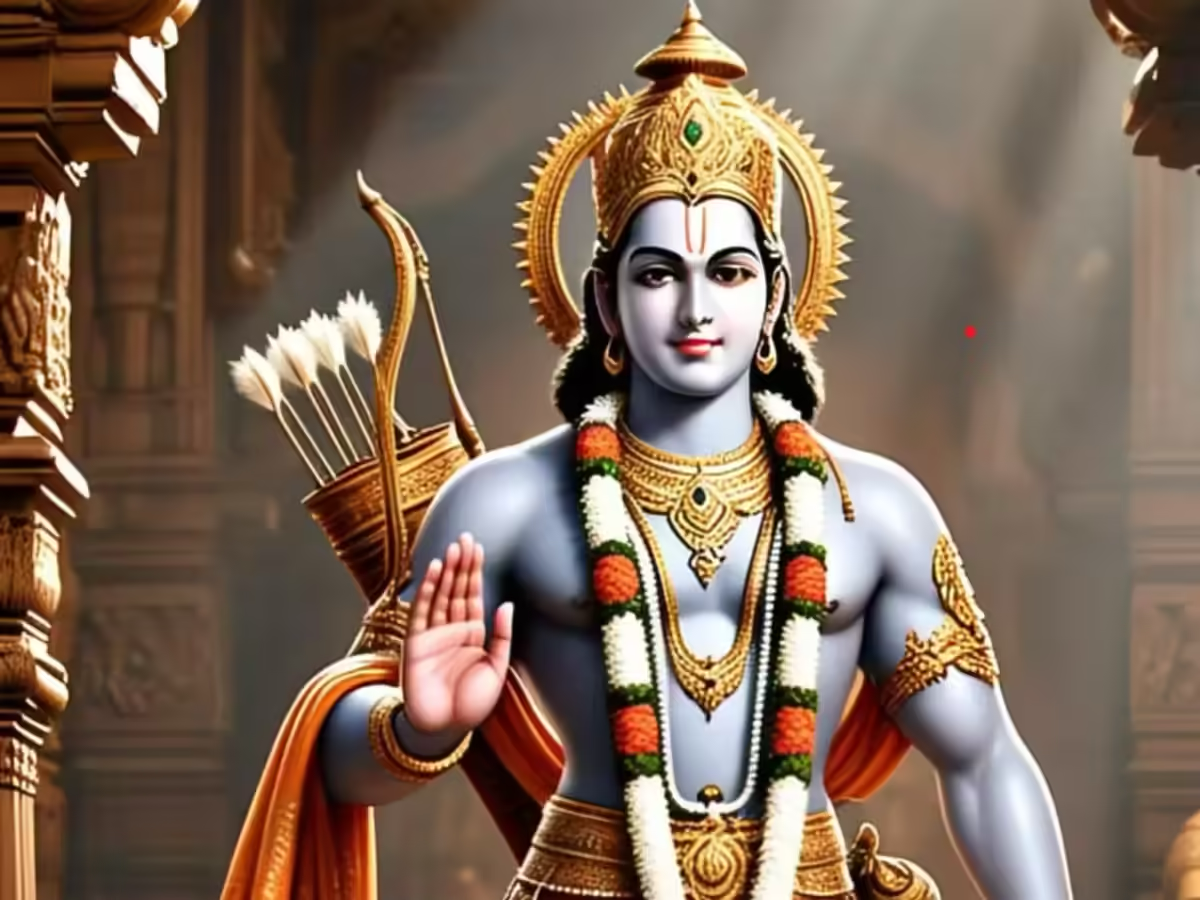
The Navratri is ongoing, and Ram Navami is upcoming on March 26, 2026. Ram Navami celebrates the birth of Bhagwan Rama in the Treta Yuga. So powerful and pristine are the learnings from the life and character of Rama that aeons later, they still inspire us, hence the tradition of celebrating Ram Navami!
The word Rama is so pure that it tastes like nectar on the lips. As we speak the word Rama, we open our mouth to utter Ra and close it to say Ma. It is said that the entire creation is encapsulated in the word Rama. Such is Rama infused into our lives and culture that Rama’s name is used as a salutation by many, like “Ram Ram!”, “Jai Shri Ram!”, “Jai Siya Ram, “Jai Sal Ram!”
The word Ramayana means Rama’s path/journey. I have childhood memories of my father, Justice MM Punchhi, telling us stories from the Ramayana. He said that Rama led the way while Sita and Lakshmana followed the path he had tread upon. Amar Chitra Kathas like Valmiki’s Ramayana, Luv Kush and Tales of Hanuman, were an integral part of my growing years. Watching Ramanand Sagar’s Ramayana TV serial is another vivid and beautiful memory. The finesse and devotion with which it was presented left a deep impression on my mind. Its dialogues, songs, screenplay, acting, etc., weaved magic.
The Rama story has been enacted in films, plays, skits, Ramlila’s and role-plays thousands of times. Because the story is extremely captivating, each time it is enacted, watched, read or heard, it doesn’t lose its charm. And each time we are exposed to it in any form, a tiny impression is left on our minds.
The story of Rama teaches us how to live life. It showcases how a son should obey his father, as Rama obeyed Dashratha. It portrays the kind of relationship one should have with siblings. The four brothers Rama, Lakshmana, Bharat and Shatrughana were united in all circumstances.
Rama loved and respected his wife Sita, and vowed to have only one wife, even though most kings had many. Sita was an ideal wife. She was used to living in a palace as a princess and the daughter-in-law of a king. But she renounced everything and chose to go with Rama to the forest. Here, the story tells us that when she saw a golden deer, she asked Rama to get it for her. This led to Rama chasing the deer, and in his absence, Ravana abducted Sita. There is a deeper meaning in this. When Sita renounced everything, she got Rama. When she got tempted by the golden deer (Maya), her troubles began!
Queen Sumitra, the wife of King Janaka, exemplifies the role of a mother in how she advises Sita and her sisters before their wedding. The role of a mother-in-law is epitomised by how Queen Kaushalya treated Sita as a daughter.
Lakshmana represents the mind. He followed his brother Rama, who was the embodiment of Dharma, like a shadow. When the mind follows dharma, it can do no wrong!
The equanimity of mind displayed by Rama when he was told to go to the forest for thirteen years, instead of going for Rajya Abhishek, is unfathomable. He showed no anger… gave no arguments… asked no questions or explanations… just obedience! He wanted to honor the word of his father, who had given two boons to Kaikayi. Because he lived by the maxim, “Raghukul reet sada chali aayee, pran jaaye par vachan na jaaye.”
Another essential lesson from the Ramayana is the importance of gratitude. When Lord Rama was crowned king, he first expressed gratitude to Jamana for his help in searching for Sita. Next, Rama expressed gratitude to Jatayu, who had tried to save Sita at the cost of his own life while Ravana had abducted her. He then thanked Sugriva for his help in the battle with Ravana’s army. Next, he thanked Vibhishana for decoding the demonic illusions created by Ravana’s kinsmen. Lastly, he thanked the Vanaras who had selflessly fought for him.
Hanuman was the embodiment of devotion and service. Vibhishana’s insider information was a key factor that led to Rama killing Ravana. This is what is meant by ‘Ghar ka Bhedi, Lanka Dhaye’. (If a confidante joins the enemy, it could even cause the downfall of an empire!) Rama’s life was full of strife, hardship and sacrifice. Even Sita’s life was no less striferidden. But both always upheld the cause of Dharma. Their character and persona are truly worth emulating. Bhagawan Rama’s life itself was his message.
Rama was born as the crown prince of Ayodhya. He was known as Dasharathanandan or Kaushalyanandan Ram. When he returned after fourteen years of exile, the trials and tribulations he faced further magnified the impeccable character traits he embodied. He then came to be known as Maryada Purushottam Shri Rama. A life of comforts in the palace would not have afforded him this title! Gold shines after much heating in the fire…
The Ramayana is a story that plays out in each home, some time or the other. There is lots to learn from it. The ideals set up by Rama are a guiding light on how to maintain unity and harmony in the family.
Many times, we raise our religious books to our eyes to show reverence. But is showing reverence enough? Isn’t it paramount to put into practice what’s written in them? Rama walked the talk. Are we following his footsteps? Are our character, reactions, thoughts, words, deeds, even remotely close to Rama’s?
Our lives revolve around the word ‘I’. I want this, I want that, I am going, I am eating, I am happy/angry… But, who is this I? Is it the gross body that shall be left behind in Mrityulok at the time of Mrityu? Or is it the dweller of this body? Do look within and ask yourself if you are aware of the in-dweller, the divinity within. Your Atma is a minuscule part of the Paramatama. The Atma-Rama resides within.
Sri Sathya Sai Baba says, “Rama is the in-dweller in everybody. He is the Source of Bliss (Atma-Rama), the Rama in every individual. His blessings, upsurging from that inner spring, can confer peace and bliss. He is the very embodiment of dharma, of all the codes of morality that hold mankind together in love and unity.”
Coming up on April 2, is Hanuman Janmotsavam. It is said that when Rama ended the River Sarayu at the end of his earthly sojourn, he blessed Hanuman to be a Chiranjeevi and to stay on the Earth till the end of time. We celebrate Hanumana as the epitome of duty, devotion, discipline, discrimination and dedication. He was the perfect diplomat sent by Rama to Ravana. He gathered information about the strengths and weaknesses of the enemy, as well as gave them a taste of the might of Rama’s army.
Each time we read the Ramayana, there is something new to learn! Stay tuned … Tera main Ram, Maun mein Ram, Sab mein Ram samaye!