
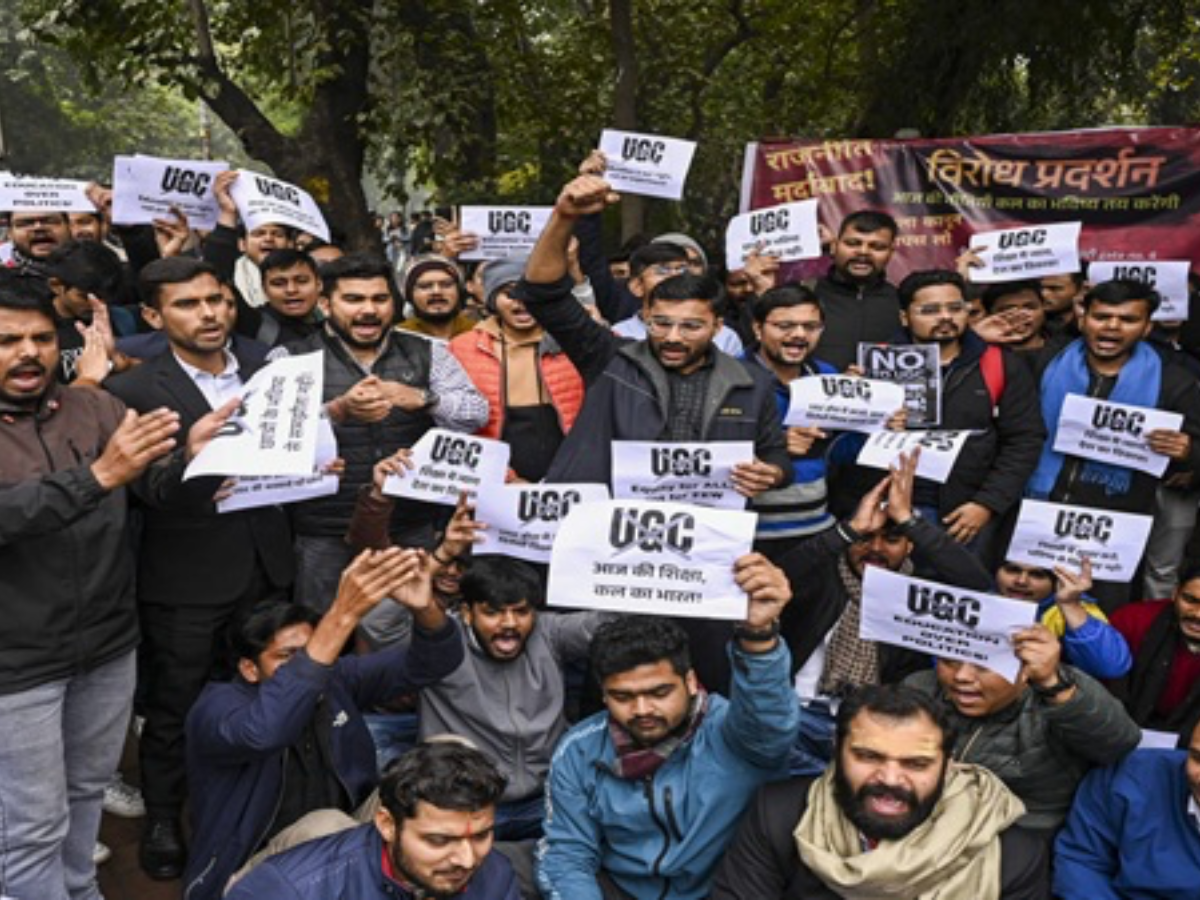
If universities were buildings, equity would not be the security camera at the gate, but the air inside, invisible, natural, relational, and shared. The University Grants Commission (UGC) new Promotion of Equity in Higher Education Institutions Regulations, 2026, attempts to convert the concern over this issue into an actual form: Equitable Opportunity Cells, time frames for grievance, reporting lines and the ability to monitor. In making this conversion however, the UGC is also asking a far more difficult question which needs attention than the regular slogans and headline coverage: At what point does protection start looking like policing?
To see why, imagine a University as a living ecosystem; the ideal is a community where neighbours know each other and look out for one other, where minor infractions are handled through conversations, and major infractions are handled through trusted institutions. The UGC’s new regulations are akin to establishing a new Neighbourhood watch with cameras, incident reports, helpline squads and a centralised control room. This potential ability to reduce harm could have an unintended consequence, which is how the people in a community relate to one another. Disputes that were once resolved by peers informally are now formalised incidents on a docket. Discussions in an academic environment are cautious. Mentors are hesitant to give honest feedback due to the watchful eye intended to promote safety, however, this same watchful eye inhibits the level of trust and risk taking needed to foster learning.
This is not an argument against rules. Two legitimate concerns exist relative to this debate that are not mutually exclusive. First, there is a compelling necessity to recognise and address structural injuries. Caste, gender, disability and other forms of exclusion occur both on an interpersonal basis and on an institutional basis. Formal mechanisms are necessary because informal norms have failed many individuals. Second, there is a concern relative to procedure. Broad definitions, short timelines and minimal protection against frivolous or abusive complaints could generate additional injustice, that is, reputationally damaging claims, career damaging claims and the creation of a culture of self-censorship. The dead-end exists when well-intentioned rules do not incorporate the detailed, on the ground methods that assist in restoring social relationships instead of punishing.
If the objective is justice, then what can regulatory bodies learn from other areas of law? Restorative Justice provides an example of an alternative approach to the traditional blame-and-punishment model. Instead of focusing on punishment and restitution, Restorative Justice emphasises repair, dialogue and reintegration, especially when harm arises from social ignorance, prejudice or imbalance of power rather than from intentional criminal conduct. In addition to establishing protective reporting mechanisms, many of the leading universities throughout the world utilise a combination of protective reporting and restorative approaches to resolve incidents occurring within their learning communities. India’s regulation could require institutions to establish certain formal processes for addressing incidents of harm, but India’s regulation could also provide an opportunity for institutions to require restorative alternatives to punitive actions prior to the escalation of sanctions.
Consider two analogies, First: a hospital that replaces bedside conversations with algorithmic flags to reduce medical error. Error rates might fall, but the clinic loses the soft intelligence physicians gather at the bedside. Second: a neighbourhood that installs more cameras to cut crime, petty offenses may decline, but so does the freedom to make mistakes and repair relationships. In both cases, surveillance reduces some harms while producing subtler costs: chilled speech, mistrust, and the loss of restorative possibilities. The UGC’s Equity Regulations risk the same trade-offs if institutional culture isn’t addressed alongside new rules.
And also, we must question difficult institutional questions. Who serves on equity committees? Are the committee members representative? Do complainants and defendants receive counsellors or independent advisors? How will complaint data be anonymised and reported so as to prevent misuse? Are there measures in place to prevent frivolous complaints from being used as tools in internal University politics? Issues of institutional design such as these are far more significant than slogan-making since they determine whether a regulatory system is fair in practice and not simply in theory. What are the broader implications? If universities become compliance regimes, they run the risk of abandoning the messiness and the freedom that allow them to innovate and challenge established order. If regulators take no action, universities will continue to replicate exclusion. The practical way to proceed is somewhere in between these two extremes: robust protections developed with humility, transparency and a commitment to restorative practices.
This includes spending money to train faculty and administrative staff, creating independent ombudsmen, developing confidential counselling and mediation services, and publishing anonymous complaint data so that Universities can learn patterns of harm without publicly identifying specific individuals. Therefore, here are the questions that every University and policymaker should be asked to answer before the ‘watch list’ becomes the ‘only list’: Will the process distinguish between intentional harassment and unintentional cultural ignorance? Will the rules protect academic debate and dissent? Who will police the ‘policers’? And perhaps most importantly, will measures intended to create safety ultimately produce a different type of harm: fear that silences, rather than protects, students and teachers?
The UGC’s equity rules are an ethical experiment on a national scale. They ask whether law can scaffold social change in a polity where caste and social capital shape opportunities every day. Protection is necessary; policing is not. As educators in non-governmental higher education institutions, we have experienced that identities exist in such spaces in more complex ways that can be understood from lay observations. Identity assertion, which could be indispensable to the everyday existence and assertion of the students in government sphere, find no place here. Inhibition to surface categorically distinct adds to the complexities of identity. In which case, the new equity rules may also uncover the attempts to rise beyond the boundaries and rather reinforce them.
The rules are asking if laws can help build social change in a society with daily opportunities limited by caste and social capital. We need protection, but we do not need policing. The rules will have no ability to deliver on its promise unless it is redesigned to be instruments of repair and pedagogy, rather than simply tools of enforcement. Otherwise, in trying to make campuses safer, we may end up making them smaller, quieter, and more fearful and that would be a poor trade for anyone who believes education should remain a space for risk, recovery, and real transformation. In universities we learn not only inside the classrooms, but in fearless innocent interactions with the peers, the new Equity Rule may challenge the innocence into carefully informed exchanges, limiting the natural process of learning.
By Geetanjali Atri (Sociologist, PhD JNU) & Tushar V Sharma (Assistant Professor of Law, GD Goenka University)