
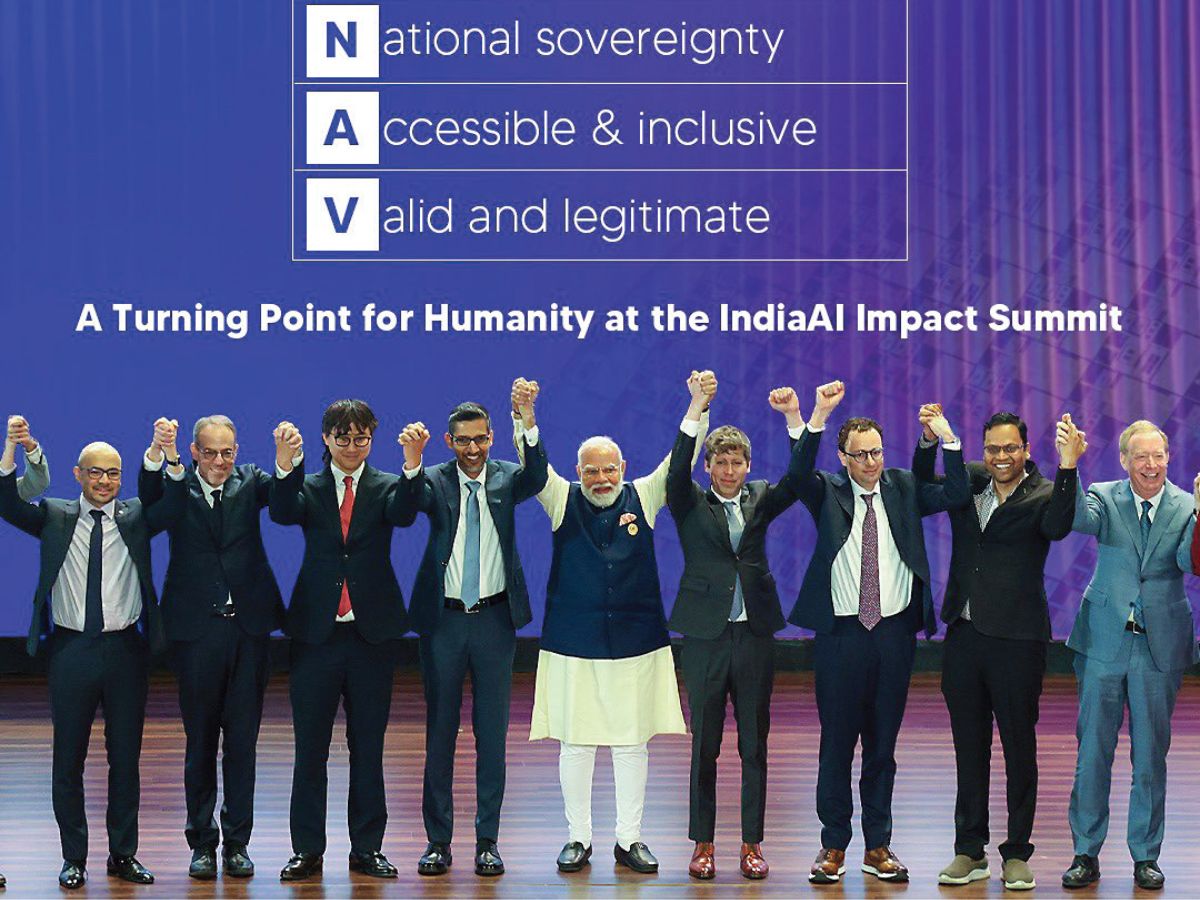
When Prime Minister Narendra Modi inaugurated the India AI Impact Summit 2026 at Bharat Mandapam in New Delhi, it was not merely the opening of another technology conference. It was the articulation of a civilizational response to a technological inflection point.
Artificial Intelligence is not just another wave in the long arc of industrial revolutions. As the Prime Minister observed, humanity rarely recognizes epochal shifts while living through them. Fire, script, wireless communication, each reset the trajectory of civilization. AI belongs to that lineage. The difference this time is velocity and scale. The journey from machine learning to learning machines has compressed decades into years, perhaps even months.
And it is no coincidence that this global conversation found its epicentre in India.
Geopolitics: AI and the Rebalancing of Global Power
In the 20th century, geopolitics revolved around territory, military alliances and fossil fuels. In the 21st, it increasingly revolves around algorithms, data flows and semiconductor supply chains.
AI is not just a technological asset; it is strategic infrastructure. Nations that lead in AI will shape global supply chains, defence architectures, financial systems, healthcare innovation and even democratic discourse. Yet India’s framing is refreshingly distinct. While some view AI as a tightly guarded strategic asset, India positions it as a Global Common Good. Hosting over 100 countries, including leaders from the Global North and Global South, the Summit signalled that AI governance cannot be monopolized by a few technological superpowers.
For the Global South, India’s leadership offers an alternative model, one that is democratic, plural and development centric. When one sixth of humanity articulates a human first AI doctrine, the world listens.
Business and Economic Power: The New Engine of Growth
From agriculture to fintech, from cybersecurity to healthcare diagnostics, AI is already reshaping value chains. But the economic story is larger.
India’s demographic dividend, the world’s largest youth population and one of the deepest tech talent pools, gives it a structural advantage. Secure data centers, a rapidly expanding semiconductor ecosystem, and ambitious investments in quantum computing place India at the heart of next generation technological supply chains.
Three Indian companies launching indigenous AI models at the Summit is not symbolic; it is systemic. It reflects a maturing innovation ecosystem where startups, academia and policy move in alignment.
For global investors and enterprises, the message is clear. If an AI model works in India, with its linguistic diversity, regulatory complexity and massive scale, it can work anywhere. “Design and Develop in India. Deliver to the World. Deliver to Humanity” is not a slogan; it is an economic proposition.
Society and Public Policy: Human Centric by Design
The most compelling aspect of India’s AI vision is philosophical. Anchored in the civilizational ethos of Sarvajan Hitaya, Sarvajan Sukhaya, welfare for all, happiness for all, India rejects a dystopian, machine centric future.
Prime Minister Modi’s M.A.N.A.V. framework, Moral systems, Accountable governance, National sovereignty, Accessible inclusion, and Valid legitimacy, is not rhetorical flourish. It is a governance blueprint.
Moral and Ethical Systems ensure AI does not outpace humanity’s conscience. Accountable Governance embeds transparency and oversight. National Sovereignty recognizes that data belongs to its rightful owner. Accessible and Inclusive AI prevents technological monopolies. Valid and Legitimate Systems guarantee lawful and verifiable deployment.
In an era of deepfakes, algorithmic bias and opaque black box models, India’s insistence on watermarking, authenticity labels and global standards is both timely and necessary. “Sunlight is the best disinfectant,” the Prime Minister reminded us, transparency must be built into code itself.
Technology and Innovation: Co Creation, Not Replacement
The anxiety around AI often centers on job displacement. History suggests a more nuanced trajectory. The internet did not eliminate work; it transformed it. AI, similarly, will redefine rather than erase labor.
We are entering an era of co creation, humans and intelligent systems designing, building and problem solving together. Higher value creative and analytical roles will expand. But these future demands massive investments in skilling, reskilling and lifelong learning.
India’s scale again becomes an advantage. With millions of engineers, developers and researchers, and a policy emphasis on digital public infrastructure, the country is uniquely positioned to mainstream AI literacy. The Summit’s thematic working groups spanning Economic Growth, Democratization of AI Resources, Safe and Trusted AI, Human Capital, Science, and Resilience demonstrate an integrated approach. AI is not being treated as a siloed sector; it is being woven into the fabric of national development.
Social Impact: Inclusion at Scale
Perhaps the most inspiring showcase at the Summit was the application of AI in agriculture, support for persons with disabilities, multilingual interfaces and grassroots service delivery. In a nation of hundreds of languages and diverse socioeconomic realities, inclusive AI is not optional; it is essential.
When AI tools can interpret regional dialects, assist farmers with predictive analytics, or enable accessibility for divyangjan, technology becomes an equalizer.
This is where India’s democratic diversity becomes a testing ground for global deployment. Diversity, demography and democracy together create a laboratory for scalable solutions.
The Global Narrative: From Fear to Fortune
The Prime Minister framed the global discourse succinctly. There are those who see fear in AI, and those who see fortune.
India chooses fortune, not blind optimism, but responsible confidence.
Confidence rooted in talent. Confidence backed by policy clarity. Confidence anchored in ethics.
At a time when technology debates are polarized between techno utopianism and existential dread, India offers a third path. Embrace innovation. Democratize access. Embed accountability. Safeguard sovereignty. Protect children. Build trust.
This is not merely India’s AI moment. It is India’s moral moment.
If the 20th century was shaped by industrial might and military blocs, the 21st will be shaped by digital architectures and ethical frameworks. By hosting the world’s largest AI Impact Summit and articulating a coherent, human first doctrine, India has positioned itself not just as a technology hub, but as a thought leader.
The world stands at an algorithmic crossroads. The choices made today will echo for generations.
From New Delhi has emerged a clear proposition. Let AI expand human capability, not diminish human agency. Let innovation be inclusive. Let sovereignty coexist with collaboration. Let technology serve humanity.
In that vision lies not only India’s future, but perhaps the world’s.
Tuhin A. Sinha, National Spokesperson, BJP
Sumit Kaushik, a social impact and a public policy consultant