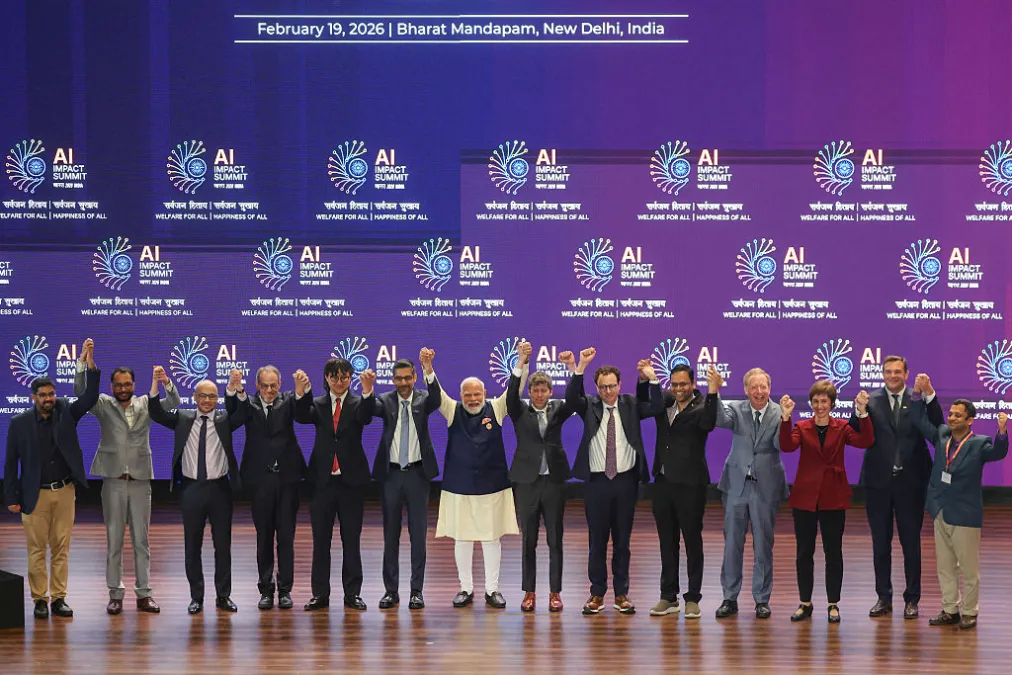
AI is going to be the most disruptive and transformative technologies for Bharat and we are at a pivotal moment in our technological trajectory that will shape the future. The four-day AI Impact Summit, held between February 16 to 20 at Bharat Mandapam in Delhi, signalled Bharat’s emergence on the global stage, putting it at the forefront of this technological transformation. In the words of our esteemed prime minister Shri Narendra Modi, Bharat should emerge at the forefront of this revolution. It is the moment for advancing AI on a mission from machines to MANAV for welfare of the whole mankind. MANAV, meaning human, represents a guiding framework in which M stands for moral and ethical systems; A for accountable governance, transparent rules and robust oversight; N for national sovereignty—whose data, their rights; the second A for accessibility and inclusivity, positioning AI not as a monopoly but as a multiplier; and V for validity and legitimacy. This vision underscores Bharat’s aspiration to align AI development with broader societal welfare and human-centric progress.
The AI Impact Summit, which witnessed participation from more than 20 heads of state, over 45 ministerial-level delegations and leading figures from the global technology ecosystem, represented one of the most significant international gatherings focused on artificial intelligence. The summit also featured demonstrations of state-of-the-art AI systems, including Bharat AI company Sarvam’s unveiling of its large language models, Sarvam 105B and Sarvam 30B, positioning them as Bharat’s response to frontier systems developed by Google, OpenAI and Anthropic. It was the largest AI summit to date, with more than 70 signatories to the New Delhi Declaration, surpassing the previous summits at Bletchley Park (UK), Seoul and Paris, which recorded 30, 31 and 53 signatories respectively. The summit also marked several firsts, including being the first global AI summit hosted in the Global South, drawing participation from over 100 countries and more than 100 global technology leaders and attracting footfall exceeding five lakhs, illustrating the deep democratic aspirations of the Global South to the forefront through Prime Minister Modi’s vision of MANAV AI—described as AI that is of the humans, by the humans and for all humans. Participants widely echoed this sentiment and expressed appreciation that the summit brought critical discussions about responsible and ethical AI to the forefront. The summit represented a bold assertion of Bharat’s arrival on the world stage.
The summit’s organisers, the Ministry of Electronics and Information Technology (MeitY), led by Minister Ashwini Vaishnaw, described the event as a grand success, noting that it generated investment commitments exceeding USD 250 billion for infrastructure and USD 150 billion for deep tech venture capital. The importance of the event was reflected in the extensive coverage it received across global media. Guided by the vision of “Sarvajana Hitaya, Sarvajana Sukhaya” (Welfare for All, Happiness for All), the summit emphasized the beneficial use of this transformative technology for all of humanity without discrimination while promoting equal partnership and strategic autonomy.
This AI revolution is analogous to the Industrial Revolution of the nineteenth century and the IT revolution of the twentieth century. The pace of change is accelerating rapidly and advances in artificial intelligence are increasingly enabling machines to replicate many functions traditionally associated with the human mind, including aspects of creativity and emotional understanding. Nations that fail to participate meaningfully in this transformation risk marginalization in the emerging technological order. As the rules of global technological competition are being reshaped, the United States and China have moved to develop sovereign AI stacks that span compute, models, platforms and applications. In this context, there is growing recognition that other middle powers such as Bharat, France, Japan, the United Kingdom and Canada must also assert their technological sovereignty and secure a substantive role in the evolving AI ecosystem. By convening the summit and articulating a national vision, Prime Minister Modi sought to position Bharat at the forefront of this impending technological disruption. AI or artificial intelligence in the words of Nobel Laureate Prof. Geoffrey Hinton, also known as the “Godfather of AI” and Professor Emeritus at the University of Toronto, is often described as systems that learn complex patterns directly from data using neural networks, enabling breakthroughs across perception, language, and decision-making tasks. For the past two decades, virtually all major breakthroughs in AI research in North America have emerged from a small group of scientists originating from University of Toronto, Stanford and Massachusetts Institute of Technology (MIT) and AI research organizations like Google DeepMind, OpenAI and Anthropic. The core group forms a tight-knit scientific community that, despite being spread across institutions and exhibiting substantial movement between academia and industry, remains a largely overlapping network responsible for many of the field’s most influential advances. A notable counterbalance to this predominantly North American research concentration is China, which has emerged as another major center of AI innovation. Through this summit Bharat positions itself in this front row.
Sovereign AI stacks refer to the deployment of state-of-the-art AI infrastructure, high-performance semiconductor chips supported by secure supply chains for critical minerals, high-speed data centers, graphical processing units (GPUs), reliable and clean energy sources and adequate water availability, alongside a deep pool of skilled human capital capable of leveraging these capabilities. At the summit, Bharat staked its claim to sunshine with right intent and commitment and trust of its top leadership, which saw many announcements, old bonds of friendship were refurbished and new bonds and partnerships were built. Kenya, with its vast reserves of critical minerals such as lithium that are essential for semiconductor and battery manufacturing, indicated willingness to collaborate with Bharat in supporting advanced AI infrastructure development. In parallel, several global technology firms including OpenAI, Google and Meta announced partnerships with Bhartiya industry leaders such as Reliance Industries, Adani Group and Tata Consultancy Services, alongside investment commitments valued in the billions of dollars.
DP Vajpayee is the founder chairman of Dr AS Technologies Indian and well-known science communicator. Samanvay Vajpayee is an AI researcher and PhD student at the University of Toronto.