
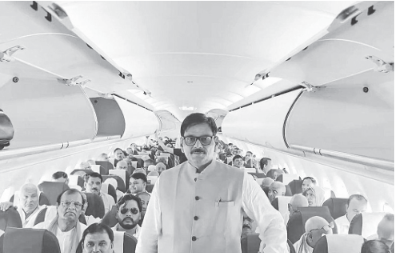
The inaugural flight carrying 172 farmers is a testament to Yogi Adityanath’s emotionally intelligent leadership
Commercial aviation has been carrying passengers across the world for more than 114 years, while India is approaching 94 years of civil aviation history. Yet it is difficult to recall an instance where every passenger aboard a flight was a farmer. At least, I am unaware of any such precedent. Creating this unique chapter in aviation history is the achievement of Uttar Pradesh Chief Minister Yogi Adityanath.
Years ago, Prime Minister Narendra Modi articulated a dream that even those who wear simple rubber slippers should one day be able to travel by air. The story of this inaugural flight is, in many ways, a realisation of that vision. It is worth recalling that India’s low-cost aviation revolution began in 2003 when GR Gopinath launched Air Deccan. Although the airline merged with Kingfisher Airlines in 2007 and eventually ceased operations, it paved the way for a new era. Airlines such as SpiceJet, IndiGo, Air India Express and others expanded affordable air travel across the country. During the tenure of Praful Patel as Civil Aviation Minister, special emphasis was placed on extending air connectivity to smaller cities. Yet, despite the growth of low-cost aviation, there has never been an occasion when an entire commercial flight was occupied exclusively by farmers. That change came on the morning of June 15, when an IndiGo aircraft took off from the Noida International Airport for Lucknow. On board were 172 farmers, including 20 women farmers, all of whom had contributed land for the airport project. One can only imagine the emotional significance of such a gesture. These farmers had undoubtedly watched aircraft streak across the sky for years, perhaps never imagining that an international airport would one day stand tall on their own land. The idea of establishing an international airport in the region was first envisioned in 2001 by Rajnath Singh, who proposed it as the Taj International Aviation Hub. Later, in 2010, Mayawati prepared a blueprint for the project, but it failed to move beyond the planning stage. When Yogi Adityanath assumed office, he was determined to turn the dream into reality. Initially, the administration was given a hundred-day target to secure farmers’ consent for land acquisition, but the effort met with resistance. Yogi Adityanath himself travelled to Jewar to engage directly with the farmers, yet opposition persisted. It was then that he reportedly told them, “I am giving you one hour. This is an opportunity to transform your destiny.” Whether one calls it persuasion, conviction, or political charisma, the farmers ultimately agreed. Prime Minister Narendra Modi laid the foundation stone in November 2021, and in less than five years, aircraft were taking off from the runway. I have always maintained that institutions, officials, and systems may remain largely unchanged, but leadership is the decisive factor that shapes outcomes. Yogi Adityanath’s greatest political asset is not merely administrative ability but the emotional connection that underpins his leadership. By ensuring that the very first flight carried the farmers whose land made the airport possible, he offered them not only a symbolic journey but also a deeply meaningful gesture of gratitude and respect. Upon their arrival in Lucknow, the farmers were honoured in person, further reinforcing that sentiment. Only the first phase of the airport has been completed; three more phases remain. Even at this stage, it is among the greenest airports in the country. More importantly, it has been equipped to enable safe aircraft landings even in dense fog, a significant advantage for the Delhi-NCR region, where winter fog often disrupts air traffic. Once all phases are completed, the airport will emerge as the largest in Asia, with eight runways and the capacity to handle nearly 70 million passengers annually. It is, indeed, an extraordinary achievement. Chief Minister Yogi Adityanath is doing a wonderful job.
Hum Chhod chale is maifil Ko…
Those who, until yesterday, walked arm in arm, proclaimed their friendship at every opportunity, and were never tired of pledging loyalty to their leader, have suddenly begun leaving the very gathering they once celebrated. They were the first to echo every word spoken by their leader and seemed eager to carry her message far and wide. Yet, for reasons known only to them, they have quietly drifted away. In West Bengal, the word of Mamata Banerjee once carried unquestioned authority. Others remained silent while her political influence was at its peak. But the moment she appeared even slightly vulnerable, some of her associates turned away. They seemed to join a new chorus: “We are leaving this gathering.” And this phenomenon is not just confined to one state!
In Maharashtra, some of Uddhav Thackeray’s closest associates had already departed. Now, even among those who remained, a few more appear to be ready to exit the stage. How ironic it is that politics, a field in which trust ought to be the most essential foundation, often becomes a theatre of distrust. Voters cast their ballots believing that a leader belongs to a particular party and will work in accordance with its principles. Yet, the leader changes party altogether. One must also acknowledge that larger political platforms possess a powerful attraction. Their influence, visibility, and prospects can be difficult to undermine. Then again, none of this is new. History reminds us that many prominent leaders once abandoned the Indian National Congress, drawn by the allure of larger opportunities elsewhere.
Even the master’s voice goes unheard
To borrow a familiar expression, the ink on the memorandum of understanding between the United States and Iran had barely dried before tensions flared once again. Meanwhile, Israel appears unwilling to heed even the advice of its closest ally, the United States. Despite sharp criticism from Donald Trump, Israel has continued its military operations in Lebanon. I have visited Lebanon and know its people to be deeply proud and self-respecting. They are unlikely to surrender easily. The challenge for the United States now is figuring out how to restrain a partner that seems increasingly determined to chart its own course.
Photographs Have a Curious life of their own
President Trump is, as always, a fascinating political personality. He has now claimed that Giorgia Meloni repeatedly ‘begged’ for a photograph with him. Unsurprisingly, Meloni has rejected the claim, insisting that no such thing occurred. Yet Trump appears unwilling to retreat from his statement and continues to repeat it with confidence. So what do you think? Did Meloni really insist on a photograph?
*The author is the chairman, Editorial Board of Lokmat Media and former member of Rajya Sabha. vijaydarda@lokmat.com