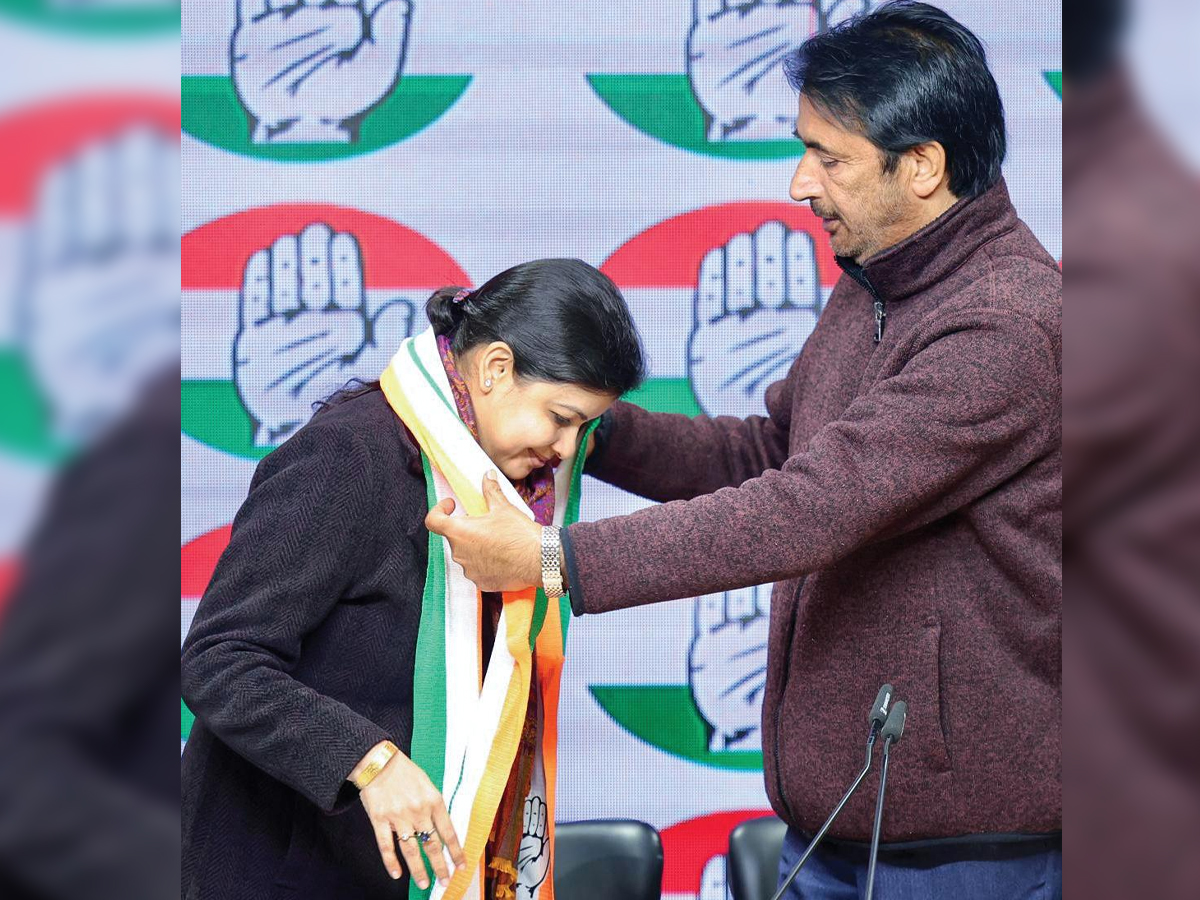
Mausam Benazir Noor’s recent return to the Congress from the Trinamul Congress (TMC) has caused ripples in West Bengal’s politics. Before she changed sides, Noor was a TMC-backed member of the Rajya Sabha whose term was going to end in April 2026. Those opposed to the TMC — a perceptively growing tribe — see this move, ahead of the state elections in West Bengal, as the metaphorical sailor jumping from a drowning ship. More than a Congress resurgence, Mausam Noor’s decision, they say, portends the TMC’s electoral fortunes tanking out in the key battleground of Malda district.
The legacy Noor refers to pertains to being the niece of the Congress stalwart A.B.A Ghani Khan Choudhury (popularly called ‘Barkatda’) who served eight terms as the MP from Malda and was a minister in Indira and Rajiv Gandhi’s cabinets. Noor became an MLA in 2008 from the family’s pocket borough of Sujapur constituency after her mother Rubi.
Noor — married to A.B.A Ghani Khan Choudhury’s brother — died. Next year, she was elected to the Lok Sabha from Malda North and retained the seat in 2014. Noor’s cousin Isha Khan Choudhury is currently serving as a Congress MP from Malda South.
Noor however, needs to remember how her return to the Congress may seal her options. A.B.A. Ghani Khan Chowdhury had himself got a taste of “politician Sonia” months before Bengal assembly polls of 2001. Chowdhury, holding charge of WBPCC, had raised the bogey of ‘mahajot’ envisaging BJP becoming part of the grand alliance against the Left Rule.
However, closer to the 2001 assembly polls, Chowdhury became lukewarm to the idea of mahajot even though it was without the BJP. One evening, the veteran leader called on Sonia highlighting virtues of going alone in Bengal. As Chowdhury finished speaking and gulped a noisy sip of tea, Sonia said, “but Barkatda, a few weeks back, you were saying something different. I have all your statements, press clippings in a folder,” she said. The old man shuffled uncomfortably and then sought permission to leave. The moment he was out of 10, Janpath, he told a close aide, ‘tini metri hoye gechchen!’ (she has become a leader).
Coming back to Noor’s political journey in 2019, Noor left the Congress and joined the TMC after the West Bengal Pradesh Congress Committee turned down her proposal for an electoral alliance with the party for the general elections. The CPM is believed to have put a spanner in the works. The TMC rehabilitated Noor by sending her to the Rajya Sabha. And now, her return to the Congress is an admission that, in the party’s current thinking, the Gani Khan Choudhury legacy can unify a factionridden Congress in Malda.
The buzz in Delhi is that since Noor’s political identity has largely been tied to the family legacy, the party may get a tailwind advantage of the Ghani Khan Choudhury brand if she is fielded from the family pocket borough of Sujapur in the upcoming assembly elections.
Not everyone, however, buys this line. In fact, a significant section in the Pradesh Congress sees no advantage in getting Noor on board. Faced with no possibility of renomination to the Rajya Sabha, joining the Congress is her only way to stay relevant in state politics, they argue. Pointing at the Delhi-oriented Congress think tank’s naivety about Bengal politics and the waning influence of Ghani Khan Choudhury’s legacy, they believe foisting Noor and her possible assembly nomination may, in fact, frustrate district-level Congress workers who stuck with the party all these years in facing both the TMC and the BJP onslaught.
This is not the first time Noor has catalysed political drama. In 2019, her family’s hold over Malda’s two Lok Sabha seats appeared loose as she defected to the TMC and fought against Isha Khan Choudhury in Malda North, resulting in the defeat of both Noor and Khan to the BJP candidate, Khagen Murmu, due to the splitting of votes. Just before the 2024 Lok Sabha elections — Noor was a Rajya Sabha MP from the TMC by then — she could not be traced in Malda. She had not been campaigning, as the TMC had not fielded her in either of the two Parliamentary seats. There was serious discomfort in the TMC about an unhappy Noor switching over to another party as she hadn’t received a ticket. Tongues wagged when she was spotted in Delhi. One day, ending all speculation, Noor returned to Malda and blamed viral fever for her disappearance.
Though there were party workers disappointed with Noor’s decision to jump ship — leading to a political split in the first family of Malda — others were more sympathetic towards her decision. One of her associates, who worked closely with Noor when she was in the Congress, said that she couldn’t be blamed; she simply wanted to serve her constituency better by aligning with Bengal’s ruling party.
This reasoning bears credence as a large section of the traditional Congress voters in Malda, mostly Muslims, were shifting to the TMC as revealed in the 2018 Zila Parishad and Panchayat Samiti elections. During her stint as a Congress MP, Noor alleged a lack of cooperation from the TMC-led state government in the implementation of development projects in Malda. Hence, her association with the TMC by deviating from her family’s long-held glorious association with the Congress, could be seen as an act of political expediency in light of the rapidly changing political dynamics in Malda, as well as in the larger context of West Bengal.
Despite her uneasy relationship with her own political parties, Noor’s work as a Parliamentarian cannot be ignored. As I and Ambar Kumar Ghosh have documented in the book titled, “Missing from the House – Muslim Women MPs in Lok Sabha [Juggernaut 2025]” during her first stint as a Lok Sabha MP, 1,500 kms of roads were built in her constituency under the Pradhan Mantri Gram Sadak Yojana. Under the Rajiv Gandhi Grameen Vidyutikaran Yojana, she got funds allotted for Malda North. She also got impressive developmental funds sanctioned for National Highway 81 (running from Gajole to Harishchandrapur), for building the Ratua-Nakatti Bridge, and she was allotted the Backward Regions Grant Funds to address erosion caused by the Mahananda River and for the construction of the Samsi railway overbridge.
In July 2024, Noor strongly raised the issue of river-bank erosion in Malda due to the merger of the Ganga and Fulhar rivers, leading to huge loss of human lives and livestock and damage to crops every year, in the Rajya Sabha. She also took on the Central government for not allocating funds for tackling this perennial devastation caused by floods in the riverbanks of Malda. She informed the upper house with visible anguish that “a huge area will be engulfed by the rivers causing loss of land, farms, and mango orchards, rendering lakhs of people homeless”.
All this reflects Noor’s involvement, sincerity, and vision, which is not only confined to the challenges of her own region but also addresses the broader concerns of society. With political capital, age, family legacy, and a developmental vision on her side, Noor can leverage herself as a key political figure not only in Malda but in the larger landscape of West Bengal.