
BIRTH OF A LEADER
On the 20th of October in 1876, about eleven o’ clock, Maharaja Jayajirao Scindia, received the news of the birth of his son. Salvos of cannon and musket shots were fired. In his spacious Durbar Hall at the grand Jai Vilas Palace, Jayaji Rao received the congratulations of his Sardars and high officers. The child was named Madhav (Madho) Rao Scindia. This young prince bore a significant legacy: on his father’s side, he was a descendant of the renowned Maratha Maharaja and his namesake, Mahadji, also referred to as Madhavrao Scindia, who had established Maratha supremacy over the Mughal Empire in the eighteenth century. On his mother’s side, he traced his lineage to the Yadavas of Devagiri, known as the Seuna dynasty. The year 2026 holds special significance as it marks the sesquicentenary of this remarkable ruler’s birth.
THE MAHARAJA
Maharaja Madho Rao Scindia ascended to the throne of Gwalior State on June 20, 1886, and governed under a Council of Regency until he reached maturity and was granted full ruling authority on December 15, 1894. The founder of Benaras Hindu University, Pt. Madan Mohan Malviya (Bharat Ratna), wrote about the reign of Madho Maharaja that “Since His Highness (Madho Rao Scindia) came to the Gaddi, the progress achieved by his administration has been very great. He has shown a truly fatherly solicitude in the welfare of the people entrusted to his loving care, and, as we all know, has never spared himself in promoting that welfare. The success achieved by His Highness as the ruler of a great State has rightly won for him the respect and admiration of all who have followed the progress of the State under His Highness.”
On June 23, 1910, a public gathering was held at Madhav Bagh in Bombay, where Pandit Malaviya delivered a lecture on the Banaras Hindu University. The meeting was chaired by Maharaja Madho Rao Scindia and attracted a significant audience, including prominent figures such as Mahatma Gandhi, the Maharaja of Bikaner, and Maulana Shaukat Ali. It was noted that both Pandit Malviya and two Maharajas approached them that afternoon as humble petitioners. Consequently, it was their responsibility to contribute as much as possible to the University’s funds, and they should do so immediately and on site. In appreciation, Pandit Malviya proposed a heartfelt vote of thanks to Maharaja Scindia for his role as the meeting’s presiding officer.
During the non-cooperation movement of 1922, Maharaja Madho Rao Scindia conveyed an oral message to Mahatma Gandhi through his Home Minister, Sadashivarao Pawar of Dewas Jr., expressing his warm regards along with a box containing a monetary donation for the struggle against British rule. The Mahratta Newspaper in Poona, founded by Bal Gangadhar Tilak, published an article stating, Maharashtra takes pride in the achievements of this Maratha Prince in Northern India. The Maharaja has maintained close connections with his home province in various capacities. Under his leadership, the administration of Gwalior has seen significant improvements, and overall, the populace is content and happy. The All India Shri Shivaji Memorial Society (AISSMS) was founded in 1917 by Madho Maharaja and Chhatrapati Shahu Maharaj of Kolhapur. The latter remarked about the former that “… my brother Maratha Maharaja Madho Rao Scindia), a Prince who has kept alive the glorious traditions of his illustrious ancestor Mahadji Scindia, who dictated the policy of the Marathas after Shivaji … I hope that the involvement and concern of the Maharaja of Gwalior would make the scheme (Creation of Chhatrapati Shivaji Memorial) a success. The work of the Memorial could not be entrusted to a better man.”
SERVICE AND WELFARE
Maharaja Madho Rao Scindia’s unwavering commitment to establishing a robust administration was matched by his equally strong resolve to develop the Scindia State’s economic resources for the benefit of its citizens. A prime example of this is the railways that traversed the State. While some advancements had been made in railways development during the tenure of his predecessor, it was Madho Rao Scindia who significantly advanced the Gwalior Light Railway, which, rather than being merely a pastime for the Maharaja, generated substantial profits for the State. Annie Besant, the first female President of the Indian National Congress, remarked on Maharaja Madho Rao Scindia, stating, one unique aspect of his capital is… A park has been designated for the equal use of all religions within his State, each having its temple, and all are treated with complete impartiality. Scindia believes that a Monarch should equally protect all religions in his State. He aspires to transform this Park into a gathering place for all citizens, where, under his fair governance, all religions are respected and honoured, allowing everyone to enjoy freedom and safety.
At the dawn of the 20th century, Scindia State experienced swift advancement under the dynamic leadership of Madho Maharaja. By 1911, the State had one college, four high schools, 29 middle schools, 321 primary schools, 10 girls’ schools, and seven special institutions, accommodating a total of 21,560 students. The education budget stood at Rs. 3,55,381. By 1925, the year of Madho Maharaja’s passing, the number of educational institutions in the State had surged to 1,066, with a budget of Rs. 9,92,368. Maharaja Madho Rao Scindia was particularly attentive to ensuring that his educational initiatives would not exceed the available funds in subsequent years, establishing an education fund that currently provides a significant portion of the annual financial requirements. He also founded the Scindia School, which is recognized as one of the most esteemed educational institutions in India.
Scindia was also the initiator of the concept of establishing factories with the support of the State, leading to the establishment of the Gwalior Leather Factory in 1912, which was soon followed by several other ventures—all of which created job opportunities for the subjects of Scindia State and allowed for the expenditure of public funds within the State. Another significant initiative that greatly impacted the economic status of the State was the investment of nearly Rs. 24 crores in irrigation projects. Numerous other programs were implemented during the 31 years of Maharaja Madho Rao Scindia’s reign, and by 1920, these initiatives had expanded sufficiently to warrant the creation of a Board for the Development of Economic Resources. It was published in the Times of India about him “It is a truism that were it not for the co-operation and powerful help many of the undertakings prompted by the capitalists of Bombay which appeal to our imagination would have still been in a state of embryo or in-animation for want of capital. The services he rendered in this connection entitle him to the foremost place among the industrial captains of India. He can truly be said to be an Indian Carnegie and when this title is bestowed on an Indian Prince its value can be easily imagined.”
TRIBUTE BY THE FIRST PRESIDENT
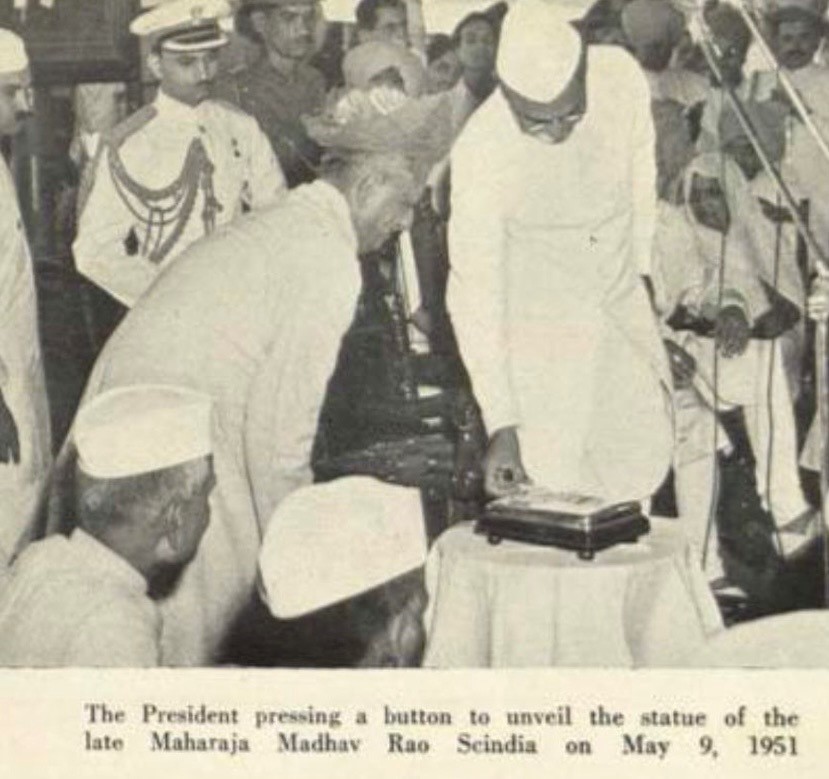
On May 9, 1951, the statue of Maharaja Madho Rao Scindia was inaugurated by Dr. Rajendra Prasad, the first President of India, in Ujjain, the initial capital of the Scindia Marathas. During this event, he gave a speech highlighting the significant legacy of Madho Maharaja. Dr. Prasad said “It is with pleasure that I am performing the unveiling ceremony of this memorial to a great scion of the Scindia dynasty the late Maharaja Madhava Rao Scindia. The Scindia dynasty has a place of its own in the history of India. It had the privilege of spreading the power of the Marathas and the glory of becoming a high idol in Northern India… Even though the late Maharaja would have won his place in history by virtue of his being a scion of that dynasty, his talent, ability and the paternal care he showered on his people, have added significance to his position in the history of Madhya Bharat.”
CONCLUSION
Maharaja Madho Rao Scindia was indeed a visionary leader who was far ahead of his time in numerous aspects. He drew inspiration from the illustrious legacy of his esteemed ancestor and namesake, Mahadji (Madhavrao) Scindia, who wielded significant influence over the politics of Delhi. Additionally, he was quite progressive and made substantial investments in Swadeshi enterprises. He developed infrastructure, including irrigation projects that remain visible in Madhya Pradesh today, and he played a crucial role in establishing prominent educational institutions such as Benaras Hindu University and the Scindia School. His life story and writings are important reading for students of public administration and politics alike.
Arunansh B. Goswami, Head, Scindia Research Centre