
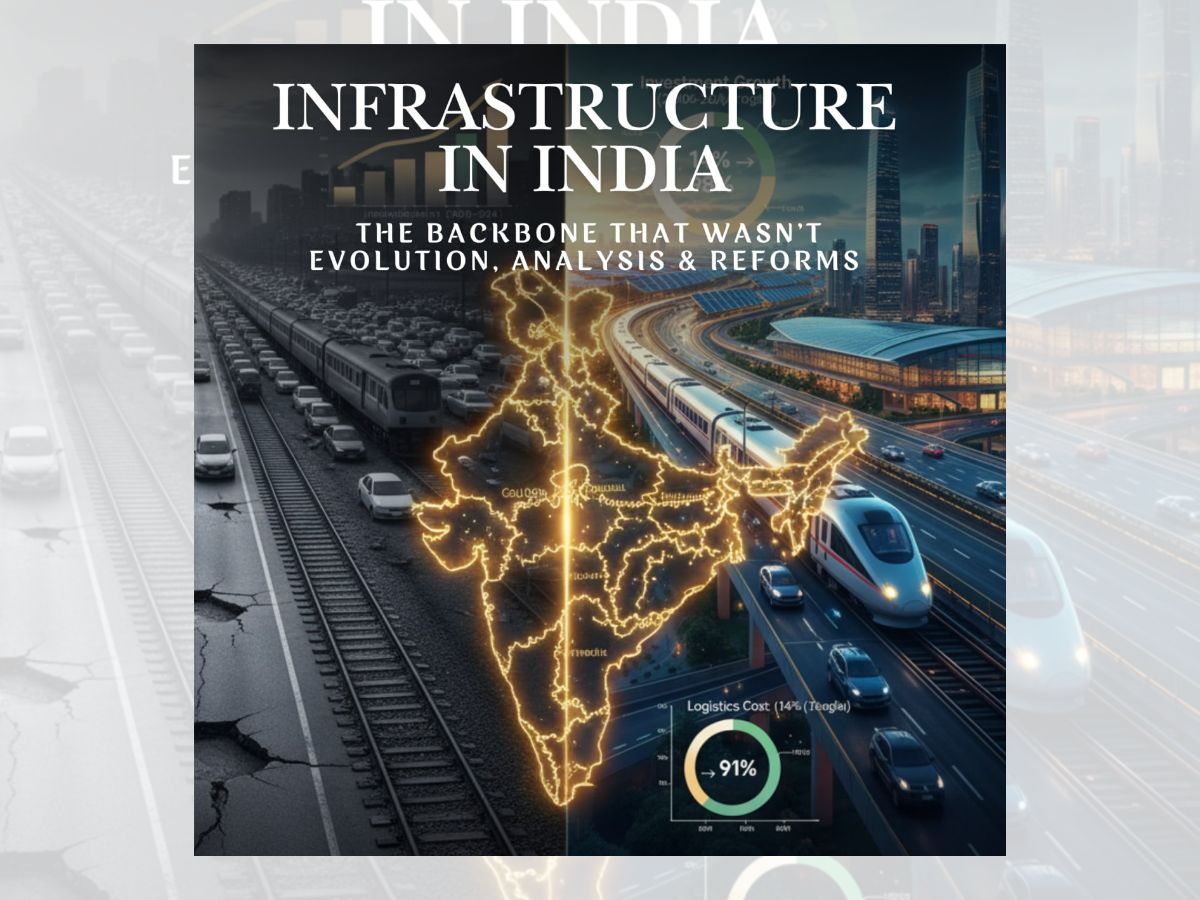
Any country has its developmental backbone in its infrastructure and the network of road, railways and airports along with the ease of logistics and transportation from one place to another. India is witnessing a revolutionary phase in infrastructure growth characterised by high-profile, large-scale undertakings to cement its status as an economic superpower. India’s infrastructure space in this decade is being reshaped by mega projects in the areas of roads, railways, and aviation in close rhythm with the vision of the government for a $5 trillion economy and a new, resilient India.
Ambitious Infrastructure Projects
- Among the prominent projects, the Delhi-Mumbai Expressway is one of the most significant Greenfield expressways that covers around 1,386 km. It is expected to reduce travel time between two of India’s most significant cities by half and features sustainability elements like solar-powered road lighting and rainwater harvesting facilities.
- The second major project is the Ganga Expressway in Uttar Pradesh, covering 594 km and linking major towns and cities, which will promote regional connectivity and economic integration.
- The Bharatmala Pariyojana is a massive effort aimed at building around 26,000 km of economic corridors, decongesting cities with ring roads and elevated corridors, and creating 35 multimodal logistics parks to improve the efficiency of freight movement. These corridors will fast-track freight movement, bring down logistics costs, and spur industrial development.
- In railway infrastructure, India is likely to electrify 100% of its rail network by 2025-26 and wants to increase its freight carrying capacity to emerge as the second-largest cargo-carrying railway in the world. Focus is being given to high-speed bullet trains and increased investments in infrastructure to modernise and make it more competitive.
- For aviation, construction of new airports and extension of existing ones is ongoing, and a push is being given to improve regional connectivity under the UDAN scheme.
Expert Views: Hope and Skepticism
Experts welcome India’s infrastructure push as a game-changer in economic expansion, job creation, and quality of life. The holistic approach across sectors promotes industrialisation, urbanisation, and sustainability. Optimists point out the good work done by infrastructure in cutting down travel times, decreasing the cost of logistics, and bringing in investments.
Yet, they cite some problems like project delays, cost overruns, and quality issues. The efficiency of expenditure on infrastructure is questioned with news showing a number of projects with time and cost overruns that put pressure on public finances. Furthermore, experts call for greater emphasis on rural connectivity, urban congestion, maintenance of existing infrastructure, and ensuring inclusivity in development gains.
The Way Forward: Reforms and Key Focus Areas
Priorities include improving rural connectivity, green urban infrastructure, digital integration through platforms such as the Unified Logistics Interface Platform (ULIP), and decreasing environmental footprints. Stress on strong logistics networks with multimodal transport capacities and rail and aviation capacity expansion is crucial.
To maintain and build up momentum, essential reforms are quicker project clearances, project bundling for efficiency, and private sector involvement through public-private partnerships. The government is working to increase infrastructure investment to 40% of GDP by 2035, complemented by innovative financing and asset monetisation mechanisms.
Nutshell
Overall, India’s infrastructure growth in 2025 is visionary and ambitious but needs to overcome execution challenges, greater planning, and inclusive growth in order to reach its full potential to be an economic prosperity driver and social progress agent.