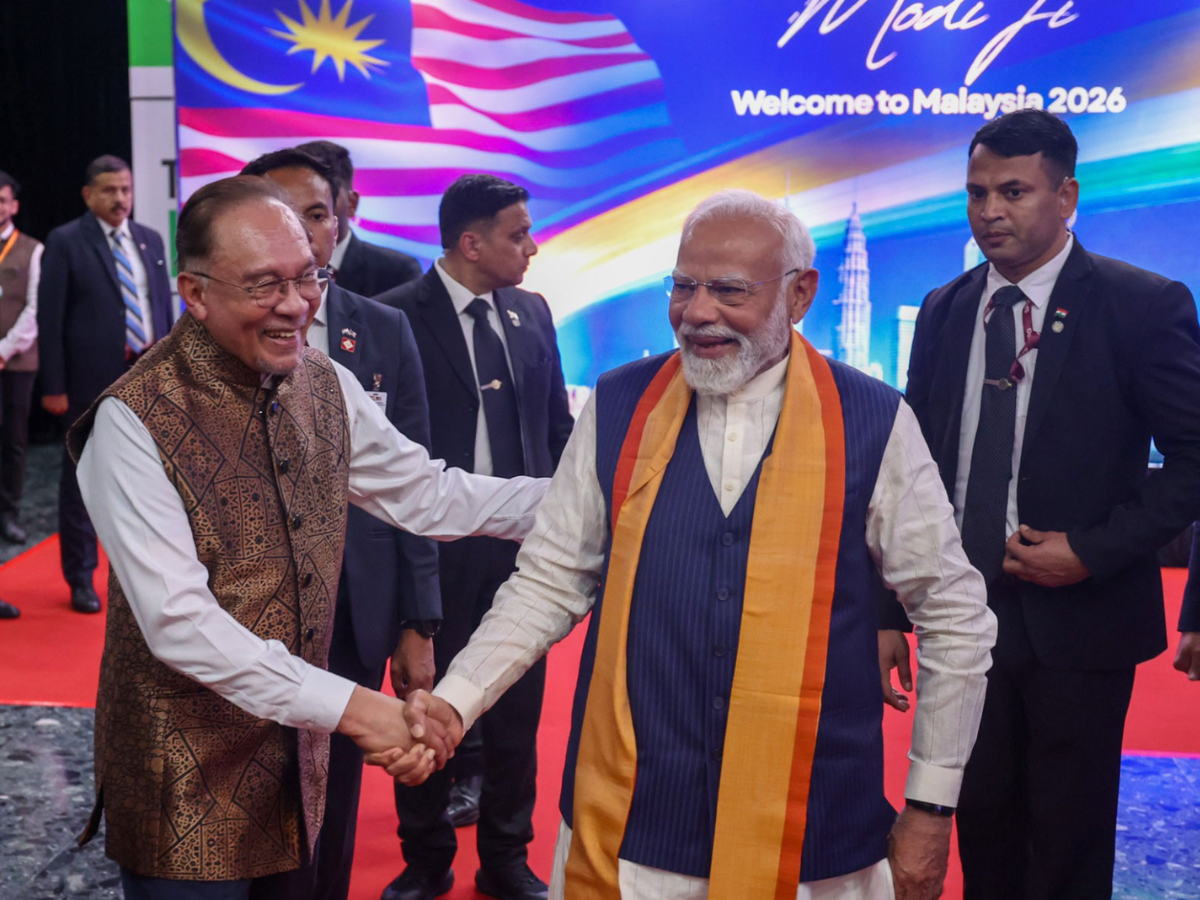
The recent official visit of Indian Prime Minister Narendra Modi to Malaysia marks a significant step in strengthening bilateral ties between the two nations. This is PM Modi’s first foreign trip of 2026 and his third visit to Malaysia overall, coming shortly after the elevation of India-Malaysia relations to a Comprehensive Strategic Partnership in August 2024 during Malaysian Prime Minister Anwar Ibrahim’s visit to India.
For Malaysia and Southeast Asia, this transformation is not abstract, and India lies squarely at the forefront of their future economic and geopolitical net and interests, providing the pillar of stability and strength in economic resilience, security support, technology access, and strategic optimality.
Prime Minister Narendra Modi’s visit to Malaysia on 7 and 8 February, 2026 therefore is strategically vital for both countries and especially for Malaysia—one in which Kuala Lumpur must think beyond traditional hedging and recognise India as a first-tier strategic partner of the coming decades. The visit reciprocated that earlier engagement and focused on deepening cooperation across economic, technological, security, and cultural domains. It underscored India’s Act East Policy and its push for stronger engagement with Southeast Asia, particularly within the ASEAN framework.
BACKGROUND
India established diplomatic relations with the Federation of Malaya (predecessor state of Malaysia) in the year 1957. India and Malaysia have developed close political, economic, and socio-cultural relations presently. Malaysia hosts the third largest PIO community in the world after the US and UAE. The year 2022, marked 65 years of diplomatic ties between Malaysia and India and presents an opportunity to further strengthen and diversify the existing ties, especially in the economic sphere. Surrounded by busy sea lines of communication such as the Strait of Malacca and the South China Sea, Malaysia is also a key pillar of India’s Act East policy and critical to India’s maritime connectivity strategies. The relations between India and Malaysia had grown from Strategic Partnership to an Enhanced Strategic Partnership in the last 10 years, with new cooperation in cultural diplomacy, digital economy, and agriculture commodity forthcoming.
SIGNIFICANCE OF INDIA’S BILATERAL TIES WITH MALAYSIA
India is one of the top 10 largest trading partners of Malaysia; while Malaysia is India’s 13th largest trading partner in the world. India’s exports to Malaysia has increased from 3.98 billion USD in 2011-12 to 6.43 billion USD in 2018-19. India’s imports from Malaysia has increased from 9.47 billion USD in 2011-12 to 10.81 billion USD in 2018-19. A MoU on higher education was signed in India on the visit of former Malaysian Prime Minister’s Najib’s visit in 2010.
There are 2000 Indian students in Malaysia and 4000 Malaysian students in India. The most number of students from Malaysia belong to the medical field. India’s Indian Council of Cultural Relations (ICCR) in 2019-20, has provided two slots for Malaysian students under its General Scholarship Scheme (GSS).
DEEPENING STRATEGIC TRADE AND DEFENCE TIES
Bilateral trade has nearly doubled since the last decade, reaching around USD 19-20 billion annually by the last two years, making Malaysia one of India’s top trading partners in ASEAN and India being Malaysia’s most important partner in South Asia.
Malaysia’s exports are mainly on electronics, semiconductors, palm oil, chemicals, and petroleum products, while India supplies refined petroleum, pharmaceuticals, machinery, iron and steel, food products, and IT-enabled services to Malaysia. Most crucially, India has consistently been among the largest importers of Malaysian palm oil, creating a large and stable downstream market. The supply of pharmaceutical exports has been crucial and critical for Malaysian consumers, giving Malaysia’s healthcare the advantage of affordability and resilience.
As India’s economy projection is projected to rise towards USD 7 trillion by 2030 and its middle class expanding with additional hundreds of millions of people, Malaysia will benefit in key sectors including electronics, digital trade, energy products, and agri-commodities that will turn the India-Malaysia trade corridor into one of the most sturdy and vibrant growth channels linking both regions of South Asia and Southeast Asia in new decades.
With rising tensions and threats facing the region, Malaysia will be boosted by the deeper role played by India in providing peace and stability in the region through its power projection and security assurances.
India’s military power has expanded notably under Prime Minister Modi, transforming India from a largely defensive force into a credible, multi-domain deterrent power in the Indo-Pacific. India is now the world’s 5th-largest military spender, with defence expenditure exceeding USD 80-90 billion annually, up by more than 40% compared to a decade ago.
Being a blue-water navy with two aircraft carriers, (INS Vikramaditya and the indigenous INS Vikrant), a growing fleet of destroyers, frigates and corvettes, and a nuclear-powered ballistic missile submarine capability, India provide the region with both reach and volume in joint deterrent capacity. The Navy conducts sustained deployments across the Indian Ocean, the Andaman Sea and increasingly toward the Strait of Malacca, displaying India’s role as a guardian of critical sea lanes. Its strategic posture is defensive and stabilising, and Malaysia and the region will benefit from India’s capacity in protecting sea lanes, deterring coercion, and preventing regional domination by any single power.
The Indian Air Force (IAF) is among the world’s largest, operating over 1,700 aircraft, including advanced multirole fighters such as the Rafale, upgraded Su-30MKI, Mirage-2000 and indigenous Tejas platforms, supported by airborne early-warning systems and platforms.
Together, India’s air and naval capabilities provide power projection, sea-lane security, and strategic deterrence, in a maritime-air power hybrid—a capability profile that is uniquely stabilising and needed for Southeast Asia and Malaysia, which depend fundamentally on open skies, secure sea lines of communication, and a free and open Indo-Pacific.
India’s strengthened military posture further bolsters the current regional security architecture that has struggled to keep up to meet the demands of deterrent capacity in protecting key national interests and territorial integrity and in upholding the sanctity of international law and maritime law. India’s stabilising presence will add further trust and combined deterrent effects, advancing regional confidence and building more capacities through joint training, interoperability cohesion and drills.
This is crucial amidst growing grey zone pressures and power asymmetries and this will help to reinforce maritime domain awareness and reduce risks of escalations.
A SHARED FUTURE
India’s current and future role and impact have never been more profound and integral. Its rise coincides with China’s structural slowdown, reshaping Asia’s balance.
For Malaysia, the choice is not between India and others. It is between either preparing early for India’s ascent or adjusting late. Both nations share similar future challenges and potential.
Prime Minister Modi’s visit is a strategic inflection point in creating a new wave of resonating ties with interwoven benefits in a multi-faceted partnership based on history, trust and shared future aspirations. Deepening ties with India in defence, technology, semiconductors, energy, food security, education, and culture is not merely prudent, but forming the key foundational essence for the region and Malaysia’s long-term prosperity, security, and autonomy.