
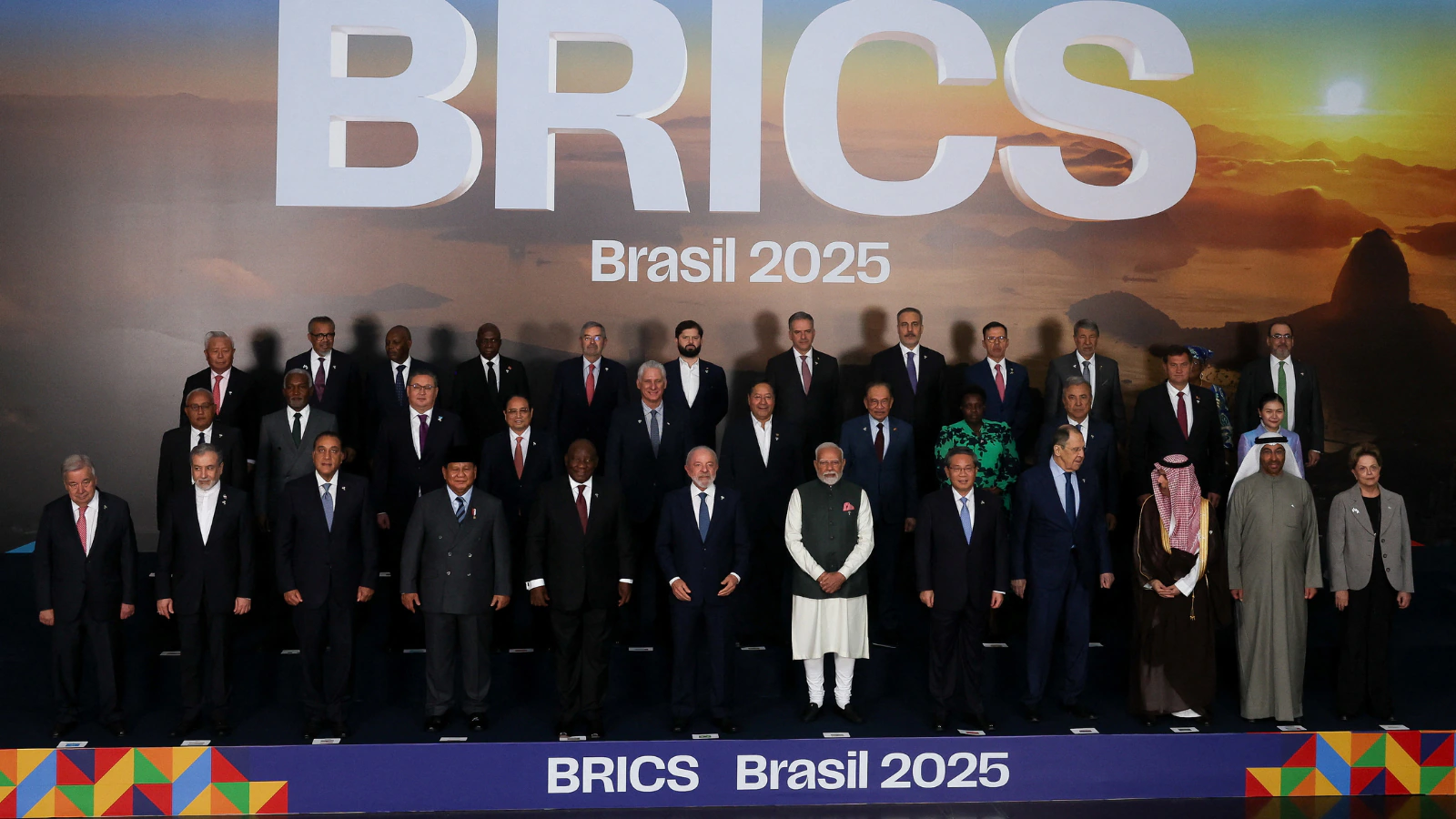
The timing is almost Shakespearean in its cruelty. India assumed the presidency of BRICS on the very first day of 2026, with ambitious plans to spearhead a rule-based international order and amplify the voice of the Global South. Within three days, the rules lay in tatters. On January 3, the United States launched pre-emptive military strikes on Venezuela, codenamed Operation Absolute Resolve, and extracted President Nicolas Maduro and his wife directly to New York City to face trial in American courts. This transpired all without a whisper of international consultation or UN authorization. The American justification was bowdlerized, dressed as a law enforcement manoeuvre against narcoterrorism. However, the reality, on closer inspection is far more draconian: diminution of sovereignty, a government toppled and international law rendered stripped of its binding force squarely at a conjecture when India sought to fortify it.
This crystallises a profound crisis. The grim splendour of Venezuelan episode offers a stark testament not merely to a flagrant breach of the UN charter, but has returned to the fore the doctrine of pre-emptive war, under which superpowers claim anticipatory force against perceived threats. For America, unfettered by opposition, International law is stripped of its constraint and is transmuted in pageantry, dignified in appearance though inert in effect. Ramifications have rippled beyond Caracas, vitiating protections expressly crafted to shield smaller states against hegemonic aggression.
The UN Secretary-General Antonio Guterres branded it “a dangerous precedent,” as General Assembly President Annalena Baerbock cited Article 2, reiterating the Charter’s bedrock: states must refrain from the threat or use of force against another state’s territorial integrity or political independence. She posed a question that hangs unanswered through the corridors of New York: “A peaceful, safe and just world for everyone is only possible if the rule of law prevails instead of might makes right.” Yet left unspoken, though unmistakenly apparent, is a more ominous question: who will enforce this principle against the world’s most formidable military?
Consider the breadth of the violation. The operation was not carried out in lawful self-defence as provided for in the Charter. Maduro had not attacked the United States, now was there any imminent threat demonstrated under International law (strict Caroline criteria). Instead, the trump administration framed this as a preemptive action, a semantic sleight of hand resurrecting the Bush-era pre-emption rationale.
What makes this moment so perilous for India, and for BRICS, is that Venezuela operation is not an aberration. It is a facet of a pre-emptive war trajectory emerging across the Trump administration’s second term. In Nigeria, the US has coordinated strikes with local authorities, though packaged for public consumption as pre-emptive response to terrorism. Threats of force have been wielded against Greenland on the putative grounds of national security vis-à-vis rare earth minerals. The administration has threatened military action against Cuba, Colombia and Iran. Individually, each justification carries the sheen of legitimacy. Collectively, however, they sketch the contours of a doctrine the Global South relegated consigned the history, the doctrine of intervention cloaked in contemporary garb.
The cruel irony is that these justifications often resonate within nations beset by genuine instability. Venezuela suffers corruption of staggering proportions and repression bordering on crimes against humanity. Grave terrorism plagues Nigeria. Greenland holds critical minerals in an era of systematic rivalry for resource dominance. For citizens suffocated by misgovernance, the allure of swift foreign intervention order enforced from outside under the guise of pre-emption), often outweighs the familiar anarchy of their own failed regimes.
This is perhaps the most insidious aspect of the American approach: it capitalises the vulnerabilities of the Global South, weaponizing the frustrations of citizens against the sovereignty those citizens inherited through decades of anti-colonial struggle.
This is where BRICS, and India’s presidency, emerges as potentially decisive. BRICS is not a monolithic and homogenous group. Internal contradictions are abound within the bloc. India and China are locked in deepening border friction. Russia is under sanctions from the west. Saudi Arabia and the UAE vie with Egypt and Ethiopia for regional dominance. Iran navigates isolation. The expansion to include Iran, the UAE, and Egypt has widened the circle but has also made it herculean to reach a consensus. These are not the natural allies of a unified front. They are nations held together by the recognition that the post-Cold war order, dominated by America’s financial, military and institutional hegemony, no longer serves their interests.
However, it is the very endurance of these dissonances that makes the Venezuelan precedent momentous. If the United States may unilaterally divest another country of its sitting head and haul him before its courts, without recourse to the UN Security Council or International law, claiming pre-emptive rights against speculative threats, then sovereignty itself becomes precarious. Brazil, which presided over the 2025 iteration before handing the presidency to India, has itself been threatened with 50 per cent tariffs by the Trump administration. South Africa faces American indictment over its foreign policy alignment. Russia and China are locked in confrontation with Washington. Iran is under perpetual jeopardy of strikes. The message embedded in Venezuela operation is unmistakable: the US will act unilaterally when it calculates its interests demand it, and the international order will not impede it.
India’s response for the response it facilitates as BRICS chair) carries extraordinary weight. India itself maintains a strategic autonomy that distinguishes it from other nations in the bloc. It is simultaneously a QUAD member, a partner of the US in critical domains, and yet a committed non-aligned nation insistent on charting its own course. The Venezuelan crisis presents India with both a test and an opportunity. The test is whether it can hold together a fractious coalition united primarily by opposition to unilateral American action ad resurrection of pre-emptive war doctrines. The opportunity is to articulate, with clarity and force, why Venezuela precedent threatens not merely BRICS members but the entire system of international law that buttresses the rights of all smaller nations.
BRICS has condemned similar violations before. Yet statements alone won’t suffice. India must pair moral clarity with tactical prudence, given its acute economic vulnerabilities: 60 % US tariffs already biting $65 billion in exports, with Trump’s “Sanctioning Russia Act of 2025” threatening 500% duties over Russian oil purchases. India’s real leverage lies not in moral suasion or public confrontation, but in structural alternatives. As BRICS chair, India can quietly accelerate the New Development Bank (NDB), build a SWIFT-independent payment system, and expand currency swap agreements among members. This subtle response to American unilateralism and pre-emptive aggression creates parallel institutions requiring no US endorsements, slower than denunciations, but far more durable, as China has demonstrated in the past.
Strategic diversification furthers further. India must hasten FTA negotiations with the EU, ASEAN, and others as hedges against tariff shocks, looking in preferential market access elsewhere. The upcoming 2026 budget should prioritise trade finance, non-US export promotion, and logistics efficiencies, leveraging $607 billion in forex reserves for this transition. On energy, where Trump’s rhetoric is focused, calibrated diversification signals responsiveness without capitulation, gradually increasing Gulf and Guyana supplies without straining strategic flexibility. This maintains BRICS credibility without inviting economic devastation.
Thus, the current Indian Presidency, formulated in terms of resilience, innovation, cooperation and sustainability, thus gains a fifth pillar: institutional sovereignty. By convening Global South dialogue through BRICS platforms while constructing these alternatives, India becomes the neutral infrastructure of resistance to pre-emptive unilateralism without becoming the confrontational figurehead. The question confronting India transcends diplomacy. It touches civilisational values. Does India, as the world’s largest democracy with a proud tradition of non-alignment and strategic autonomy, believe in the possibility of an international order governed by law rather than pre-emptive force? If so, then the Venezuela precedent cannot be permitted to stand as the new normal. India’s BRICS presidency offers the platform, credibility and responsibility to steadily counter unilateralism and expansive doctrines.
The game is afoot. The responsibility now rests with India’s BRICS gavel, to prove that even the mighty must eventually reckon with collective resolve.
Dr. Manan Dwivedi, IIPA, Anushka Tiwari, DNLU, MP