
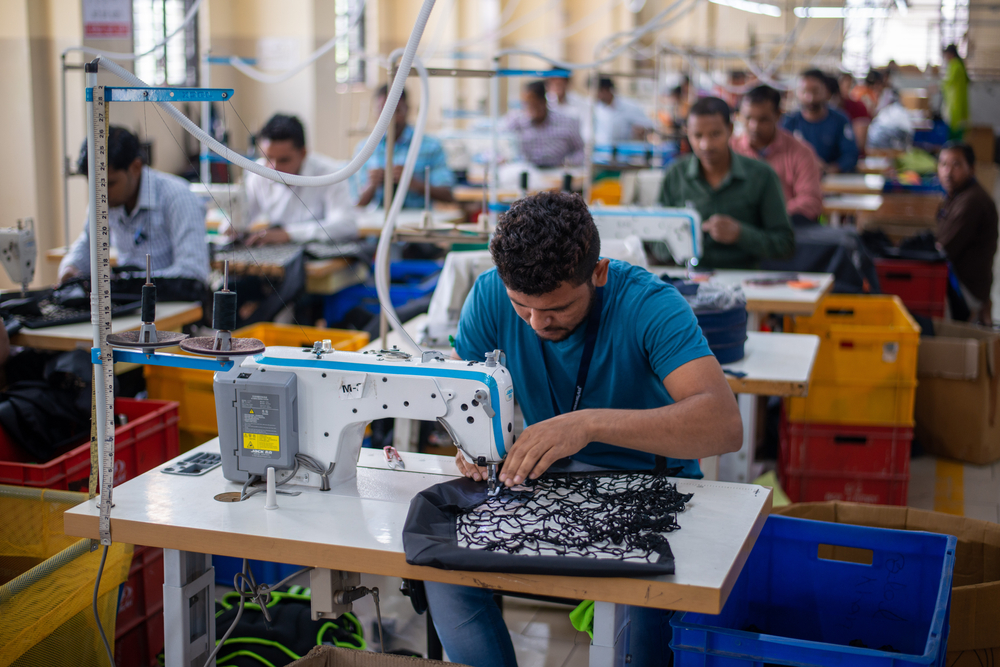
Across advanced and emerging economies alike, MSMEs are being asked to do more than survive. They are expected to absorb supply chain shocks, drive employment, anchor domestic manufacturing, and increasingly, meet the sustainability and compliance standards of global trade. In this context, MSME policy is no longer a domestic development concern. It is a competitiveness strategy.
India has over 68 million MSMEs, contributing nearly 18 to 30 percent of the country’s GDP, making the sector central to economic growth, employment generation, and domestic value chains across regions. Its performance will decisively shape India’s growth momentum and manufacturing competitiveness.
Improving productivity, simplifying compliance, and ensuring convergence across schemes and institutions are therefore not administrative choices but economic imperatives to unlock scale, efficiency, and sustained value creation across the MSME ecosystem. India has responded to this challenge with scale and intent. Few economies deploy as many targeted interventions as possible for small enterprises. Yet the defining constraint today is not policy attention but policy architecture.
As global capital becomes more selective and trade regimes more exacting, fragmentation within MSME support systems has begun to carry macroeconomic consequences. The renewed emphasis on convergence must therefore be read as a strategic inflection point. Not a bureaucratic consolidation, but a systems reform with implications for productivity, exports, and economic resilience.
FRAGMENTATION IS A HIDDEN DRAG ON GROWTH
In a world shaped by near-shoring, friend-shoring, and supply chain rebalancing, the speed and reliability of MSMEs matter as much as their scale. Fragmented policy delivery introduces delays, raises compliance costs, and weakens the ability of small firms to integrate into time-sensitive value chains. Convergence offers a way to address this structural drag, but only if it is framed around enterprise outcomes rather than institutional convenience.
DESIGNING POLICY AROUND THE FIRM, NOT THE FILE
Leading economies increasingly design MSME support as platforms rather than programmes. The objective is coherence. Data integration across taxation, registration, finance, and skilling allows governments to anticipate stress, allocate capital more efficiently, and calibrate interventions in real time.
When credit schemes are decoupled from technology upgrades, when skilling operates independently of industry demand, and when market access initiatives do not align with quality and sustainability standards, MSMEs struggle to convert policy support into measurable output. At the macro level, this translates into lower productivity, weaker export competitiveness, and reduced investment efficiency.
For India, information convergence can enable a shift from reactive policy-making to predictive governance. But data integration must be complemented by process alignment. From the enterprise perspective, engagement with the state should feel continuous, intuitive, and proportionate to scale. Digital infrastructure is an enabler, not a solution. Platforms must reduce decision friction, lower compliance burdens, and provide actionable insight. Otherwise, digitisation risks replicating fragmentation at a faster pace.
SUSTAINABILITY IS NOW A TRADE VARIABLE
Perhaps the most significant global shift facing MSMEs today is the convergence of trade and sustainability. Carbon intensity, resource efficiency, and traceability are rapidly becoming prerequisites for market access, not optional differentiators. For export-oriented MSMEs, especially those linked to European, North American, and East Asian markets, sustainability compliance will increasingly influence pricing, financing, and buyer relationships.
This reality demands that sustainability be embedded within MSME policy design rather than addressed through standalone initiatives. Converged policy frameworks can align technology upgradation with energy efficiency, skilling with environmental management, and cluster development with shared sustainability infrastructure. When sustainability is treated as a productivity driver rather than a regulatory cost, MSMEs are better positioned to compete globally.
CONVERGENCE REQUIRES INSTITUTIONAL MATURITY
The risks of convergence are real. Large-scale restructuring without sequencing can disrupt delivery and weaken accountability. Execution will require shared metrics, inter-ministerial coordination, and capacity building at the administrative level. Equally, convergence must be selective. Targeted programmes serving specific regions, communities, and sectors should retain autonomy where scale and context demand it. Strategic systems are not uniform systems; they are adaptive by design.
A STRATEGIC OPPORTUNITY IN A FRAGMENTED WORLD
As global trade becomes more fragmented and geopolitical risk reshapes supply chains, countries that can offer reliability, transparency, and scale will gain advantage. India’s MSMEs are central to that proposition. The question is no longer whether India has enough MSME schemes. It is whether the ecosystem allows enterprises to move quickly, comply effortlessly, and compete credibly on the global stage.
Convergence, if executed as systems leadership rather than administrative reform, can reposition India’s MSMEs as anchors of growth, exports, and economic resilience. This is not incremental policy work. It is a strategic choice about how India competes in a more complex, more demanding global economy.
Former Ambassador Anil Trigunayat is a Retd. IFS Officer, and has served as the trade commissioner in New York, USA. Sumit Kaushik, a social impact and a public policy consultant.