
India arrived at Davos this year riding a wave of confidence. Political leaders, chief ministers, and corporate executives highlighted reforms, digital governance, and India’s emergence as a stable growth engine amid global uncertainty. The messaging was clear: India is open for business.
Then came a reality check. Speaking at a session on India’s economic outlook, Gita Gopinath, former Chief Economist of the International Monetary Fund, listed familiar constraints to growth—judicial delays, land reforms, tariffs. But she placed special emphasis on a challenge that rarely receives comparable political urgency: pollution. Its impact, she noted, is far more economically consequential than tariffs.
The data supports her claim. According to The Lancet, air pollution alone costs India nearly 9% of GDP annually through healthcare expenditure and lost productivity. World Bank estimates place the figure at 5-6% of GDP. By contrast, most trade-impact models suggest that tariff-related losses account for less than 1% of GDP. In other words, pollution is not a peripheral issue—it is among the largest silent drags on India’s economic performance.
Yet public discourse remains inverted. Trade disputes trigger outrage, statements, and diplomatic firefighting. Pollution triggers little more than seasonal resignation.
A PROBLEM TOO BIG TO IGNORE—YET CONVENIENTLY DENIED
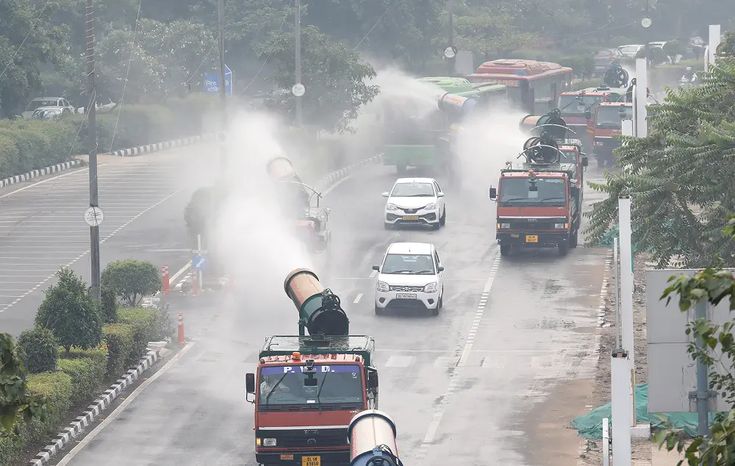
The reluctance to confront pollution is striking given how visible it has become. In recent months, international sporting events have been disrupted as air quality crossed hazardous levels. Corporate executives have quietly exited Delhi, citing health concerns. Residents across cities report record respiratory illness.
India loses an estimated 1.7-2 million lives every year to air pollution—roughly 18-26% of global pollution-related deaths. That is nearly 5,500 deaths every day. Even when pollution does not kill, it diminishes productivity. Studies show an 8-10% drop in worker output on high-pollution days, translating into an estimated 1.3 billion lost working days annually.
These numbers matter to investors. They reflect workforce reliability, healthcare burden, and long-term human capital formation—factors far more decisive than marginal tariff adjustments.
And yet, denial persists. Air Quality Index readings periodically disappear from public dashboards. Emergency measures focus on optics rather than structural change. Pollution is treated as episodic rather than systemic, seasonal rather than chronic.
BEYOND AIR: INDIA’S BROADER QUALITY-OF-LIFE BREAKDOWN
Pollution is only one dimension of a deeper quality-of-life crisis.
Water safety remains precarious. Despite improved tap connectivity under flagship missions, access has outpaced quality. Sewage contamination, untreated industrial discharge, and aging pipelines continue to pollute drinking water across cities. Periodic outbreaks of waterborne disease are no longer aberrations; they are symptoms of governance failure.
Food safety tells a similar story. Adulteration, antibiotic residue in poultry, pesticide misuse, and mislabelled packaged foods have repeatedly drawn regulatory scrutiny. The consequences extend beyond consumer trust to long-term public health risks, including antimicrobial resistance.
Then there is urban safety. The preventable death of a young professional who drove into an unmarked construction pit during fog is not an isolated tragedy. India records over 160,000 road fatalities annually, the highest in the world. Unsafe infrastructure, poor enforcement, and inadequately trained first responders make everyday mobility a risk.
Taken together, these failures point to a state that has retreated from guaranteeing basic safety as a public good.
WHY HAS SAFETY COLLAPSED? THE SCARCITY MINDSET
One explanation lies in what economists call a “scarcity mindset.” Decodes of unreliable public systems—healthcare, policing, water, transport—have conditioned citizens to expect failure. Survival becomes individualized. Households retreat into gated communities, private vehicles, purifiers, and personal risk buffers.
This privatization of safety creates a vicious cycle. As the influential exit public systems, collective pressure for reform weakens. Public spaces degrade further. Accountability dissolves. Negligence becomes normalized.
In such an ecosystem, denial is not accidental—it is functional. Acknowledging systemic failure would demand systemic reform, which is politically harder than managing outrage after disasters.
THE INVESTMENT QUESTION NO ONE WANTS TO ASK
Davos conversations revolve around capital flows and growth forecasts. But investors ask a simpler question before spreadsheets: Can people live here safely?
No amount of policy reform compensates for an environment perceived as hostile to life and health. Talent mobility is sensitive to quality of life. Executives, researchers, and skilled workers factor in air, water, healthcare, and safety long before tax incentives.
If India does not course-correct, pollution risks becoming not just a domestic crisis but a global reputation problem.
THE FIRST STEP: ACKNOWLEDGEMENT
This is not a call for instant solutions or silver bullets. It is a call for honesty.
Pollution is not an inconvenience; it is not a seasonal annoyance. It is a macroeconomic threat, a public-health emergency, and a governance failure rolled into one.
Until political leadership acknowledges this openly—without deflection, diffusion, or denial—policy responses will remain cosmetic. India does not need foreign assistance to clean its air or secure its water. It needs political will and institutional accountability.
At Davos, India was celebrated for its ambition. The challenge now is credibility. Growth narratives cannot outrun poisoned air forever.
The question is no longer whether pollution hurts India’s economy. The evidence is overwhelming.
The real question is whether India is ready to admit it—before the cost becomes irreversible.