
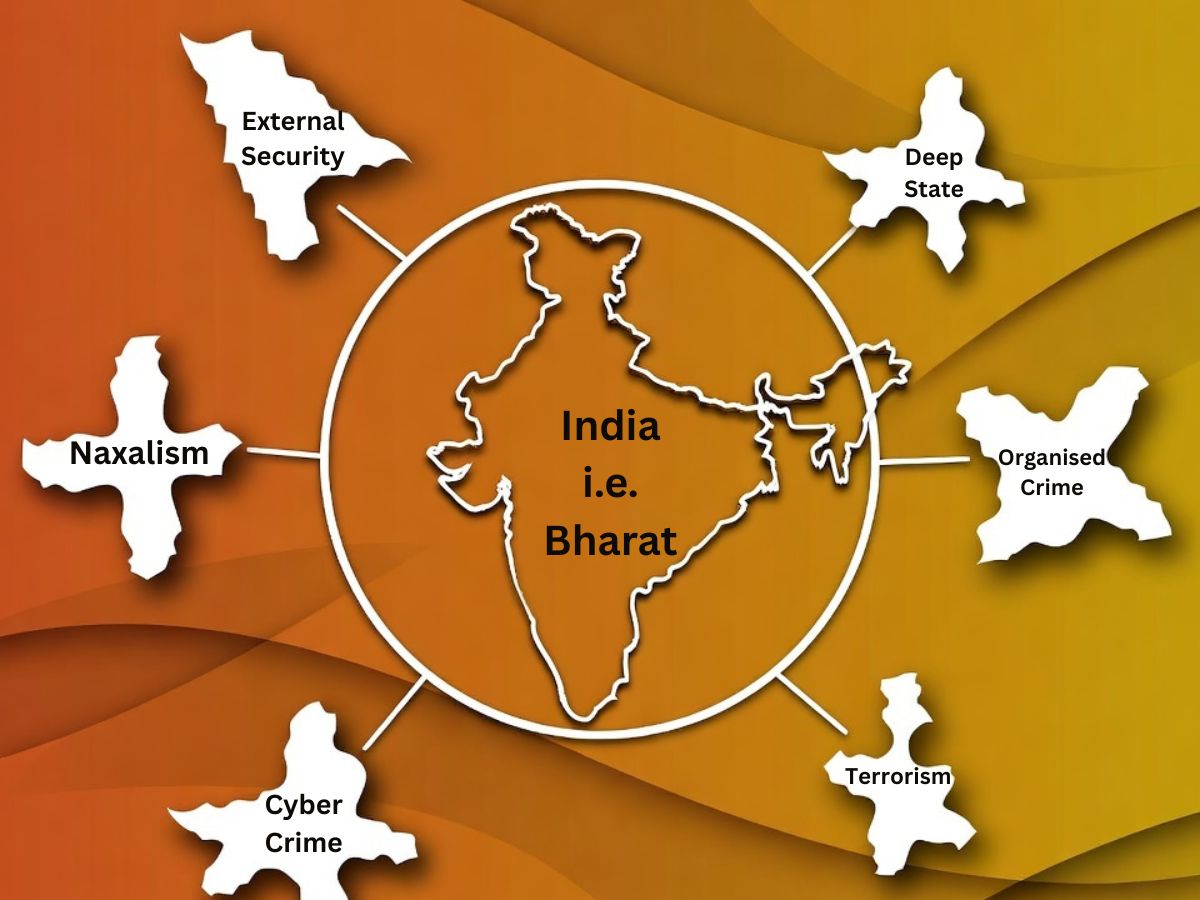
India’s battle against internal and external security is growing more intense, driven by traditional issues and new-age threats from within and outside. Instances of religious intolerance, disinformation, cybercrime, organised violence, and foreign meddling have potential to deepen cracks in society and weaken momentum towards national development.
Internal Security: Challenges and Manipulation
India’s internal security system is under constant threats from secessionism in border states and terrorism to organised crime. The sentiments rising from ideas of Tamil Eelam, Khalistan, Kashmir, and Naxalism have displayed the influence they can have in disturbing peace. While Left-Wing Extremism (Naxalism) and North-East insurgency have significantly reduced due to focused development and peace agreements, fresh threats arise like narco-terrorism in Punjab, cross-border intrusions, and sleepers operating undercover. Communal violence based on religious intolerance has increased dramatically, with crimes against religion having increased by 65% in the past four years and communal riots rising over 130%. Social media campaigns of disinformation deepen the divisions, reducing latent intolerance to active tools of rioting.
The Deep State: Domestic and Foreign Interference
India has become more vocal regarding the power of a “deep state” which is a network of actors, agencies, and external forces purportedly conspiring to destabilise the government through malicious means and economic interests. Well-resourced NGOs, media outlets, and foreign foundations have been blamed for coordinating mass protests, discrediting major infrastructure conglomerates, and advancing regime change strategies. Internal actors, such as politicised police and intelligence services, have also been said to have played a role by fomenting communal tensions, stifling opposition, and leveraging state resources for partisan purposes. Stakeholders from USA, China and Russia have raised eyebrows in India after showing significant interest in internal matters of the country.
Societal Fault-lines: Hatred, Misinformation, and Protests
Religious bigotry continues to be weaponised, transmitted through WhatsApp and Facebook, fuelling violence that quickly escalates from social media rhetoric to street protests. AI-generated and Pseudo-graphic videos, and manipulated news content tend to go viral, shaping public opinion and distorting events to suit polarising narratives. Mass protests, sometimes fuelled by fake news and foreign funding, pose the risk of transforming democratic dissent into disruptive movements.
The Cyber Frontier: A New Battleground
India’s cyber space is the world’s second most targeted, with increasing cases of ransomware, phishing, and cyber espionage endangering not only banks but the nation’s overall national security. Cybercrime and internet-based radicalisation facilitate speedy dissemination of extremism, organise criminal groups, and erode government confidence.
Towards National Development: The Roadblocks
These multifaceted threats keep the government in a perpetual state of defence, more or less defending its actions as a reaction to accusations, demonstrations, or conspiracies instead of forward-thinking nation-building. Resources are redirected from rallying collective efforts towards development and innovation to combating disinformation, monitoring, and crisis management
India’s journey to emerging nation status is checked not only by traditional adversaries, but by weaponising societal fault-lines, the hijacking of economic agendas, and meddling from deep state networks, both internal and external. These issues very well need to be dealt with strong security doctrine, staunch policy action, and a revisit to unity, truth, and development with an iron fist.