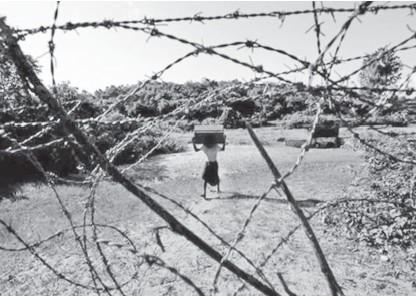
Illegal immigration has long been a contentious issue in India, particularly in states sharing borders with Bangladesh. The movement of people across the porous India-Bangladesh border has generated significant political, social, economic, and security concerns. While migration is a global phenomenon driven by poverty, unemployment, environmental degradation, and the search for better opportunities, illegal immigration presents unique challenges for sovereign states. In India, the issue of undocumented migrants from Bangladesh has remained a matter of public debate for decades.
The discussion surrounding illegal immigration is often emotionally charged, involving questions of national security, demographic change, human rights, economic burden, and electoral politics. While humanitarian concerns must be acknowledged, it is equally important to examine the implications of large-scale illegal migration on India’s resources and security apparatus.
Historical Background
The roots of migration from Bangladesh to India can be traced to the partition of British India in 1947 and the subsequent creation of East Pakistan. Large-scale population movements occurred due to communal violence and economic hardships.
The situation intensified during the Bangladesh Liberation War of 1971 when millions of refugees crossed into India seeking safety. Although many refugees returned after Bangladesh gained independence, migration did not completely cease. Economic disparities, population pressure, environmental challenges such as floods and river erosion, and employment opportunities in India continued to encourage cross-border movement. Over time, concerns arose regarding the presence of undocumented migrants in several Indian states, particularly Assam, West Bengal, Tripura, Meghalaya, and parts of Delhi and Maharashtra.
Economic Impact on Resources
Pressure on Public Infrastructure
One of the primary concerns associated with illegal immigration is the increased pressure on public infrastructure. Schools, hospitals, housing facilities, transportation networks, and sanitation systems are designed based on population estimates. A sudden or sustained increase in population due to undocumented migration can strain these facilities.
Local administrations often face challenges in providing adequate healthcare and education services when population growth exceeds planning projections. In densely populated urban areas, the demand for public services may outpace available resources, resulting in overcrowding and reduced quality of services.
Competition in Labour Markets
Illegal immigrants often seek employment in the informal sector, where regulations and documentation requirements are limited. They frequently work in construction, domestic services, agriculture, and small-scale industries.
Critics argue that the availability of low-cost labour can suppress wages and create competition for economically weaker sections of the local population. Native workers may find it difficult to compete with labour willing to work for lower wages under difficult conditions. This may contribute to underemployment and wage stagnation in certain sectors.
However, economists also point out that migrant labour contributes to economic activity and fills labour shortages in specific industries. Therefore, the economic impact is complex and varies across regions and sectors.
Demographic and Social Implications
Several regions, especially border districts, have witnessed significant demographic changes over the decades. These shifts have become politically sensitive, leading to concerns among local communities about cultural identity, language, and traditional social structures.
In states such as Assam, demographic change has historically been linked to political movements demanding the identification and removal of illegal immigrants. The Assam Agitation of the late 1970s and early 1980s remains one of the most significant examples of public mobilization on this issue.
Rapid demographic changes can sometimes generate tensions between local populations and migrant communities. Competition for land, employment, housing, and public services may create resentment and contribute to social friction. Political actors may exploit these concerns for electoral gain, further polarizing communities. Consequently, illegal immigration can become not merely an administrative issue but also a source of social and political instability.
National Security Concerns
l Border Management Challenges
India shares a border of over 4,000 kilometers with Bangladesh, making border management a complex task. Rivers, forests, agricultural fields, and densely populated areas create difficulties in maintaining complete surveillance. Despite significant efforts by the border security forces, illegal crossings continue to occur. Smuggling networks often exploit vulnerabilities in border management systems, facilitating the movement of people, goods, and contraband.
l Document Fraud and Identity Issues
One of the major security concerns is the acquisition of forged identity documents by illegal immigrants. Fraudulent voter identification cards, ration cards, and other documents can complicate efforts to identify and deport undocumented individuals. Document fraud undermines the integrity of governance systems and creates challenges for law enforcement agencies. Accurate population records are essential for effective policymaking, security planning, and welfare distribution.
l Potential Criminal Networks
While the vast majority of migrants seek economic opportunities, security agencies have occasionally expressed concerns regarding the exploitation of illegal migration routes by criminal organizations. Human trafficking networks, counterfeit currency operations, narcotics smuggling, and other transnational crimes may utilize porous borders. Such activities can threaten public safety and require significant law enforcement resources to combat.
l Terrorism and Extremism Concerns
National security experts have periodically warned that weak border controls may be exploited by extremist groups seeking to infiltrate the country. Although it would be inaccurate and unfair to associate illegal immigrants as a whole with terrorism, security agencies remain concerned about the possibility that hostile actors could use undocumented migration channels to conceal their activities.
For any sovereign nation, the ability to identify individuals entering and residing within its territory is a fundamental component of national security.
Political Dimensions
Illegal immigration has become a major political issue in India. Different political parties have adopted varying positions on the matter. Some emphasize humanitarian considerations and the need to protect vulnerable populations, while others focus on national security and demographic concerns.
The debate has intensified around measures such as the updating of the National Register of Citizens (NRC) and discussions surrounding citizenship policies. Supporters argue that such measures help identify undocumented migrants and protect national interests. Critics contend that implementation challenges could affect legitimate residents and raise humanitarian concerns.
The political nature of the issue often makes consensus difficult, even though most stakeholders agree on the importance of secure borders and effective immigration management.
Humanitarian Considerations
While discussing illegal immigration, it is essential to maintain a balanced perspective. Many migrants leave their homes due to poverty, environmental disasters, or lack of opportunities. Bangladesh itself faces challenges related to climate change, river erosion, and population density, factors that can influence migration patterns.
International human rights principles emphasize the humane treatment of all individuals regardless of immigration status. Therefore, enforcement measures must respect due process, dignity, and legal protections.
Government Measures
India has invested heavily in fencing large portions of the India-Bangladesh border. Advanced surveillance technologies, floodlighting, drones, and enhanced patrolling have been introduced to reduce illegal crossings. The expansion of digital identity systems and improved verification mechanisms aims to reduce document fraud and improve the accuracy of population records.
Cooperation between India and Bangladesh has improved significantly in recent years. Both countries have worked together to address issues such as border crime, human trafficking, and illegal migration. Strong diplomatic engagement remains essential for managing migration effectively.
Governments at both Central and State Levels continue to explore legal and administrative measures to identify undocumented migrants, strengthen immigration enforcement, and streamline deportation procedures where applicable under law.
The Way Forward
Illegal immigration from Bangladesh remains one of the most debated issues in India’s public discourse. Concerns regarding pressure on public resources, demographic changes, labour market competition, and national security have led successive governments to pursue various policy responses. At the same time, the issue involves complex humanitarian and historical dimensions that cannot be ignored.
Key priorities include:
-
Strengthening border management through technology and infrastructure.
-
Enhancing cooperation with Bangladesh on migration-related issues.
-
Improving identity verification systems and preventing document fraud.
-
Ensuring fair and transparent legal procedures.
-
Protecting national security while respecting human rights.
-
Promoting economic development and regional cooperation to reduce migration pressures.
As a sovereign nation, India has the right and responsibility to regulate its borders and maintain accurate records of its population. However, effective solutions require a balanced approach that safeguards national interests while upholding legal and humanitarian principles.
Through stronger border management, improved governance, and constructive bilateral cooperation, India can address the challenges posed by illegal immigration while preserving social harmony and national security.
Dr.S.Krishnan is an Academician and an Experienced Journalist based in Jaipur. Ms. Meghna Roy is a 2nd year student of BALLB in Ramaiah College of Law, Bengaluru.