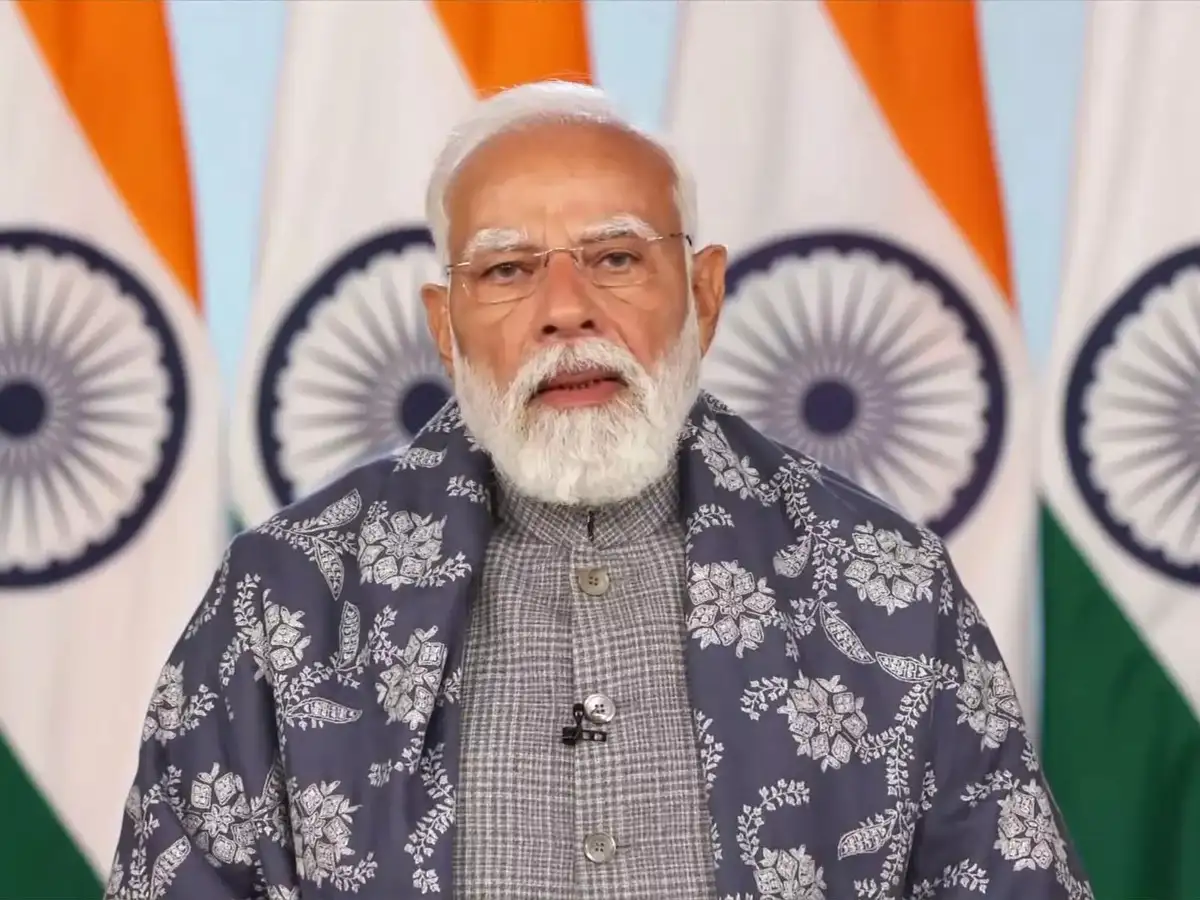
Narendra Modi’s journey is not merely a political biography. It is the story of discipline meeting destiny, of conviction forged in organisational life, and of a leader who rose not through entitlement but through endurance, ideology, and relentless public service. From the shakhas of the RSS to the highest office in the world’s largest democracy, his rise reflects a rare blend of personal austerity, political will, and national purpose. In an age when leadership is often measured by spectacle, Modi’s arc has been defined by continuity, stamina, and the ability to convert mandate into mission.
He did not emerge from dynastic privilege or institutional inheritance. He emerged from the hard grammar of grassroots politics. Born in Vadnagar in Gujarat, Narendra Modi entered public life through the Rashtriya Swayamsevak Sangh, where discipline was not a slogan but a way of life. As a young swayamsevak and later as a full-time pracharak, he was shaped by ideas larger than self: service, nationalism, organisational commitment, and the belief that public life is ultimately about duty. Those early years gave him something that formal power alone rarely provides: ideological clarity, emotional resilience, and a habit of relentless work.
When he moved into the Bharatiya Janata Party, he brought with him not just organisational ability but strategic instinct. He was not merely a functionary rising through ranks. He became one of the key architects of the party’s expansion, helping shape campaigns, sharpen messaging, and strengthen the BJP’s national machinery at a time when Indian politics itself was being reconfigured. Even then, what distinguished him was not visibility but effectiveness. Built before he led. He organised before he commanded.
The turning point came in Gujarat. In October 2001, when the state was grappling with the aftermath of the Bhuj earthquake, Narendra Modi was entrusted with one of the most difficult political assignments in the country. It was a test of leadership under pressure, and it became the laboratory in which his model of governance took shape. Gujarat under Modi began to be associated with decisive administration, infrastructure expansion, industrial growth, and a governance vocabulary centred on delivery rather than drift. The language of vikas and sushasan acquired political force because it was backed by execution. Gujarat was not merely governed. It was repositioned.
That phase mattered not only because it established him as a successful Chief Minister, but because it revealed the central traits that would later define his national leadership: a focus on implementation, a comfort with scale, a willingness to take difficult decisions, and a deep understanding that governance must create visible outcomes. The transformation of Gujarat turned Narendra Modi from a regional administrator into a national proposition.
When he took office as Prime Minister in 2014, he did not arrive with the caution of a caretaker. He arrived with the confidence of a leader seeking to reset the operating logic of the Indian state. Since then, his years in office have not simply added up in duration. They have accumulated into one of the most consequential stretches of uninterrupted elected leadership in modern India. His record in office is not just a matter of longevity. It is a measure of sustained public trust in an era when trust itself has become politically scarce.
Yet the deeper significance of Narendra Modi’s leadership lies not in how long he has governed, but in what he has attempted to make governance mean. Under him, the Indian state has increasingly been reimagined not as a slow custodian of inherited structures, but as an active instrument of national transformation. The idea of Viksit Bharat is the clearest expression of this shift. It is not framed as a bureaucratic aspiration. It is presented as a civilisational project. It seeks to move India beyond incrementalism and toward a horizon where development, dignity, technology, welfare, security, and global relevance are seen as parts of a single national ambition.
This is where Modi’s political model has been especially distinctive. He has consistently rejected the old binaries that once dominated Indian public debate. He has argued, in substance and in practice, that welfare and growth are not opposites, that technology and inclusion can advance together, that nationalism need not come at the expense of modernity, and that India can engage the world more confidently when it first strengthens itself from within. The ability to collapse false binaries into a unified governing vision is one of the defining features of the Modi era.
The reform thrust of his tenure reflects that mindset. Initiatives around manufacturing, skilling, digital transformation, infrastructure, financial inclusion, and self-reliance were not conceived as isolated policy exercises. They were part of an effort to create a more confident economic architecture, one in which the citizen, the entrepreneur, and the nation-state all become more capable. The broader narrative has been clear: India must not merely participate in the future. It must shape it. Whether through formalisation, digital public infrastructure, or the push for domestic capacity, the intent has been to strengthen India’s internal resilience while enhancing its external competitiveness.
At the heart of this is a leadership style that has never shied away from scale or disruption. Narendra Modi has repeatedly shown a willingness to make large bets when he believes the national interest demands it. That instinct has defined several of the most consequential decisions of his tenure. Admirers see in this a leader willing to absorb political risk in order to pursue structural change. Either way, it marks a break from the culture of hesitation that long haunted Indian governance. Modi’s politics has been built on the proposition that history does not reward timid states.
Nowhere is this clearer than in the way he has positioned India on the global stage. Under Modi, Bharat has spoken with greater confidence, acted with greater visibility, and projected a stronger sense of strategic self-belief. His foreign policy has combined civilisational vocabulary with geopolitical realism. India is no longer content to be seen merely as a balancing power or an emerging market. It increasingly presents itself as a voice, a bridge, and a force in shaping the international conversation. From global diplomacy to multilateral engagement, the country’s posture has become more assured, more self-aware, and more aligned with its own interests.
This external confidence is inseparable from his internal doctrine of national strength. Security, sovereignty, and decisiveness have remained central to his worldview. The message has been consistent: India will not normalise threats to its integrity, and it will not allow strategic ambiguity to substitute for political will. That posture has reinforced the image of a leader who sees national security not as a sectoral concern but as a foundational pillar of statecraft.
His leadership during moments of crisis has further deepened that image. Whether in state-level reconstruction in Gujarat or in navigating national-scale emergencies, Narendra Modi has sought to project steadiness, direction, and visible control. Crisis, in his model of politics, is not merely to be managed. It is to be converted into an opportunity for institutional response, public mobilisation, and national resolve. This ability to communicate purpose during uncertainty has been one of the most politically powerful dimensions of his leadership.
But perhaps the most enduring element of Narendra Modi’s public life is this: despite the scale of office, the ever-political grammar of the karrayakarta has never entirely left him. He continues to draw strength from the idiom of organisation, discipline, and mission. That is why his appeal has often transcended conventional political categories. Supporters do not see in him just a Prime Minister. They see a worker-leader, someone whose authority is rooted in effort, not entitlement, in continuity, not convenience.
As India moves deeper into the Amrit Kaal, the question before the nation is larger than electoral arithmetic. It is about direction. It is about whether India can think and act at the scale that history now demands. Narendra Modi’s life and leadership have come to symbolise one answer to that question: that a nation rises when leadership combines conviction with execution, identity with aspiration, and political power with a larger sense of national purpose.
From the narrow lanes of Vadnagar to the highest tables of global diplomacy, his journey has become inseparable from the story of a changing India. Not because it is flawless, and not because it is finished, but because it represents a certain idea of leadership that has defined this era: rooted in organisation, sharpened by adversity, legitimised by mandate, and driven by the belief that Bharat’s century must be built, not awaited.
Subhash Barala, Member of Parliament, Rajya Sabha