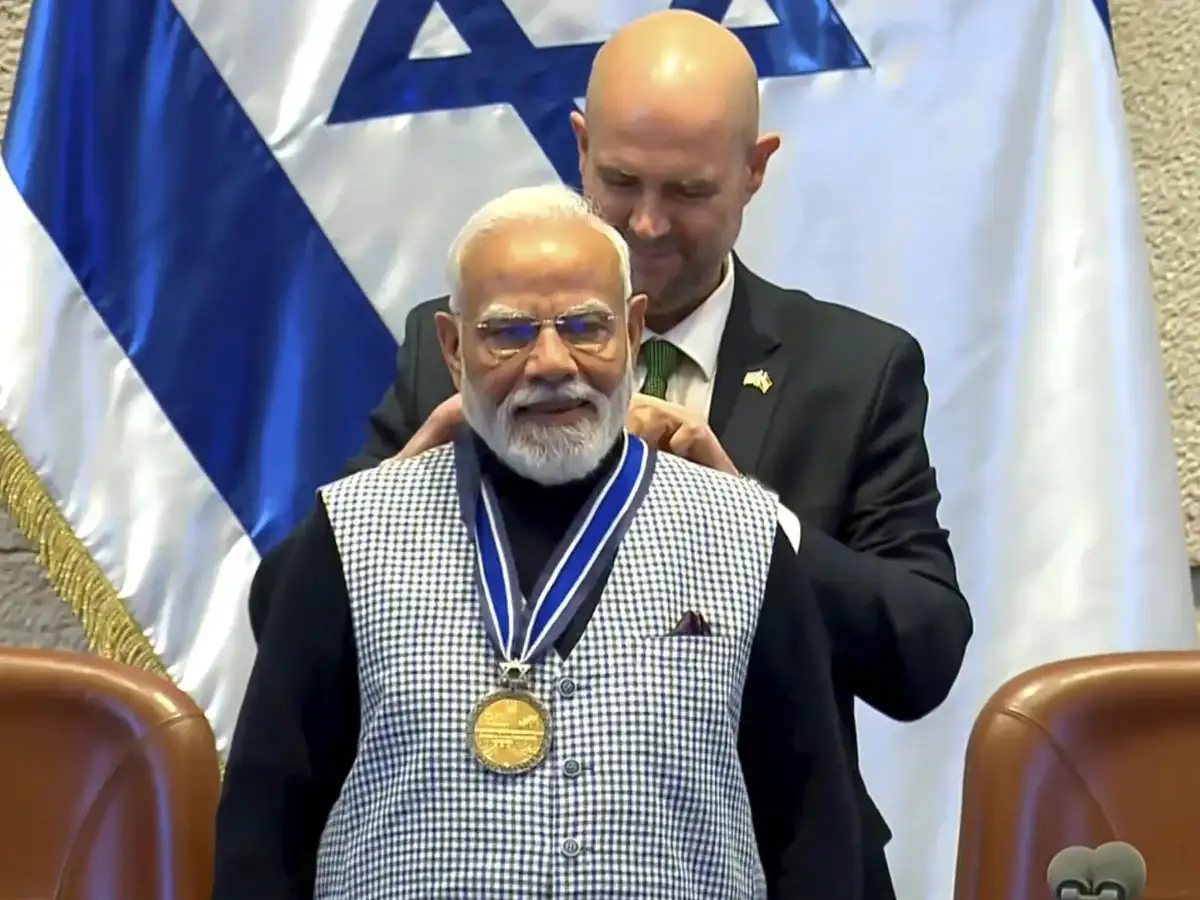
As Prime Minister Narendra Modi undertakes a state visit to Israel—a partnership that has evolved into one of the most dynamic strategic relationships of the contemporary era—it is worth pausing to remember a lesser-known Bhartiya figure who embodied an earlier civilisational bridge between the Malabar coast and Jerusalem: Abraham Barak Salem. Long before defence agreements, technology partnerships and diplomatic symbolism defined India-Israel ties, Salem’s life reflected a deeper human and cultural connection that unfolded quietly within the historic Jewish community of Kochi.
History often celebrates dramatic revolutions—wars against empires, struggles against colonial power, or mass political upheavals. Yet some of the most profound transformations begin far from the glare of political spectacle, within communities that appear outwardly harmonious but carry invisible hierarchies. In the layered civilisational landscape of Kerala, one such story emerged not in opposition to a foreign ruler but within an ancient religious society itself. At the centre of this moral struggle stood Abraham Barak Salem (1882-1967)—lawyer, nationalist, reformer and the first voice of resistance from the marginalised Brown Jewish community of Kochi, whose quiet satyagraha reshaped the social fabric of Kerala’s Jews.
Salem’s life was a testament to the courage required to confront injustice when it is defended in the name of tradition. His struggle was not against the colonial state but against inherited hierarchies sustained by custom, ritual and social memory.
A CHILD OF AN ANCIENT DIASPORA
Abraham Barak Salem was born in 1882 in the Kingdom of Cochin, a princely state within British-colonised Bharat. Raised primarily by his mother, he grew up in one of the world’s oldest Jewish diasporas—the Jewish community of Kerala, whose presence along the Malabar coast stretches back centuries. Scholars such as Nathan Katz have highlighted that the Jews of Kerala were never a single uniform community but rather a complex mosaic shaped by successive waves of migration, cultural exchange and local adaptation.
The earliest Jewish settlers, known as the Malabari Jews, are believed to have arrived in Kodungallur after the destruction of the Second Temple in Jerusalem. Over time they absorbed elements of local culture while maintaining distinct religious practices. A later wave arrived in the sixteenth century following the expulsion of Jews from Spain and Portugal; these Sephardic migrants came to be known as the Paradesi Jews, a term which now means “outsiders” in Malayalam and Tamil. Alongside them existed another group—the meshuchrarim, or Brown Jews—a term that sometimes carried neutral meaning but was often used pejoratively to denote emancipated slaves or their descendants. Salem’s family belonged to this marginalised community.
Nathan Katz notes that over centuries these distinctions hardened into a rigid internal hierarchy. Differences in lineage and ritual practice gradually became associated with skin colour, reflecting the wider hierarchical social ethos of the period, where caste-like distinctions influenced communities across religious boundaries in Bhartiya Upmahadwip (Indian Subcontinent). Although united by faith, the Jewish community of Kochi developed a layered structure where status influenced marriage, worship and social interaction.
EDUCATION AS SOCIAL DEFIANCE
Salem’s early life reflected a quiet but powerful defiance of these social boundaries. He studied at Maharaja’s College in Ernakulam before moving to Madras (now Chennai), where he earned a Bachelor of Arts degree—becoming the first university graduate among the meshuchrarim. In an era when access to higher education was itself a form of privilege, Salem’s academic journey marked a significant break from inherited limitations. He continued his studies in Madras, obtaining a law degree and becoming the first Jew from Cochin to qualify as an attorney.
When Salem returned to Kochi and began practising at the Cochin Chief Court in Ernakulam, he carried not only legal training but also a new sense of social responsibility. Education had exposed him to broader political ideas and reformist thought, preparing him for a struggle that would eventually redefine the internal dynamics of his community.
A SYNAGOGUE DIVIDED BY CUSTOM
The focal point of discrimination was the Paradesi Synagogue in Mattancherry, an architectural jewel built with the patronage of the Maharaja of Cochin. Outwardly, it symbolised continuity and prosperity; inwardly, it reflected entrenched hierarchies. Members of the meshuchrarim were not treated as equals within the sacred space. They were assigned segregated seating during prayers and were denied the same level of participation in Jewish religious rituals. Social exclusion extended beyond worship, influencing marriage patterns, everyday interactions and even burial practices.
Nathan Katz’s research provides important historical insight into how these divisions were formalised. In Kashrut, Caste and Kabbalah, Katz and Ellen Goldberg record a synagogue entry from 1757 illustrating how lineage determined status: if a Jewish man married a woman from the Black Jewish community, the children’s standing would follow that of the mother, and the man himself would remain physically separated within the congregation. Such records reveal that discrimination was not merely informal prejudice but had become institutionalised within religious practice.
Over time, these distinctions became deeply intertwined with ritual perception. Cultural differences between Paradesi and Malabari Jews hardened into visible markers of hierarchy, creating an environment where inherited status shaped everyday religious life. Jewish scholars outside Kochi criticised these practices from as early as the sixteenth century, yet change remained elusive until Salem emerged as a reformer.
THE EMERGENCE OF THE “JEWISH GANDHI”
Salem’s transformation from lawyer to social reformer accelerated after he attended the Lahore session of the Indian National Congress in 1929. The atmosphere of nationalist awakening and Mahatma Gandhi’s call for satyagraha profoundly influenced him. He returned to Kochi determined to confront discrimination not through confrontation or violence but through moral resistance rooted in non-violence.
Salem initiated a sit-in within the Paradesi Synagogue. He deliberately placed his sons in areas from which Brown Jews had historically been barred, challenging centuries-old customs through symbolic acts. On several occasions he and his supporters reportedly sat on the path leading to the Torah scrolls, refusing to move and thereby exposing the contradiction between sacred scripture and social exclusion.
Edna Fernandes describes how Salem’s protests unsettled the community but rarely provoked open hostility. His stature as an advocate and his connections with prominent nationalist leaders such as Jawaharlal Nehru and Mahatma Gandhi lent legitimacy to his cause. Nathan Katz’s scholarship suggests that Salem’s strategy succeeded because it framed reform not as rebellion against religion but as a restoration of ethical principles within it. Gradually, younger members of the Paradesi Jewish community began supporting his efforts, and by the late 1930s many discriminatory practices within the synagogue had disappeared.
A NATIONALIST VOICE BEYOND THE SYNAGOGUE
Salem’s public life extended far beyond religious reform. He served in the Legislative Council of Cochin during two separate periods and actively supported the nascent trade union movement in Kerala. His legal practice often focused on representing labourers and the economically marginalised, reflecting his broader commitment to social justice.
Participation in the freedom movement deepened his engagement with Bhartiya nationalism. By attending the Lahore Congress session that declared the demand for complete independence, Salem aligned himself with a larger struggle that transcended community boundaries.
ZIONISM, MIGRATION AND GLOBAL NETWORKS
While rooted in Kochi, Salem also engaged with global Jewish politics. A visit to Palestine in 1933 drew him towards the Zionist movement, and after independence he played an important role in facilitating migration of Cochin Jews to Israel. His efforts included negotiating with Israeli authorities and encouraging members of the community to consider a new path towards opportunity.
Nathan Katz observes that migration ultimately dissolved many of the internal hierarchies that had shaped Jewish life in Kerala. Once in Israel, distinctions between Paradesi, Malabari and Brown Jews became less meaningful, as all were perceived as newcomers navigating a new society. Ironically, the divisions that had persisted for centuries in Kochi lost relevance in a different geopolitical context.
Despite his involvement in these global networks, Salem himself chose to remain in Kochi. His decision reflected a deep emotional attachment to the land and culture that had shaped him.
A PUBLIC INTELLECTUAL AND CHRONICER
Salem’s intellectual legacy extended beyond activism. In 1929 he authored The Eternal Light, an English-language work examining the architecture and customs of the Paradesi Synagogue. Through Biblical references and subtle commentary, he alluded to the discrimination faced by Brown Jews without overt confrontation. He was also a prolific diarist, leaving behind twenty-one volumes of personal writings now preserved in international archives.
His house in Jew Town became a space for dialogue and discussion. Outside his residence he created what locals called “Salem’s looking glass,” where newspaper clippings were displayed to encourage debate among passersby. This initiative reflected his belief that reform required conversation and awareness rather than silence.
PERSONAL BRIDGES ACROSS DIVIDES
Salem’s personal life mirrored the social changes he championed. Two of his sons married into the White Jewish community, helping to formalise relations between previously segregated groups. His children pursued professional careers across the world, embodying the new possibilities opened by education and social reform. Though the family received documents enabling migration to Israel, Salem ultimately chose to remain in Kerala, emphasising his enduring connection to the place where his struggle had begun.
THE LEGACY OF A QUIET REVOLUTIONARY
Today, as Bhartiya diplomacy reaches new heights through high-level engagements like Prime Minister Modi’s visit to Israel, Salem’s legacy reminds us that the relationship between Bharat and the Jewish world did not begin in conference rooms or strategic agreements. It was nurtured over centuries through shared histories, migration, faith and the lived experiences of communities along the Malabar coast. While modern diplomacy speaks the language of geopolitics, Salem’s life tells a more intimate story — one of ethical reform, civilisational dialogue and the courage to confront injustice within one’s own tradition. Abraham Barak Salem passed away in 1967, buried in the very cemetery from which his ancestors had once been excluded — a quiet but powerful symbol of change. Remembered as the “Jewish Gandhi,” he represents a chapter of Bhartiya history where reform did not arise from confrontation with the state but from moral conviction rooted in community life. As contemporary India strengthens its ties with Israel on the global stage, Salem’s story offers a reminder that the deepest connections between societies are often forged not through alliances alone, but through individuals who bridge cultures, challenge prejudice and leave behind a legacy of dignity that transcends time.
Siddhartha Dave is an alumnus of United Nations University, Tokyo, an eminent columnist and a former Lok Sabha Research Fellow. He writes on Foreign Affairs and National Security.