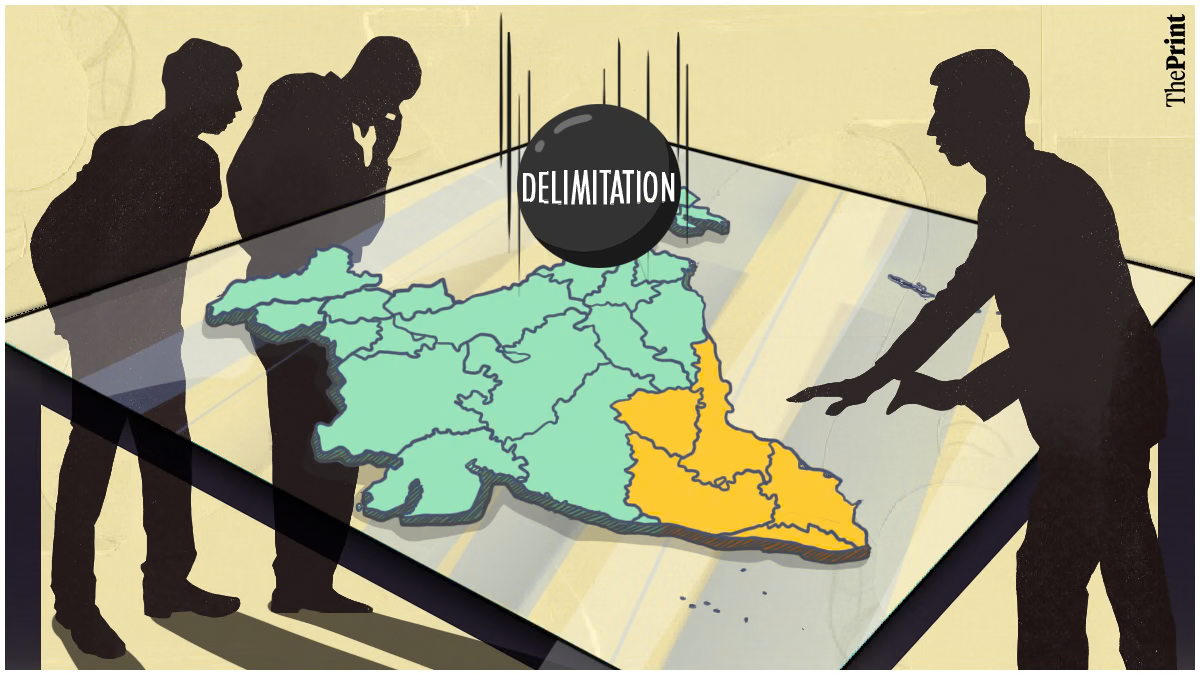
As India approaches the 2026 threshold, this year, the half-century-long freeze on seat allocation is set to expire. While the new 888-seat Lok Sabha chamber in New Delhi is ready, the political struggle to fill those seats will be crucial for India’s future.
The nation faces a paradox between democracy and federalism. This impending delimitation process isn’t just about boundary correction; it’s a true litmus test for the very foundation of our constitution’s basic structure, particularly its balance between democracy and federalism. The soul of our democracy, the principle of fair representation, is under threat.
MECHANISM OF REPRESENTATION
Delimitation is the process of redrawing parliamentary and assembly constituency boundaries. This process reflects population changes to ensure fair representation in light of demographic shifts. It also determines the number of reserved seats for SC/STs and, as per the Constitution, must occur after each census.
Article 82 of the Constitution of India gives power to the Parliament for the readjustment of Parliamentary constituencies after each census—similarly, Article 170 talks about the readjustment of the constituencies of the State Assembly. Read alongside, Articles 330 to 332 deal with the reservation of seats for Scheduled Castes and Scheduled Tribes in the Lok Sabha and the State’s Assembly, respectively.
The process of delimitation is done by a delimitation commission that’s set up under an Act of Parliament. The reason this delimitation is done is to ensure that, as the population grows, the number of constituencies also grows. Essentially, the population number dictates the number of seats in each state.
POLITICAL MAP FROZEN IN TIME
So far, India has experienced four delimitation processes: 1952, 1963, 1973, and 2002. Based on the 1951, 1961, 1971, and 2001 censuses. The first delimitation was done in 1951 when the population was 361 million, and the seats in the Lok Sabha were 494. In 1961, the population had risen to 439 million, and the seats had risen to 522. In 1971, when the population was 548 million, the seats had risen to 543.
A freeze on delimitation was initially introduced during the Emergency in 1976. The Atal Bihari Vajpayee government extended this freeze for another 25 years via the 84th Amendment Act in 2001 to promote population control.
THE DEMOGRAPHIC TAX
Following the delimitation exercise, each state’s number of seats will be determined by its Base Average Population. For instance, during the 1977 Lok Sabha, each MP in India represented an average of 10.11 lakh population. The same base average population can’t be put in today’s time because if the base average is kept at 10.11 lakh, then Lok Sabha seats have to increase to 1400.
If the Average Base Population is set at 2 million, the Lok Sabha would have 707 seats. Such a shift would heavily favour the northern states, while the southern states would probably see their representation decrease.
Consider the Hindi heartland, which comprises northern Indian states like Uttar Pradesh, Bihar, Madhya Pradesh, and Rajasthan. The number of seats allocated is 80, 40, 29, and 25, respectively. This would increase Uttar Pradesh’s seats to 122, Bihar’s to 66, Madhya Pradesh’s to 45, and Rajasthan’s to 42. Conversely, in the southern states, Tamil Nadu would retain the same number of seats despite a 50-year population increase. Kerala, however, would lose two seats, highlighting the concern among southern states about their declining share of the Lok Sabha.
MAJORITARIAN FAULT LINE
The current system breaches the principle of one person, one vote, one value. In Uttar Pradesh, one MP represents nearly 3 million people, far exceeding the 1.9 million people represented by a single MP in Tamil Nadu. This effectively dilutes the voting power of individual citizens in populous states.
The delimitation process, which adjusts Lok Sabha seats based on population data, creates a paradox. Southern states that have successfully implemented population control policies lose political influence compared to northern states experiencing higher growth.
In S.R. Bommai vs Union of India (1994), the Supreme Court affirmed that federalism is a part of the Constitution’s basic structure. States are not mere administrative units but possess an independent constitutional identity. This democratic shift violates the basic structure of federalism by potentially creating a permanent regional majority, alienating states that contribute disproportionately to India’s GDP.
This would lead towards the possibility of a permanent northern hegemony leading the South without a meaningful safeguard, threatening the basic structure of federalism. The Constitution must protect the minority (southern states) from the constitutional possibility of being silenced by the majority (northern states).
LEGAL PARADOX
Outcomes affecting the federal balance may invite intervention from the judiciary. However, Article 329(a) of the Constitution of India bars any court from questioning the validity of laws related to the delimitation of constituencies.
However, a paradox emerged from the Supreme Court’s judgment in Meghraj Kothari vs. Delimitation Commission (1966). The Supreme Court ruled that judicial interference is limited only to avoid unnecessary delays in the election process, but this does not impose an absolute bar on the constitutional court’s power to review orders.
This position was clarified further in the case of Kishorchandra Chhanganlal Rathod vs. Union of India (2020), where the court held that constitutional courts have the authority to review orders if they are manifestly arbitrary and incompatible with constitutional values.
LESSONS FROM ABROAD
India needs to develop a fiscal and delimitation framework that upholds the democratic principle of “One man, One vote” while avoiding penalties for progressive demographic trends. Achieving a balance between population equity and regional fairness demands a transparent, evidence-based approach grounded in global best practices and constitutional values.
For instance, the European Union Parliament employs the principle of Degressive proportionality, ensuring that while larger states get more seats overall, smaller states receive more representation per capita, ensuring smaller states’ representation isn’t overshadowed by larger ones.
In contrast, the United States (House of Representatives) uses a Redistributive method based on equal proportions. Since 1913, the number of representatives has been capped at 435 despite a population surge from 94 million in 1911 to 334 million in 2023. Rather than increasing seats, the U.S. redistributes the same number among states using the equal proportion method.
It is understandable to question the significance of representing one million people versus two million or even 50,000. Therefore, refining delimitation criteria is crucial. Government policies promoting population control and family planning should be encouraged for all citizens. If the Indian government has successfully implemented family planning or population welfare measures in certain states, it raises concerns about using these criteria against those states.
THE VAJPAYEE DOCTRINE
The concern lies in North India getting more seats and greater representation. Delimitation is seen as a clear advantage for the BJP, which enjoys strong support in North India. It’s not just the regional parties in the South who fear that a northern seat surge will make their hard-won southern influence irrelevant at the centre, but also Congress fears the negative impact on its electoral prospects. The Congress has struggled in the Hindi heartland in the 2024 elections it has 99 seats in the Lok Sabha, of which 42 alone came from southern states.
However, such an exercise must transcend political considerations. As Atal Bihari Vajpayee famously stated in his 1996 address to the Lok Sabha: “Governments will come and fall; parties will be created and dissolved, but this country and its democracy must survive.” Therefore, the Union government must now develop a model acceptable to all stakeholders, ensuring none feels that it has lost the Union because of its success. While politicians and parties are transient entities, the Constitution must be upheld in full force to safeguard the “Basic Structure” of federalism. As Alexander Hamilton wrote in Federalist No. 89: “The constitutional possibility of misuse is itself an unanswerable objection.” We must ensure the 2026 deadline doesn’t foster division but reaffirms our shared commitment to democracy.
The author is a third-year law student pursuing an integrated LL.B. from the Faculty of Law at the University of Lucknow. His previous legal commentary has been published on platforms such as Legal Service India and In The Daily Guardian.