
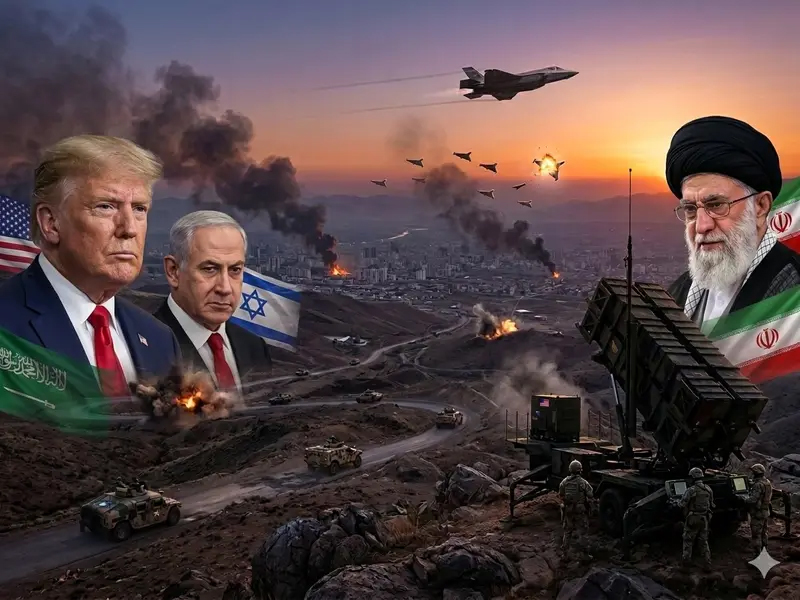
When a school, a child milk powder factory, a city health facility or a temple next to a military installation gets damaged or decimated then the loss to the civilian life and property is referred to as, grave “Collateral Damage”. Its an accompanied to combat and war that intermittent swathes of civilian habitations bear the brunt of the war, as witnessed in conflict hot spots of the order of the besieged Gaza strip or the Hezbollah in Lebanon or the civilian sections in Tehran in the ongoing conflagration between US and Iran. But, the manner in which the non-combatants get directly caught in military action of the order of aerial bombing, missile strikes and Drone maneuvers or artillery shelling is a phenomenon which has accompanied the nature of, “Warre”.
IHL (International Humanitarian Law) does not restrain the warring sides from causing and inflicting collateral damage to each other’s civilian segments, but, it does strive to regulate the losses inflicted on the non-combatant populations. It is also mentioned in the international law statutes that the carnage done to the civilian nodes need not be “clearly excessive” in relation to the expected military advantage accruing to a nation in the aftermath of the military move. In the context of the “Warre” in the Ukraine war and the Hamas-Israel strife in Gaza, the conceptualization of collateral damage has once again come to attain the academic and Media centerstage in the realm of Global politics. It has been observed historically that human shields are often utilized in the course of a conflict where in one may zero-in upon the scenarios adopted by the non-state actors such as the militants in Kashmir in India and Hamas in Gaza. It is a well documented fact that fact that the Hamas denomination in the besieged Gaza strip often hides and stores its missiles, hand held weapons and other lethal “ammo” in the hospitals and health facilities and thus when the enemy missile or bomb destroys their ammo and warring equipment storage then it causes considerable damage to the main building of the hospital or the designated health facility thus attracting the blame of harming civilians during the course of a military onslaught.
Similarly, who can forget the utility of sliding door vans as they were cannily utilized by the militants in Kashmir when they had to pepper population centers with bullets in order to enforce the writ of the “Unjust and Inhuman” to lead to nefarious political messaging and communication. Distinctions, precautions and proportionality are the three checks in the parlance of International Law which reflect the century old human concern over the vivid and myriad instances to gory Collateral damage. There have been commendable codifications in relation to Collateral damage where in order to restrain the state and the non-state actors to inflict carnage at the doorsteps of homesteads.
Tracing the theme and the tenet of, “Collateral Damage” to the times of western philosophy in the era of thinkers such as Thomas Aquinas. The dictum is called as, “DOD” or the Doctrine of Double Effect” which postulates that if the military objective of a nation is imbued with a “Just and moral cause” then an iota of decimation to the innocent bystander can be tolerated in a restrained manner but since time immemorial just war as the causes belli has been utilized by the state actors as a fall back rationale and logic in order to justify “killings and bystander maiming”. No strike lists and the Rules of engagement (ROE) also serve as checks on the militaries and the resultant Force Majeure in order to mitigate and manage civilian casualties as part of the, “had consequences” of war.
The Geneva conventions propound that there need not be any hostage taking and there ought to be no belittlement of human dignity, causing humiliation and mutilation to a non-armed combatant. The passing of sentences and basing of executions without looking at judicial precedent is too codified in the Geneva conventions. Concerning the Gaza conflict, its implied that forces should facilitate the hospitals and health facilities with “Taboo” certificates so that no harm comes to the occupants during the course of the conflict. As the storage of weaponry and ammo in such no zones makes these hospitals and other related human congregations deprived of the protection by law in accordance with the Additional Protocol of the Geneva conventions. The theme of humanitarian corridors too became a bone of contention in the light of the politicking involved in providing humanitarian aid, and service to the old personages and informs, women and children which finds a clearly delineated mention in article 17 in the Geneva conventions.
In the Indian sense too, if one explores the conceptualization of Righteous war that is, Dharma Yuddha too then regulations are in place as far as civilian decimation is concerned. Pravritti and Nivritti are the key themes which position themselves as Indic standpoints which propound the rationale of the Puranas in the context of Just war and the attendant Just cause. One stand out theme happens to be a deft mention in the Puranas that inside the rubric of Just war, only chariots should engage chariots, Elephants need only clash with other, and foot soldiers and the cavalry need only confront and engage their co-equals in the battlefield. Then comes the theme of granting pardon to the non-combatants, where-in, non-weapon-wielders need to be allowed to go Scott free, untouched and unmaimed. All in all, the Sanskrit Epics focus upon the entry of the divine into the prosaic during wartime along with a stress on instances such as Yudhistir violently fighting for Just causes and how Arjun the royal gladiator prince, had to be coaxed and cajoled into the battle to decimate his own kith and kin in the name of a moral causus belli. Thus, apart from the western theology of Juyat War, several other prominent traditions let it in the Indic epoch too which lay down telling blows to the dictum of, “Everything is fair in love and war” as the all moaning Alauddin Khilji declares to the Maharawal Ratan Singh of Chittor in the aftermath of a treacherously conducted fencing in the tracts of a besieged Mewar.
The dictum is called as, “DOD” or the Doctrine of Double Effect” which postulates that if the military objective of a nation is imbued with a “Just and moral cause” then an iota of decimation to the innocent bystander can be tolerated in a restrained manner but since time immemorial just war as the causes belli has been utilized by the state actors as a fall back rationale and logic in order to justify “killings and bystander maiming”.
Dr. Manan Dwivedi, Faculty, International Relations and International Organizations, IIPA