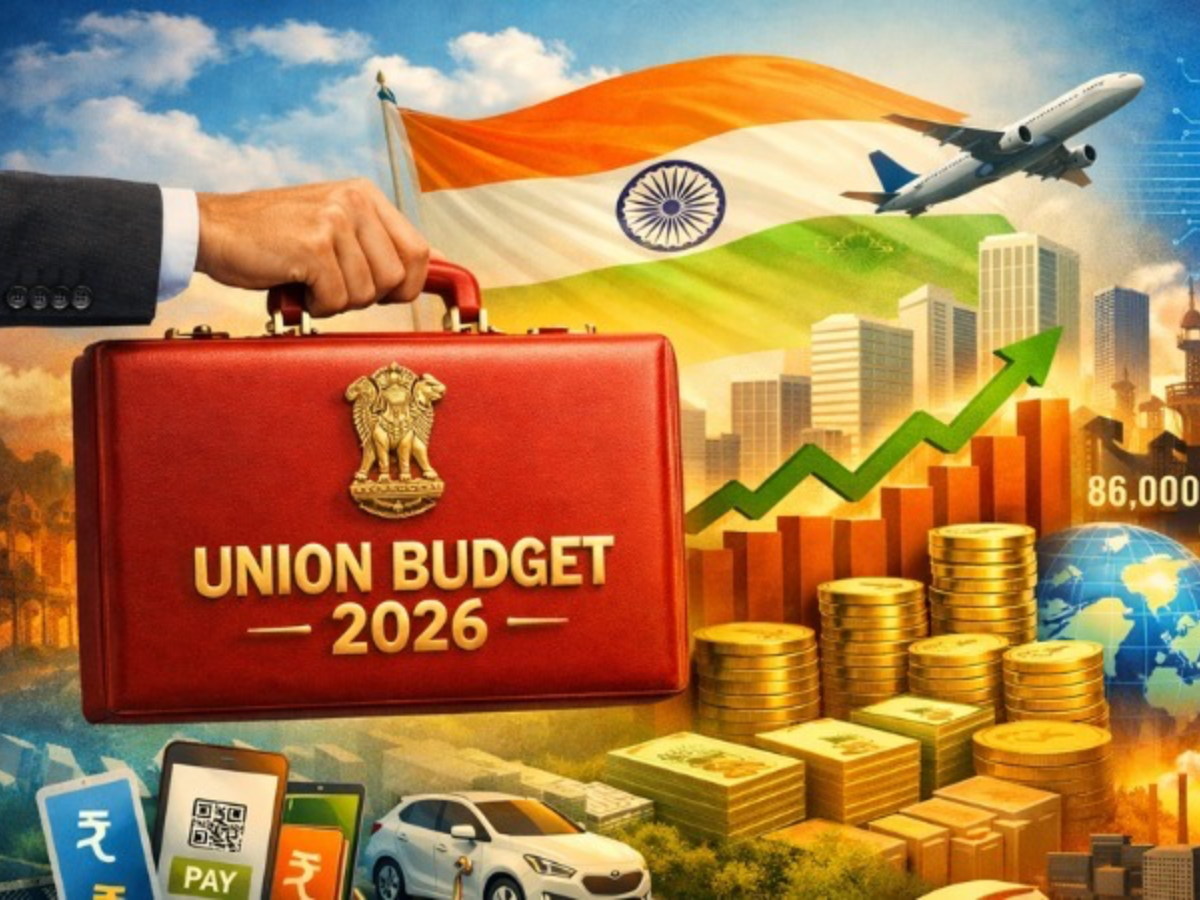
India’s Union Budget for 2026-27 is notable less for what it promises than for what it refuses to assume. There is no inflationary gamble, no fiscal bravado, and no attempt to conjure growth through easy nominal arithmetic. Instead, the Budget accepts a harder truth: India is entering a phase where trend growth must be sustained without help from inflation, limited external demand, or fiscal excess.
The headline assumption makes this explicit. Nominal GDP growth for FY27 is projected at 10 per cent. Real growth, as laid out in the Economic Survey, is expected to lie between 6.8 and 7.2 per cent. The implied GDP deflator, at roughly 2.8 per cent, is modest by historical standards. After a year in which nominal growth lagged real expansion, the Budget does not assume a sharp price rebound to rescue revenues or ease consolidation.
This matters because much of fiscal management in the past decade has relied on inflation to do the heavy lifting. Higher deflators inflate tax bases, compress debt ratios, and make deficits appear manageable. Budget 2026 declines that route. The arithmetic here works only if growth is real, tax compliance continues to improve, and spending discipline holds.
The tax projections reveal where the confidence lies. With nominal GDP growing at 10 per cent, tax revenues are assumed to grow faster, supported by a buoyancy of 1.14. Direct taxes are projected to rise by 11.4 per cent, while indirect taxes are expected to recover on the back of base normalisation and rate rationalisation. The strategy around both direct and direct tax rationalisation over the last year is to nudge towards formalisation, better compliance, and structural reforms will continue to push tax growth ahead of the economy.
That logic also explains the government’s approach to customs duties. Reductions on electronics components, critical minerals, and other intermediates are not treated as revenue foregone in the conventional sense. The stated intent is to raise trade volumes, deepen integration into global value chains, and generate revenue through scale rather than rates. It is a shift away from tariff protection as a fiscal instrument toward trade as a tax base.
On the fiscal side, the consolidation path is deliberately smooth. The fiscal deficit is budgeted at 4.3 per cent of GDP, down marginally from 4.4 per cent in the previous year. Critics looking for sharper adjustment will be disappointed. But the restraint is intentional. The finance minister has been explicit in rejecting front-loaded consolidation, arguing that abrupt fiscal tightening risks destabilising growth in an environment already marked by external uncertainty and weak nominal momentum.
The deeper anchor, however, is no longer the deficit itself but the debt ratio. Debt-to-GDP is projected to decline from 56.1 per cent to 55.6 per cent in FY27, keeping India on track toward the medium-term objective of 50 per cent by the end of the decade. The deficit is now explicitly framed as an operational instrument, not the ultimate goal. This is a quiet but important evolution in India’s fiscal framework. Credibility is being sought through steady debt reduction, not through headline deficit theatrics.
Public capital expenditure reinforces this strategy. Effective capex is maintained at around 4.4 per cent of GDP, slightly above the fiscal deficit itself. This means that government borrowing is being fully absorbed by asset creation, while revenue expenditure is largely tax-financed. There is no attempt to engineer a consumption boom through fiscal stimulus. Growth is expected to come from balance-sheet repair, infrastructure-led crowd-in, and private credit revival.
The macro-stance is therefore internally consistent, if demanding. Trend real growth of around 7 per cent is assumed, not exceeded. Inflation is expected to remain contained, not opportunistically elevated. Fiscal consolidation proceeds gradually, not dramatically. And revenue growth relies on institutional improvements rather than macro-tailwinds.
The risk, of course, lies in nominal fragility. With deflators low and external conditions volatile (trade fragmentation, capital-flow sensitivity, and geopolitical shocks) the margin for error is thin. Any disappointment in real growth or tax buoyancy would quickly tighten the fiscal envelope. But the Budget’s answer to that risk is not pre-emptive stimulus; it is credibility and predictability.
In that sense, Budget 2026 is less a growth-maximising document than a stabilising one. It accepts that India’s binding constraint today is not ambition but arithmetic. The economy can grow at 7 per cent, but only if institutions, compliance, and capital formation do their work. Inflation will not be asked to paper over gaps. Nor will the fiscal account be stretched to manufacture momentum.
What is equally striking about Budget 2026 is what it leaves unsaid. There is no explicit discussion of contingency planning if nominal growth undershoots the 10 per cent assumption, despite last year’s experience of weak deflators.
There is no articulated framework for managing capital-flow volatility in a world of geopolitically driven reallocations, beyond a general appeal to stability. Nor does the Budget engage with the growing divergence between Centre and State fiscal capacities, even as much of the expected growth strategy relies on sub-national execution. Finally, while innovation, manufacturing depth, and services exports are repeatedly invoked, there is little discussion of firm-level productivity, private R&D intensity, or regulatory risks as binding constraints on medium-term growth.
This is a conservative Budget in the classical sense—cautious in assumptions, disciplined in spending, and explicit about trade-offs. It may not excite markets looking for surprise or voters hoping for largesse. But in a world where nominal growth is no longer guaranteed and external buffers are being tested, it reflects a strategic choice. India is choosing to grow without the crutch of inflation, and to see whether credibility itself can become a source of resilience.