As I sip my filter coffee, I sit anxiously wondering: how will OpenAI reshape India’s growth story?
I often recall Swami Vivekananda’s immortal call, which rings truer than ever: “Arise, awake, and stop not till the goal is reached.”
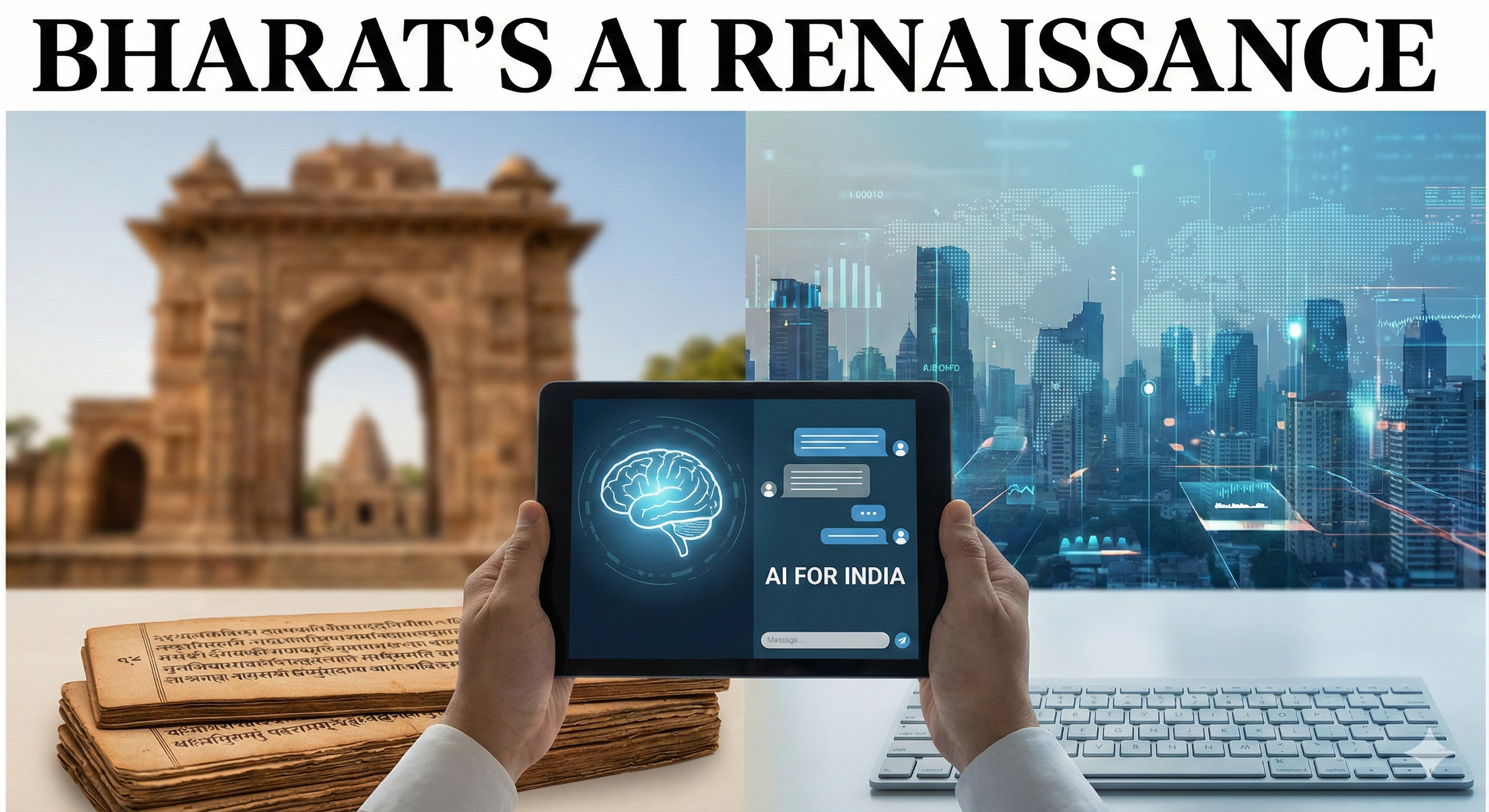
India’s growth story has always been defined by its ability to leapfrog limitations—from Green Revolutions to self-sufficiency to the digital payments revolution powered by UPI. In 2026, a new chapter is unfolding: the AI era, with OpenAI at its forefront. With 100 million weekly active ChatGPT users—making India OpenAI’s second-largest market after the United States—the company is not merely a visitor but a co-architect of Bharat’s next phase of growth.
The milestones are striking. OpenAI opened its New Delhi office in August 2025, introduced a sub-$5 ChatGPT Go tier tailored for price-sensitive users, and later made it free for a full year for millions of Indians. Sam Altman, speaking ahead of the India AI Impact Summit 2026, highlighted how Indian students form the world’s largest user cohort on the platform. These moves have democratised frontier AI at a scale unmatched elsewhere.
The reshaping is already visible across sectors. In education, AI-powered tutors deliver personalised learning in 22 Indian languages, helping first-generation learners master concepts at their own pace. This directly realises Vivekananda’s vision: What better tool than AI to awaken the infinite potential latent in every young Indian?
In healthcare, OpenAI-backed models assist in early disease detection and rural telemedicine, significantly reducing diagnostic costs. In agriculture, AI tools analyse satellite imagery and soil data to guide smallholders on optimal sowing, irrigation and pest control—potentially lifting yields by 15-20 percent and raising incomes for 140 million farm families.
The IT-BPM sector, currently worth $283 billion and a cornerstone of India’s services exports, is evolving from code maintenance to AI innovation. While routine call-centre roles face pressure, new opportunities in prompt engineering, AI ethics, data curation and domain-specific model fine-tuning are expanding rapidly. PwC projects that AI could add $350 billion to India’s economy by 2035 across agriculture, education, healthcare, energy and manufacturing. The IndiaAI Mission, with its Rs 10,371 crore outlay, complements this by building sovereign compute capacity and supporting thousands of AI start-ups.
OpenAI’s enterprise partnerships—from Zomato’s supply-chain optimisation to industry solutions developed with Infosys and Anthropic—show how global frontier models are being adapted to Indian realities. The result is higher productivity, greater formalisation of the informal economy, and faster progress towards the $5 trillion GDP target.
Challenges remain. Digital divides, data privacy concerns, ethical guardrails and large-scale skilling needs cannot be ignored. Yet India’s application-led approach—focusing on solving real problems in vernacular languages for the bottom of the pyramid—is pragmatic. By doing so, India is pioneering truly democratic AI.
As the world watches the India AI Impact Summit 2026, one truth is clear: OpenAI is not replacing India’s growth engine—it is strengthening it. The same demographic dividend that powered the services boom is now driving the intelligence boom.
Millions of young Indians, equipped with accessible AI tools, will innovate, create and lead. With OpenAI as a powerful ally, India is not merely awakening—it is accelerating towards its ambition of becoming a global AI superpower by 2047. The growth story is being rewritten, and this time the pen is powered by intelligence itself.
WHAT WILL BE THE CONSEQUENCES FOR INDIA’S DOMESTIC MARKETS?
India’s domestic markets remain the cornerstone of economic resilience in 2026, sustaining growth amid global headwinds such as US tariffs and slowing exports. Private final consumption expenditure accounts for around 61.5 per cent of GDP, reflecting strong household demand supported by low inflation (approximately 1.7-1.8 per cent), rising real incomes from tax relief, steady employment and robust rural recovery driven by favourable monsoons and agricultural output.
This consumption-led model, backed by public capital expenditure of around 3.4 per cent of GDP in infrastructure and green projects, supports GDP growth projections of 6.5-7 per cent for 2026, making India the fastest-growing major economy. Services (contributing roughly 55-60 per cent to GVA) and manufacturing continue to thrive on domestic demand, cushioning external shocks.
OpenAI amplifies this domestic dynamism. With 100 million weekly active ChatGPT users in a price-sensitive market, accessible AI tools enhance productivity in education, healthcare, agriculture and small businesses. Vernacular AI tutors and advisory platforms improve skills and incomes, stimulating local consumption. Enterprise-level AI adoption—including supply-chain optimisation—formalises informal sectors, increasing efficiency and demand.
As exports face uncertainty, AI democratises innovation within India, reinforcing the twin engines of consumption and investment. It unlocks potential across millions, fuelling inclusive domestic growth towards a self-reliant and prosperous Bharat.
WILL IT AFFECT JOBS IN INDIA?
AI will reshape jobs in India, but not eliminate them on a mass scale. A recent ICRIER-OpenAI study (2026) indicates no large-scale layoffs in the IT sector. Instead, AI is enhancing productivity, redefining roles, easing entry-level hiring and sustaining mid- and senior-level positions.
Routine tasks, including basic coding and call-centre operations, may face pressure. However, new roles are emerging in prompt engineering, AI ethics, data curation and sector-specific AI applications. PwC estimates that AI could add between $350-607 billion to the economy by 2035, generating millions of jobs across agriculture, healthcare, education and manufacturing through improved efficiency and innovation.
Challenges remain in bridging skill gaps and managing displacement in vulnerable segments. Yet widespread domestic adoption suggests AI will augment human potential rather than replace it, strengthening the labour market over time.
WHAT ARE THE GEOPOLITICAL RAMIFICATIONS FOR BHARAT WITH OPENAI?
OpenAI’s deep integration into Bharat reshapes its geopolitical standing. As OpenAI’s second-largest market and host of Sam Altman at the India AI Impact Summit 2026, India strengthens its strategic technology partnership with the United States, reinforcing a democratic AI ecosystem distinct from China’s state-led model.
This positions Bharat as a credible “third way”—sovereign yet open, people-centric and strategically non-aligned. Investments in data centres and cloud infrastructure, aligned with the IndiaAI Mission, enhance compute sovereignty while expanding India’s soft power through vernacular AI applications in education, agriculture and healthcare.
However, reliance on American frontier models raises legitimate debates around data sovereignty and potential vendor lock-in. Overall, OpenAI’s presence accelerates Bharat’s emergence as a trusted AI hub, strengthens partnerships such as the Quad, and enables it to navigate the evolving China-US technological rivalry with greater confidence. Under the leadership of Narendra Modi, India has taken a significant step in shaping its AI future. By inaugurating the India AI Impact Summit 2026 in New Delhi and hosting Sam Altman alongside global technology leaders, the Prime Minister positioned Bharat as a key AI hub for the Global South.
Backed by the IndiaAI Mission, this initiative has accelerated OpenAI’s local presence, expanded affordable ChatGPT access and fostered investments in human-centric AI for inclusive growth.