
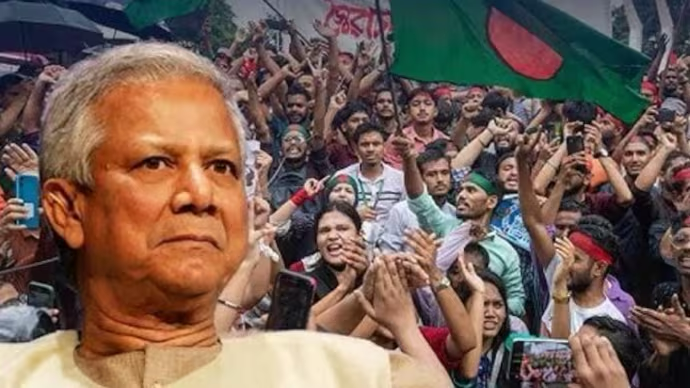
As Bangladesh moves toward its parliamentary election on 12 February 2026, the country finds itself at a defining political juncture. This Jatiyo Shangsad election will be the first national election since the dramatic mass uprising of mid-2024 that brought an abrupt end to the long rule of former PM Sheikh Hasina. More than a routine democratic exercise, the February poll is widely viewed as a roadmap for the future direction of the Bangladeshi state—its institutions, constitutional framework, and its capacity to reconcile justice with inclusion after a turbulent transition.
The election is being organised under an interim caretaker administration led by the Nobel laureate Dr. Muhammad Yunus, who assumed office after the collapse of the previous government. Tasked with restoring order and steering the country back to democratic rule, Yunus has promised a fundamental political “reset”. Central to this effort is the decision to pair the general election with a nationwide constitutional referendum based on the July Charter, a sweeping reform blueprint negotiated among more than 30 political parties and alliances.
A TRANSITION BORN OUT OF UPHEAVAL
The background to the February vote is inseparable from the events of 2024, when protests initially triggered by the reinstatement of a controversial quota system for public sector jobs escalated into a nationwide mass uprising. Students, opposition parties, and civil society groups converged in unprecedented numbers, and the state’s violent response proved politically fatal for the Hasina government.
The subsequent dissolution of parliament and installation of a caretaker regime marked one of the most dramatic ruptures in Bangladesh’s post-independence political history. Throughout 2025, the interim government struggled to stabilise a deeply polarised polity while laying the groundwork for elections and reforms. In addition, political competition intensified, new actors entered the arena, and unresolved questions about accountability for past abuses loomed large. It is against this backdrop of uncertainty, expectation, and unresolved grievances that Bangladesh approaches the forthcoming February polls.
A RESHAPED ELECTORAL LANDSCAPE
The February 2026 election is unlike any election held by Bangladesh in recent decades. Most notably, it will take place without the participation of the Awami League, which has been barred from contesting the upcoming election due to its alleged role in the 2024 violence. For supporters of the ban, this exclusion represents long-overdue accountability for years of authoritarian governance, while for the critics, it raises troubling questions about political inclusivity and the long-term consequences of sidelining a party with a substantial support base.
This absence has fundamentally reshaped the electoral landscape of the country at present. The principal beneficiary has been the resurgent Bangladesh Nationalist Party (BNP), which has regained momentum following the return of Tarique Rahman after seventeen years in exile and the death of BNP President and former PM Khaleda Zia in December last year. The BNP has framed the February election as an opportunity to “reclaim democracy,” positioning itself as the main national alternative capable of leading a post-Hasina order.
At the same time, Jamaat-e-Islami, banned from elections since 2013, is preparing a strong political comeback. Its re-entry has altered electoral calculations, particularly in alliance politics. Adding to the volatility is the emergence of the National Citizen Party (NCP), formed by leaders of the student protest movement. Despite symbolising generational change, the NCP remains confined to an urban activist base and has been weakened by internal rifts over its proposed alliance with Jamaat.
Beyond party competition, the February election is also significant for its logistical and symbolic innovations. For the first time in Bangladesh’s history, overseas citizens—estimated at nearly 15 million people—will be able to vote through a postal ballot system. Importantly, diaspora voting has the potential to reshape electoral outcomes while reinforcing the idea that migrant workers, whose remittances underpin the economy, are stakeholders in the country’s democratic future.
THE REFERENDUM FACTOR
However, what truly sets the February vote apart is the simultaneous constitutional referendum proposed by the current interim administration. Voters will be asked to decide on proposals that include the creation of a bicameral parliament, reforms to the Election Commission and constitutional bodies, and binding commitments on governance, representation, and checks and balances.
Supporters argue that these measures could finally dismantle the winner-takes-all politics that have repeatedly fuelled authoritarianism and instability in Bangladesh. Critics, however, warn that asking voters to endorse far-reaching constitutional changes amid a highly polarised environment carries risks. Some analysts fear that the process could entrench new forms of exclusion if major constituencies feel marginalised, while others worry that complex institutional reforms are being rushed without sufficient public deliberation. Whether the referendum strengthens democratic legitimacy or deepens divisions will depend heavily on the credibility of the electoral process itself.
HIGH EXPECTATIONS ON FRAGILE GROUND
The stakes surrounding the February election are heightened by Bangladesh’s broader socio-economic context. Inflation remains elevated, placing pressure on household budgets, while labour unrest and factory closures have exposed vulnerabilities in the export-driven economy. Yet there are also signs of cautious optimism. International financial institutions have noted that Bangladesh’s economy has shown resilience despite political turmoil.
At the same time, attacks on ethnic and religious minorities have surged during the transition, raising concerns about law and order and the state’s capacity to protect vulnerable communities. According to the MEA, over 2,900 incidents of violence against minorities have been documented during the tenure of the current interim government. Bangladesh also experienced a series of attacks on its cultural sphere, with music concerts cancelled amid mob vandalism, including during Pahela Baishakh celebrations, while prominent cultural institutions, such as Chhayanaut and Bangladesh Udichi Shilpigosthi, were also targeted.
In another development following the death of Sharif Osman Hadi, a senior leader of Inqilab Mancha, demonstrators vandalised the offices of prominent Bangladeshi newspapers The Daily Star and Prothom Alo—a rare occasion in Bangladesh’s history. These recurring episodes of political violence and targeted attacks have exposed the fragility of the transition.
A DEFINING MOMENT FOR BANGLADESH
Ultimately, the February 2026 election will determine whether the upheaval of 2024 leads to a more accountable, plural, and institutionally resilient political order or whether it ushers in a new cycle of instability and exclusion in the country. Many citizens view the February election as a rare opportunity to reset the rules of the political game and prevent a return to one-party dominance.
A credible, peaceful, and broadly accepted vote could undoubtedly consolidate the interim government’s reform agenda, legitimise constitutional changes, and restore public faith in democratic institutions. A disputed electoral process, by contrast, would threaten to reverse the tentative gains achieved during the transition and weaken trust in democratic institutions. For Bangladesh, February is not merely about choosing a new parliament. It is about deciding whether the promise of people-powered change can be translated into durable democratic renewal, or whether the country remains trapped in its familiar pattern of polarisation and political rupture. The outcome will shape not only the next government, but the trajectory of Bangladeshi democracy for years to come.
Dr. Anchita Borthakur is a Researcher at the Chintan Research Foundation (CRF), New Delhi.