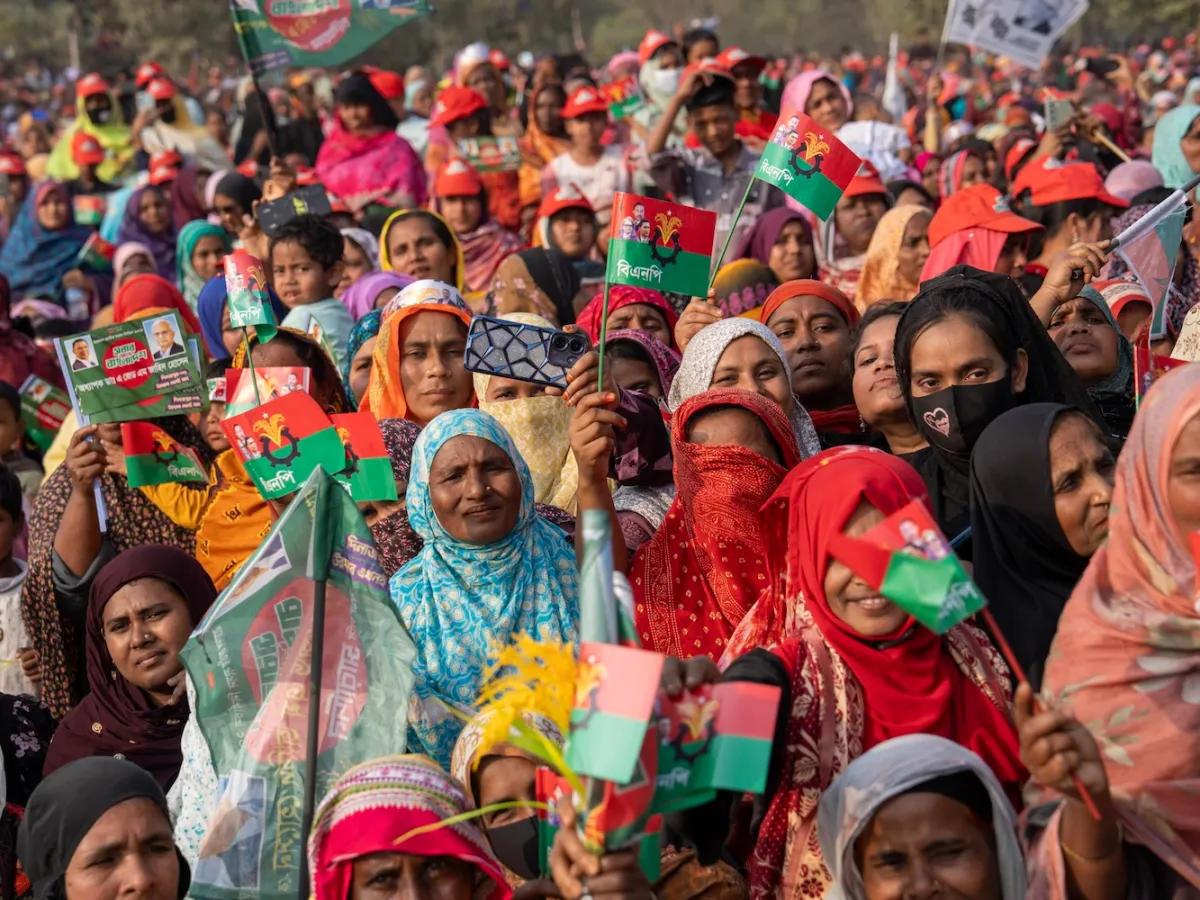
Today, Bangladesh stands at a watershed in its modern political history. Millions of voters have cast their ballots in what is widely described as the first genuinely competitive election in nearly two decades, marking a decisive turn from the entrenched dynastic politics of the past toward a volatile, youthful, and at times hard-edged political landscape.
This election, held amid high hopes and deep anxieties, comes 18 months after the Monsoon Uprising of 2024—a mass protest movement dominated by Generation Z and young voters that toppled long-time Prime Minister Sheikh Hasina and ended the authoritarian grip of her Awami League party. The contest also unfolds against the backdrop of a constitutional referendum on broad institutional reforms, a reflection of the electorate’s demand for systemic change.
THE LEGACY OF DYNASTY AND DISCONTENT
For almost 40 years, Bangladesh’s political narrative was dominated by two towering women figures: Sheikh Hasina Wazed and Khaleda Zia, whose alternating rule shaped the nation’s post-independence trajectory. Today, both legacies are contested. Hasina, once a symbol of liberation and stability, was ousted in 2024 and now lives in exile after being convicted and sentenced to death by a controversial tribunal, a verdict her supporters denounce as politically motivated. Khaleda Zia’s Bangladesh Nationalist Party (BNP) has re-emerged under her son’s leadership after years in the political wilderness.
The Awami League’s exclusion from this election due to its registration being suspended has reshaped the political field, prompting critics to question the inclusivity of the process. A segment of the electorate argues that an election without one of the country’s major parties cannot be fully representative, underscoring the fragile nature of Bangladesh’s democratic rebirth.
GEN Z’S ASCENDANCY AND UNFINISHED REVOLUTION
What sets this year’s poll apart is the unprecedented influence of young voters and first-time participants, often referred to as a Gen Z revolution. Millions of Bangladesh’s young electorate entered the fray driven by aspirations for jobs, governance reforms, and freedoms long suppressed under one-party dominance.
The newly formed National Citizens Party (NCP), born from student leadership and youth activism, has sought to translate street-level momentum into institutional power. Though still organizationally nascent, the party’s presence underscores the shifting generational dynamics in Bangladesh politics.
“This is the first time my vote feels like it could actually count,” said a 20-year-old voter in Bogura, echoing widespread sentiment among young Bangladeshis who once mobilised against perceived authoritarianism and economic stagnation.
POLITICAL FORCES IN CONTEST
Today’s election has effectively become a battle between two principal blocs. The Bangladesh Nationalist Party (BNP), led by Tarique Rahman, returned from 17 years in exile with a pledge to restore democratic norms, tackle corruption, and rebuild institutions.
An 11-party alliance dominated by the once-banned Bangladesh Jamaat-e-Islami, which regained legal status following Hasina’s fall and now presents itself as a disciplined, grassroots challenger with a message that marries Islamic identity with voter outreach beyond traditional support bases.
Unlike past elections, this contest pits established dynastic roots against a broader coalition that blends religion, youth politics, and reformist rhetoric creating a political spectrum far removed from the familiar Awami League-BNP duopoly.
SECURITY, ECONOMY AND SOCIETAL RISKS
Security preparations for the polls were among the most extensive in recent history, with tight deployment nationwide intended to prevent flare-ups after years of unrest.
Economically, Bangladesh’s key garment sector which sustains a large portion of export revenues is seeking stability after months of tariff pressures and disruptions tied to political uncertainty. Both major blocs promise jobs and economic renewal, highlighting the urgency of addressing youth unemployment and broader economic anxieties. Yet, concerns about rising identity politics and resurgent hardline forces persist. Jamaat-led forces have faced accusations of rekindling divisive rhetoric and targeting minority communities, raising alarms domestically and in neighbouring India.
REGIONAL AND INTERNATIONAL STAKES
Bangladesh’s political transformation carries significant geopolitical resonance. New Delhi must navigate a delicate balance between supporting democratic norms and safeguarding strategic interests along its eastern border. India’s policy options range from diplomatic engagement with emerging powers in Dhaka to recalibrating cooperation amid shifting geopolitical currents that now include China, the United States, and other regional actors.
The international community from the United Nations to regional partners is closely watching the election’s conduct and outcome, mindful that a peaceful, credible transition could anchor stability in a region fraught with competition and risk.
DEMOCRACY’S FRAGILE FUTURE
As results begin to trickle in, the central narrative of this election is clear: Bangladesh is redefining its conception of political legitimacy and national identity. Gone are the days when a single party’s dominance could shape outcomes. In its place is a fragmented, generationally charged political contest that carries both promise and peril.
For India, the stakes are existential as much as strategic: can it leverage its historic ties and shared interests to support democratic renewal, or will instability along its borders become a prolonged challenge? For Bangladesh, the road ahead will test not only electoral politics but the resilience of institutions, the tolerance of its people, and the capacity of a new generation to transform aspiration into enduring democratic practice.
At this crucial moment, the mandate that emerges today will not only determine who governs but will also shape the shadows and imagery of South Asian politics for years to come from the streets of Dhaka to the corridors of power in New Delhi, Beijing, and Washington.
Dr. Ravi Rameshchandra, Associate Professor at the School of International Studies, JNU, New Delhi
Shreya Singh Kasana, Research Scholar JNU,Asst. Professor, DU, New Delhi