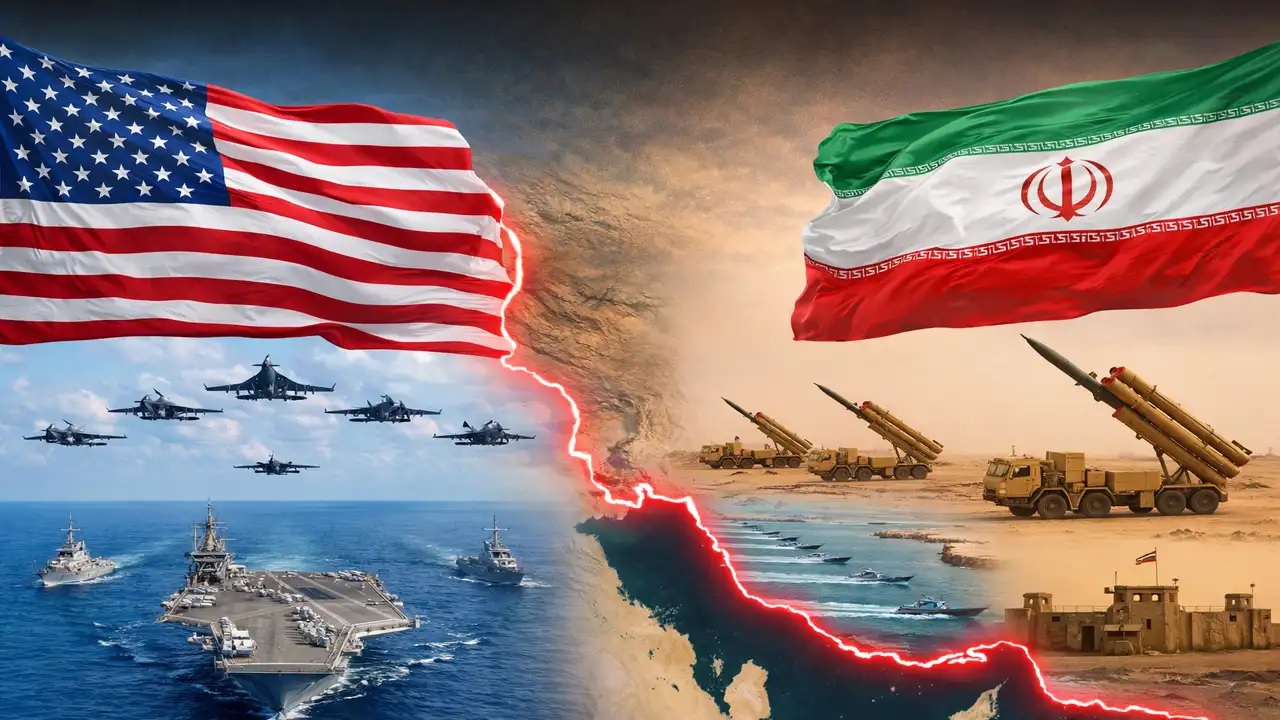
Wars need justification. More precisely, they need a hierarchy of justification, a ranked ordering of claims that tells you, in sequence, what the threat is, what you intend to do about it, and what success looks like. The Trump administration’s war against Iran has multiple justifications. What it conspicuously lacks is that hierarchy.
Four objectives have been formally stated: destroying Iran’s missile capabilities, destroying its navy, preventing nuclear acquisition, and disrupting its proxy networks. Taken together, this looks like a capability denial framework. Remove Iran’s ability to project force, strip away the conventional muscle that might shield a future nuclear deterrent, and the regional balance shifts. The logic is not incoherent. The problem is that it does not stop there.
Layered on top of these four objectives are three additional doctrinal positions: a theory of pre-emption, a theory of retaliation, and an implicit theory of political transformation. Each is defensible in isolation. Together, they produce a justificatory architecture that is comprehensive without being ordered, and ambitious without being defined.
Consider the pre-emption argument first, because it is the most consequential. The initial public framing invoked an imminent Iranian threat. Subsequent clarifications from senior officials told a different story; the United States had anticipated Israeli military action against Iran and expected that Iranian retaliation would spill over onto American assets in the region. American strikes were therefore designed to pre-empt anticipated Iranian retaliation against an allied initiative.
This is not classical anticipatory self-defence. The trigger was not evidence of a pending Iranian attack against the United States. It was the expectation that an ally’s action would generate retaliation that would affect American interests. Imminence, on this reading, becomes derivative, conditional on alliance dynamics rather than adversary intent. The doctrinal implication bears careful examination. If the threshold for war is an allied country’s military initiative and the expected retaliatory blowback, then alliance networks become escalation accelerants. The more assertive the ally, the narrower American strategic autonomy becomes.
The preventive logic runs alongside this. Iran’s missiles and drones were bad enough merely as operational threats but as a conventional shield for future nuclear coercion. Destroy the shield and you constrain the leverage. Intelligence reporting, however, indicated that Iran was not actively producing nuclear weapons and that any internalised missile capability directed at the American homeland remained a longer-term possibility rather than an immediate operational reality. If accurate, this war is not a response to imminent nuclear breakout. It is an attempt to prevent a state from reaching a threshold of coercive leverage at some future point.
Preventive wars are not automatically illegitimate, but they carry a heavier evidentiary burden and require a clearly articulated end state. The administration has not publicly defined the conditions under which Iran’s capabilities would be considered sufficiently degraded. It has not specified an acceptable residual level of Iranian military power. Without termination thresholds, operational success becomes structurally unmeasurable.
The Pentagon’s historical framing introduced a third layer. The conflict was presented as the culmination of four decades of Iranian hostility toward American personnel and interests. This is retaliatory logic dressed in strategic language. It expands the war’s justificatory horizon from threat management to long-term reckoning. When retribution and prevention are fused, the metric of success extends beyond missile depots and naval assets. It implicitly includes reputational restoration and deterrent credibility. Material destruction alone may not close a narrative built on historical grievance.
Regime change has not been listed among the objectives. Nevertheless, public statements have encouraged Iranian citizens to overthrow their government. The targeting of senior leadership and security infrastructure further blurs the distinction between capability denial and political transformation. The administration has denied any intention of nation-building. Yet removing a regime’s top leadership without a defined political transition framework creates a structural vacuum. This is a recurring pattern in American interventions where regime change is rhetorically disclaimed but operationally enabled.
The constitutional dimension compounds the problem. The war began without prior congressional authorisation. Subsequent briefings to lawmakers reportedly did not present intelligence indicating that Iran planned to strike American forces first. When major combat operations precede legislative endorsement, the signal sent to allies and adversaries alike is that executive discretion has displaced institutional constraint. This enhances short-term responsiveness. It also increases long-term volatility, because adversaries may calculate that future administrations could reverse course without structural impediment.
The wider implications are worth naming. Energy disruption in the Strait of Hormuz transmits conflict costs globally, constraining allied political space for extended operations. A war justified on preventing nuclear acquisition may paradoxically strengthen the incentive for vulnerable regimes to accelerate deterrent development. The strategic lesson inferred by others may be that non-nuclear status increases exposure to preventive intervention. And China will attend less to the tactical execution than to the justificatory template itself: the redefined imminence, the preventive logic, the elastic war aims), because these form precedents invocable in other theatres.
American operational capacity remains unmatched. The integration of cyber, space, air, and naval domains demonstrates genuine readiness and force projection. But capacity is not the same thing as strategic coherence.
Three structural features emerge from the justificatory narrative. Legitimacy is increasingly grounded in performance rather than law, precision and effectiveness substituting for deliberation about purpose. Alliance management is shifting from restraint to synchronisation, with allied timelines now driving American escalation thresholds. And domestic consensus on the use of force is considerably narrower than operational rhetoric suggests.
Iran’s capabilities did represent a long-term strategic challenge. That is not seriously in dispute. The question is whether the doctrinal basis for war has been clearly and hierarchically articulated. The current framework combines derivative pre-emption, preventive capability denial, historical retaliation, and latent political transformation. It is layered, not ordered. Without a defined end state and explicit termination thresholds, operational success risks drifting into strategic indeterminacy.
A superpower can sustain ambiguity for a time. It cannot indefinitely substitute narrative multiplicity for strategic clarity.
Aditya Sinha writes on Macroeconomics & geopolitics.