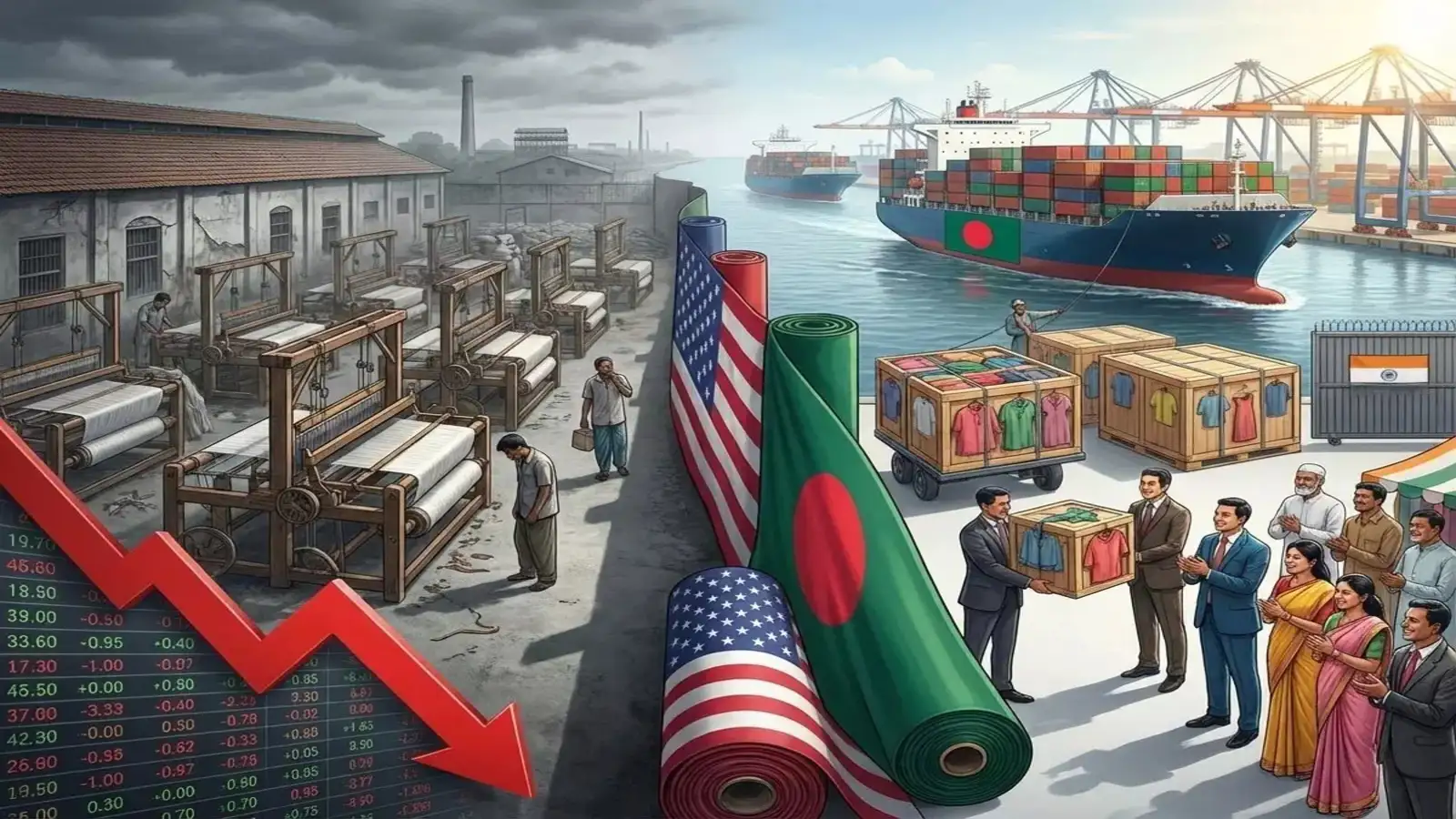
In the quiet corridors of Washington, far from the anxieties of Dhaka’s election season, an agreement was signed that may shape Bangladesh’s economic sovereignty for decades. It was presented as a breakthrough—a reciprocal trade pact promising “unprecedented access,” lower tariffs, and deeper cooperation. But beneath the diplomatic language and polished press releases lies a document that reads less like a partnership and more like a strategic lock-in.
The Yunus-led interim government may argue that it rescued Bangladesh from punitive tariffs and secured a stable trade channel with the United States. That is the headline. The fine print tells a different story.
At its core, this agreement is asymmetrical. The United States reduces reciprocal tariffs to 1.9 percent—not zero—while Bangladesh grants broad preferential access to its industrial, agricultural, digital, and strategic sectors. Dhaka’s market opens wide; Washington’s remains selectively ajar. Reciprocity, it seems, has been redefined.
Take the digital trade provisions. Bangladesh is prohibited from imposing customs duties on electronic transmissions and must permit the free transfer of data across borders. On the surface, this aligns with global digital trade norms. In practice, it means that data generated by 175 million Bangladeshis—commercial, financial, behavioral—can flow freely to U.S. platforms without meaningful restrictions. Data is not a trivial commodity. It is the oil of the modern economy. Countries from India to the European Union have wrestled fiercely over data localization and digital sovereignty. Yet Bangladesh, under an unelected interim government, has conceded its leverage without a national debate. Once such commitments are embedded in a binding trade treaty, reversing them becomes diplomatically and economically costly.
More troubling still is Section 4—the economic and national security alignment clause. Here the language shifts from commerce to geopolitics.
If the United States imposes trade or security measures against a third country, Bangladesh must adopt “complementary restrictive measures.” In plain terms: if Washington sanctions a country, Dhaka is expected to follow suit. Export controls must align. Sensitive technology flows must mirror U.S. priorities.
THAT IS NOT NEUTRAL TRADE POLICY. THAT IS STRATEGIC ALIGNMENT
For a country that has historically balanced relations among China, India, Russia, and the West, this clause narrows maneuvering space dramatically. Bangladesh’s economic rise has depended on diversified partnerships. Cheap raw materials from China, infrastructure cooperation with multiple partners, energy support from Russia—these were pragmatic choices of a developing economy. Under the new framework, such pragmatism risks becoming non-compliance.
The nuclear provision is particularly stark. Bangladesh may not purchase nuclear reactors, fuel rods, or enriched uranium from any country that “jeopardizes essential U.S. interests,” except under narrow conditions. The Rooppur Nuclear Power Plant—built with Russian assistance—stands as a symbol of Bangladesh’s energy diversification. Future expansions or similar partnerships could now collide with treaty obligations.
Energy security is not an abstract concern. Bangladesh’s industrial growth depends on stable, affordable power. Restricting supplier options in advance is not strategic foresight; it is strategic confinement.
Then there is Section 5—the procurement undertakings. Official language softens them as “shall endeavor” clauses. But when specific numbers are embedded—14 Boeing aircraft, $15 billion in LNG over 15 years, $3.5 billion in agricultural imports—the distinction between best-effort and obligation becomes largely semantic.
Biman Bangladesh Airlines is to facilitate the purchase of 14 Boeing aircraft. Energy entities are to pursue long-term LNG contracts valued at $15 billion. Agricultural imports of wheat, soy, cotton, and corn are quantified. Military procurement from the United States is to increase, while purchases from certain countries are to be limited.
This is not free trade in the classical sense. It resembles managed trade—a system in which commercial flows are guided not solely by market need, but by diplomatic commitment.
What happens if future governments determine that LNG from another supplier is cheaper? What if global grain prices shift? What if aviation market conditions change and fleet diversification becomes economically prudent? The treaty framework constrains flexibility. Policy becomes pre-negotiated.
Defenders of the agreement will say these are voluntary commercial signals, not binding mandates. Yet the enforcement mechanisms tell a harder truth. If consultations fail and the United States believes Bangladesh is not complying, Washington may reimpose reciprocal tariffs on some or all Bangladeshi imports. In effect, the United States retains the authority to judge compliance and enforce penalties. Bangladesh bears the commercial consequences. That imbalance is structural.
The most profound issue, however, is political legitimacy. This agreement was concluded during an interim administration. Trade treaties are not routine administrative acts; they shape industrial policy, foreign alignment, energy sourcing, digital governance, and defense procurement for decades. They are instruments of national strategy.
When an unelected or transitional government makes commitments of this magnitude, it binds future elected governments to frameworks they did not negotiate. The next administration—whatever its political complexion—will inherit obligations that narrow its choices. Renegotiation, if attempted, risks economic retaliation.
History offers cautionary examples. From Latin American states locked into disadvantageous commodity arrangements to small nations pressured into strategic alignments during the Cold War, asymmetrical trade deals often outlive the governments that signed them. Undoing them proves harder than signing them.
Bangladesh is not powerless. It is one of the world’s leading garment exporters. Its labor force is young. Its strategic location in the Bay of Bengal grants it geopolitical relevance. It could have negotiated a phased, balanced arrangement tied strictly to tariff relief. Instead, it accepted a broad-spectrum framework intertwining trade with security alignment and procurement undertakings.
BUT PARTNERSHIP MUST NOT MEAN DEPENDENCY.
A sovereign trade policy should preserve optionality—the ability to source energy competitively, to choose defense suppliers based on national interest, to regulate digital flows in accordance with domestic priorities, and to conduct foreign policy without automatic alignment clauses.
The Yunus government may believe it acted pragmatically under tariff pressure. Yet in seeking short-term relief, it may have mortgaged long-term flexibility. The agreement’s architecture embeds strategic concessions in exchange for tariff adjustments that remain partial and conditional.
The next government of Bangladesh will confront a difficult inheritance: comply and accept constrained autonomy, or challenge provisions and risk economic retaliation. Trade agreements should expand opportunity. This one narrows choice. And in geopolitics, the narrowing of choice is rarely a prelude to prosperity.
M A Hossain, political and defense analyst based in Bangladesh.