
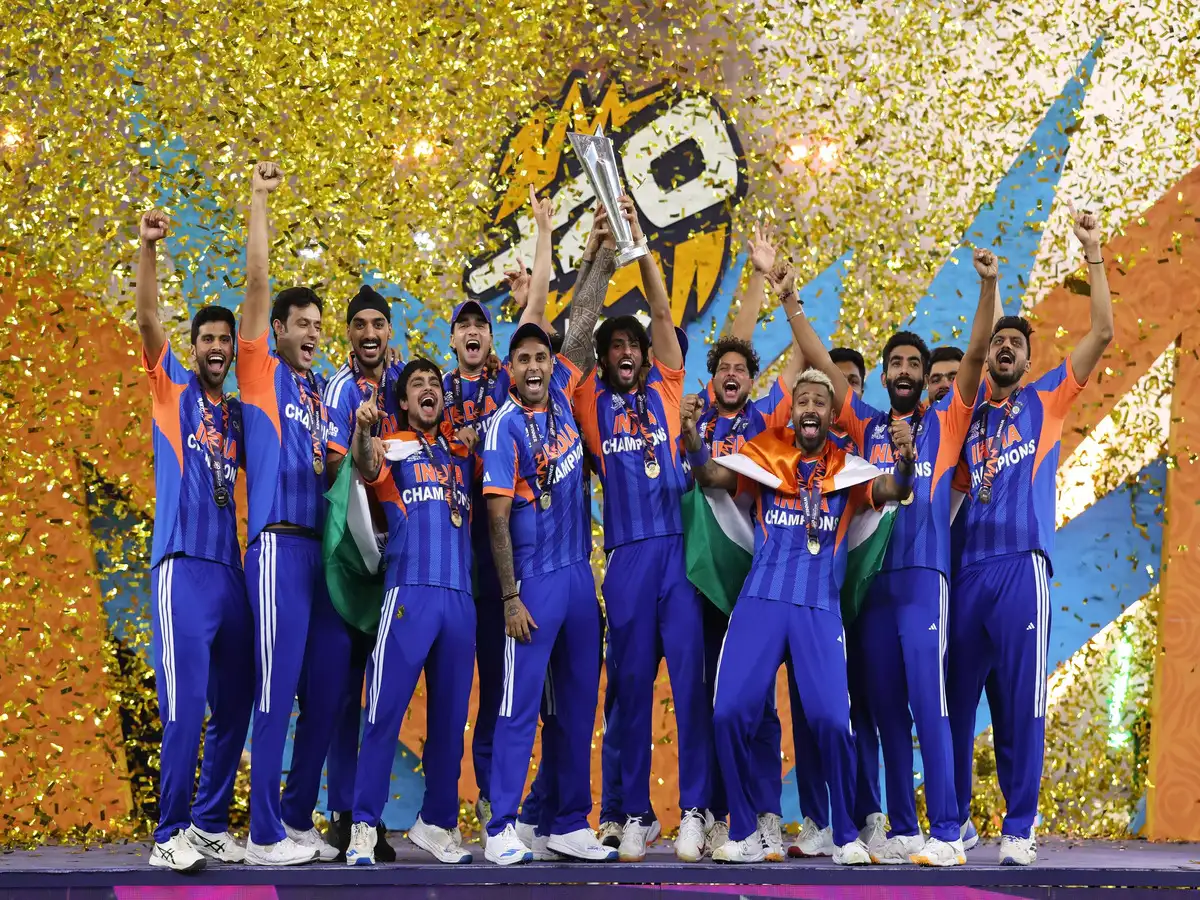
A stadium of more than one lakh spectators, a nation watching and history within touching distance. Favorites India defeated New Zealand a record third T20 World Cup crown in Sunday’s final at the Narendra Modi Stadium. Suryakumar Yadav’s side can also become the first team to successfully defend the T20 title — and the first to lift it three times. India banished the ghosts of 2023 by emphatically beating New Zealand by 96 runs in Ahmedabad to defend their T20 World Cup title. The build-up has been relentless. With every passing hour closer to the start of the final, the weight of expectation will only increase on Suryakumar Yadav’s men. India arrived here after outgunning England in a high-scoring semifinal and know the pressure is as much psychological as tactical. India became the first team to successfully defend their T20 World Cup title, winning their third overall (2007, 2024, 2026).
Boasting a legacy that spans from the inaugural victory in South Africa to the historic undefeated campaign of 2024, the Men in Blue have established themselves as the most consistent force in the shortest format of the game. While the 2026 tournament has been defined by India’s collective clinical efficiency, it has also been a landmark event for individual records, as new milestones have emerged to challenge the historic benchmarks set by legends like Virat Kohli.
NUMBER OF T20 WORLD CUPS INDIA HAS WON
India has officially won the T20 World Cup twice. The first title came in 2007 during the tournament’s debut edition, where MS Dhoni led a young squad to a thrilling victory over Pakistan in Johannesburg. After a 17-year wait, India secured its second title in 2024 under Rohit Sharma’s captaincy. That campaign was particularly significant as India became the first team in history to win the T20 World Cup without losing a single match throughout the tournament.
INDIA’S BEST PERFORMANCES IN T20 WC
Through round one, India finished top of Group A — also featuring Pakistan. Its sole hiccup in this tournament also came against South Africa — losing the first Super 8 game, also at Ahmedabad. It served as a wake-up call for the defending champions — coach Gautam Gambhir switched openers as Sanju Samson came into the playing eleven to lighten the load on Abhishek Sharma. Samson has since scored 210 runs in three innings with back-to-back half-centuries against West Indies (Kolkata) and England (first semifinal in Mumbai). Ishan Kishan has been the sole consistent performer in India’s top order. Suryakumar Yadav and Tilak Varma have shuffled up and down the order on numerous occasions — it has worked at times. Hardik Pandya and Shivam Dube offer key hitting prowess.
Beyond their two championships, India’s record is defined by remarkable consistency in the knockout stages. The team finished as runners-up in 2014 after losing a tight final to Sri Lanka and reached the semi-finals in both 2016 and 2022. The 2024 season remains the statistical peak for the nation, marked by Jasprit Bumrah and Arshdeep Singh’s dominance with the ball, which complemented a powerhouse batting lineup to ensure a flawless run to the trophy.
GAUTAM GAMBHIR CREATES HISTORY
Meanwhile, Gambhir created history after India won the T20 World Cup. Gambhir became the first man in the world to win the T20 World Cup as a player and head coach. Before leading India to a win in T20 World Cup 2026, he was part of the MS Dhoni-led team that won the T20 World Cup in 2007. Apart from the T20 World Cup, Gambhir also won the ICC ODI World Cup in 2011, and led the team to a win in the ICC Champions Trophy as head coach. Suryakumar and Gambhir adopted a fearless approach that no other Indian team dared to. Until a few years ago, the Men in Blue would go into their shells in knockout matches. The 2022 T20 World Cup semi-final against England was the best example. Rohit Sharma and Rahul Dravid took the first step towards aggression over defence, but it’s Suryakumar and Gambhir who’ve accomplished it.
HEARTBROKEN TO HEART-BREAKERS: KIWIS DESPERATE TO CHANGE THE SCRIPT?
New Zealand’s cricket men have had more than their fair share of ending up crestfallen after falling short in World Cup finals, so now captain Mitch Santner fancies it’s time to see them “break a few hearts” for once. Actually, when he says “a few”, he’s probably talking about a billion hearts as his unsung but invariably excellent side attempt to confound all the odds in Sunday’s T20 World Cup final against co-hosts India in front of 100,000-plus fans at Ahmedabad’s Narendra Modi Stadium. While not always the favorites, the New Zealand team is regarded as a consistent side, with players like Mitchell Santner noting the challenge of winning the title.
CRICKET A RELIGION IN INDIA
Cricket in India is much more than a sport. It is a religion that people practice every day and the love for it is deeply rooted in our tradition. India’s meteoric rise from winning the World Cup as the biggest underdog in 1983 to once again claiming the prized jewel in 2011, has been nothing short of an iconic odyssey. We will never forget the 2011 final match when we defeated the formidable Sri Lankan side. As Dhoni whacked a monstrous six out of the park, Mumbai erupted with unmatched euphoria as the Wankhede Stadium bore witness to our glory. What made that win even special is we emerged at the top of the world at a time when we were second best according to the ODI rankings, with the formidable Australian side at the top.
Over the last decade, things have changed. India is the undisputed best at cricket. The statement is so true that even our most bitter rivals are bound to agree. Take any statistic — best batsman in ODI or T20, best bowler, best all-rounder, all individual accolades belong to an Indian player. But sports like cricket or football aren’t individual games now, are they? When King Kohli broke Sachin Tendulkar’s record few years back to become the record country holder of all time, we were jubilant. The only feeling that can supersede those emotions is when we lift the glorious trophy. We are no longer the underdogs we were in 1983 or the second-best from 2011, we are the best cricketing nation and the World Cup will put an emphatic stamp on that.
For a cricket-worshiping nation like ours, second-best is not an option. Cricket is the great equalizer that brings people from all castes, creeds and religions together. When India wins, unity in diversity is exemplified. India’s victories at the World Cup have signaled the metaphorical genesis of a united India, which is way too utopian a notion if one looks elsewhere at other walks of life.
DEFINING MOMENTS
In India, cricket is more than just a game; it’s sporting heritage personified. As we wait with bated breath for the final on Sunday, let us remember that even though we have outclassed every other team and have rightfully earned the title ‘The Invincibles’ in this tournament, over-confidence has been the grave of many great nations. New Zealand is a dangerous side, who are sure to bring in their A-game. They are no strangers to winning World Cups. However, with top-tier quality players and the unwavering faith of more than a billion people on our side, there is no reason to believe that history won’t repeat itself.
India’s journey through the tournament mirrors the nation’s cricketing journey itself—from an underdog status to a cricketing powerhouse. The triumphs of 1983 and 2011 and T20 World Cup in 2007 and 2024 remain etched in the memories of Indian cricket fans as defining moments of national pride.
Dr. S. Krishnan is an Associate Professor in Seedling School of Law and Governance, Jaipur National University, Jaipur. Ms. Rakshita Saini is a final year student of B.A.LL.B in Seedling School of Law and Governance, Jaipur National University, Jaipur.