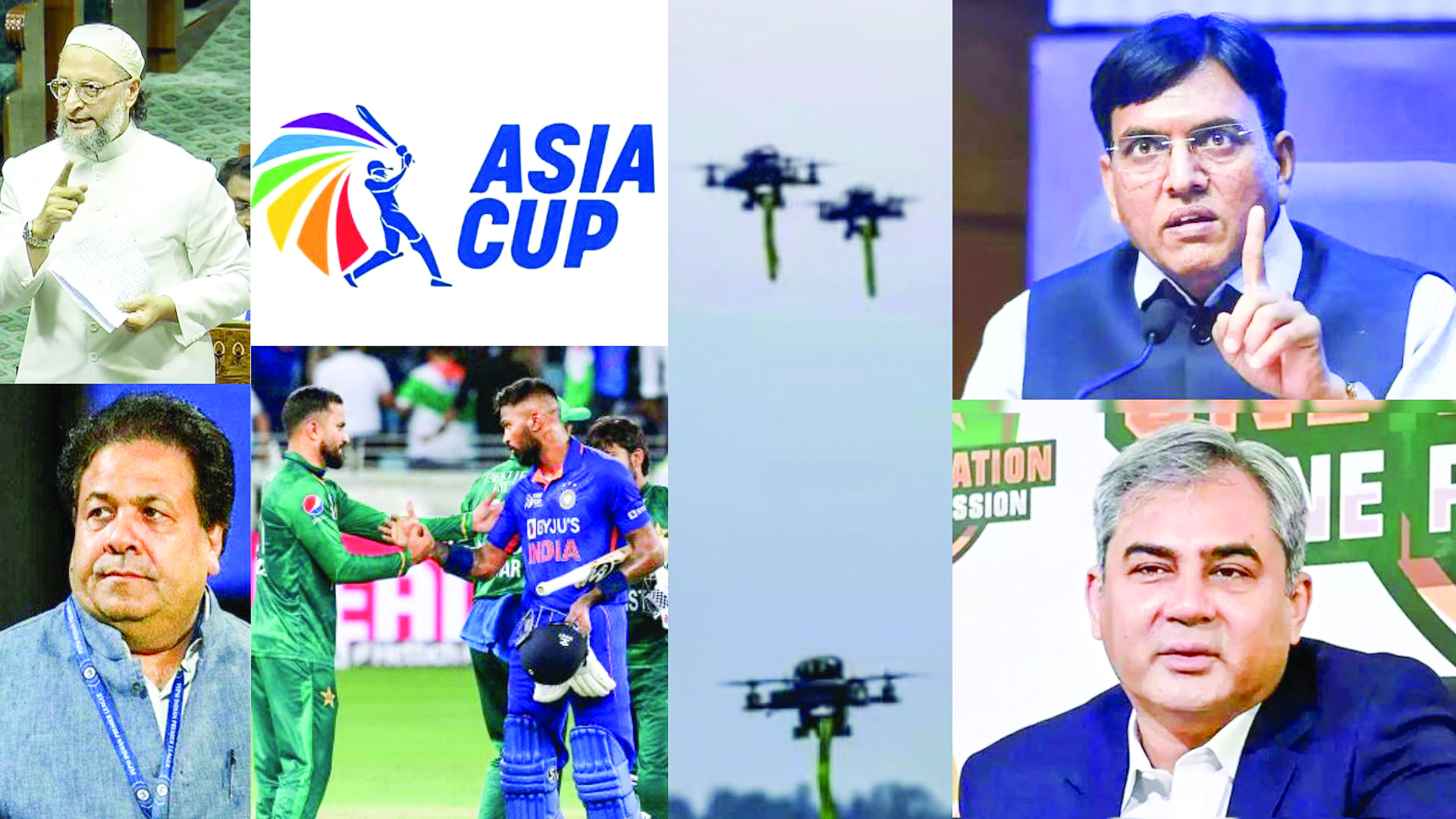
These days, from the streets to Parliament, questions are being raised about the government’s stance on India’s participation in the Asia Cup. The government is being reminded of its statement at the time of the Pahalgam incident that water and blood cannot flow to- gether. In such a situation, the question is whether blood and cricket can go together?
The second big question is the statement of Lt Gen Anil Chauhan that Operation Sindoor is not over yet… then why cricket with Pakistan?
There are two big reasons for the government softening its stance on this matter. The first is that cricket has been included in the 2028 Los Angeles Olympics. Obviously, this game has now become an Olympic sport. Now the BCCI will also have to respect the rules of the International Olympic Committee (IOC). The IOC completely works according to the Olympic Charter, in which it is clearly written that sports should not be disrupted due to religion, politics, apartheid, or any other reason. Here, the examples of Kuwait and Malaysia are relevant. Kuwait was banned by the IOC for not giving visas to Israeli players in the World Cup shooting.
Similarly, Malaysia could not escape this ban for ignoring Israel in para sports. Even the IOC had taken a tough step against India for not giving visas to Pakistani players in the World Cup held in Delhi, under which it had instructed all inter- national sports federations not to host any international competition in India. But the Indian Olympic Association (IOA) appealed to the Indian government in this regard and, after consultation with the Ministry of External Affairs and Home Affairs, the Sports Ministry had written to the IOA and assured that in the future, no player participating in any competition held in India will be denied a visa. It was only after the letter of this effect from the IOA that India was saved from the IOC ban. Now India has staked a claim to host the 2030 Commonwealth Games and the 2036 Olympic Games. If India refuses to play with any country, then it may have to face the consequences.
It is not hidden from any- one that after the Sindoor incident, the rates of Indo-Pak cricket matches have sky- rocketed. India is the host of the Asia Cup. India and Pakistan are going to face each other twice in the Asia Cup: once in the league and once in the Super-4. It is also possible that the final match may be played between the two. That means three matches each in the same tournament. If India does not play with Pakistan, then it may have to suffer losses worth billions of rupees.
It is also worth mentioning here that the Sony Network has the rights of the Asian Cricket Council till 2031. Sony has acquired these rights for Rs. 1400 crores. This includes 119 matches including emerging and women’s cricket. BCCI is going to get 65 percent of the amount from these media rights and PCB is going to get 25 percent. That means BCCI is going to get Rs. 910 crores and PCB is going to get Rs. 346 crores.
It is obvious why the BCCI would not want to lose such a huge amount of money. It is true that the International Cricket Council (ICC) and the Asian Cricket Council (ACC) are not under the International Olympic Committee (IOC), but after cricket became an Olympic sport, things have changed a lot. Even the BCCI has come under the National Anti- Doping Agency (NADA) and the ICC has an agreement with the World Anti- Doping Agency (WADA). In the new sports bill, the government will now be directly accountable. BCCI Vice-President Rajeev Shukla has already said that whatever the stand of the government is, will be the stand of the BCCI too. That means everything has changed in the changed environment, and the changed stand of the government can be understood.