
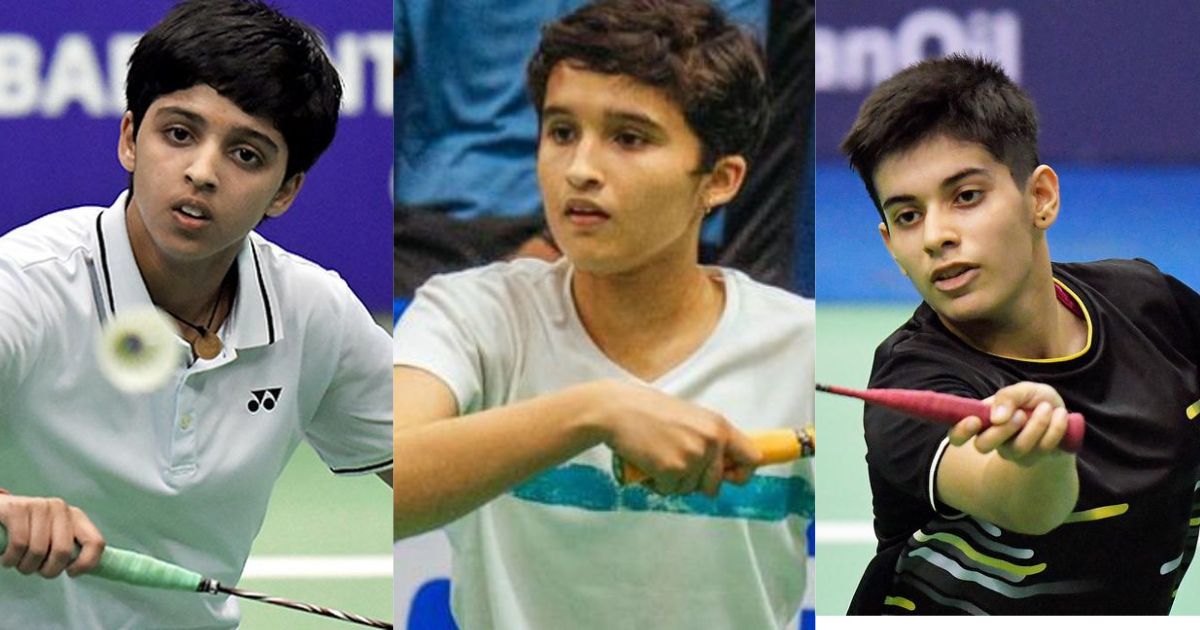
Indian women’s singles badminton is going through a quiet revolution. India won medals at the 2025 Junior Asian Championships for the first time since PV Sindhu won Asian Junior gold in 2012. Names like Unnati Hooda, Anmol Kharb, and Tanvi Sharma point towards a revival in the category.
But this isn’t about discovering the “next Sindhu.” Rather, a bold batch of young ladies is forging its destiny, separate from the canopies of previous legends. The revival seems larger, with varied personalities and playing styles propelling it.
Unnati, Anmol, Tanvi Lead a New Wave
Unnati Hooda, at 17 years old, recently beat Sindhu at the China Open. She avoids giant academies, keeps playing doubles, and will not be swayed by the notion of a symbolic baton shift. “We need to compete with the entire world, not just Sindhu,” she says in the clear voice of someone raised in an academy house.
As bold is Anmol Kharb, also 17, who has already won a national championship. Her game is constructed on intelligence, accuracy, and relentless toil. She has been trained in martial arts, which gives her badminton a quality of scientific strength.
Tanvi Sharma made it to the finals of the US Open. Her coaches have likened her to Sindhu and Saina Nehwal. Her neat strokes and proper technique are complemented by a steep learning curve.
Not Just Strength – It’s About Intelligence and Class
This generation lacks perhaps Sindhu’s towering reach or Saina’s sheer power, but it has something different: game wisdom. With shorter physiques, they depend on strategy, court vision, and slicing defence. They are not characterised by brute power but by brains and poise.
The change is also manifest in their attitude. They’re not racing each other in a two-horse race. Rather, they’re cutting different tracks, content to be themselves. The fruits of their labour are only just beginning to manifest, but the portents are encouraging.
The Supporting Cast Is Ready Too
Behind the lead trio, names like Anupama Upadhyaya, Isharani Baruah, and Malvika Bansod are pushing hard. Bansod, already 23, once shocked Saina and reached the Top 35. Each player has their own set of limitations, but also the determination to evolve.
Devika Sihag and Vennala Kalagotla are standing tall, both literally and technically. Singles and doubles-playing Kalagotla made a big impression at the Asian Juniors with her power and poise. Sihag has been well-supported developmentally and is likely to burst out soon.
Even Rakshitha Ramraj and Tanvi Patri are in contention, still coming up, but exhibiting hints of future firepower.
Players Want Autonomy, Not Assembly Lines
Different from generations before, these players eschew the notion of being coached in a single camp. Many object to being asked to be led by Sindhu’s coach, Irwansyah, as a group. They do not wish to be moulded into uniform moulds. Similar to Sindhu and Saina before them, they like to do their thing in their way.
They’ll be guided by parents and intuition, not by strict systems. Their paths will be anarchic, unplanned, and motivated by individual decision-making. And that’s precisely what might differentiate them from other countries.
Global Standard Is the Real Target
These players don’t look at each other—or even Sindhu—as the standard. Their vision is on the world stage. They’re targeting beating the likes of An Se-young, Wang Zhi Yi, and Akane Yamaguchi. That concentration might just assist them in vaulting over comparison with themselves and towards true greatness.
What’s happening isn’t a succession plan. It’s a revolution of individuality—unpredictable, diverse, and boldly refreshing.