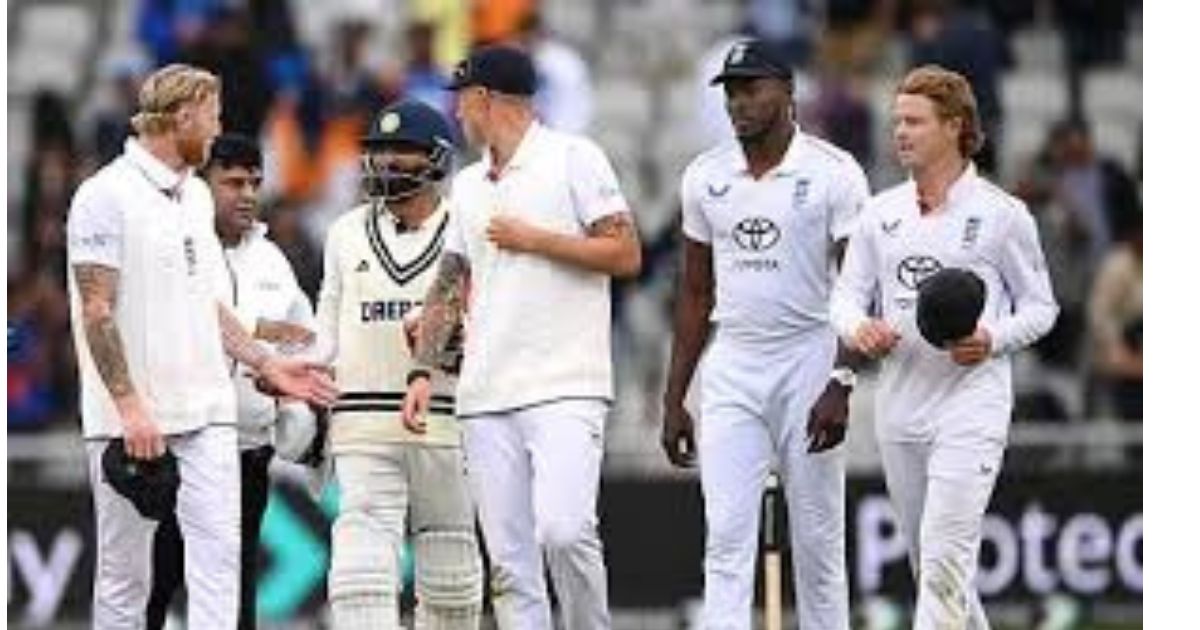
On Sunday at Old Trafford, Manchester, Ben Stokes and his team seemed visibly frustrated and helpless. The England side initially offered a handshake to Ravindra Jadeja, implying surrender. When Jadeja declined, the matter should have ended there.
But Zak Crawley’s remark that Jadeja should’ve played faster if he wanted a century was completely unnecessary. Jadeja didn’t ask for his opinion, so there was no reason to repeat it.
It’s ironic how the same team often invokes the ‘Spirit of the Game’ or the so-called “gentleman’s code,” yet frequently fails to uphold it themselves.
Where was this spirit back in 2013, when Anderson, Broad, and Pietersen reportedly urinated on The Oval pitch after an Ashes win? Or when Monty Panesar was accused of urinating on a bouncer outside a nightclub, an incident even registered by UK police?
Andrew Flintoff was dropped from the national squad for repeated late-night drinking sprees. Ben Stokes made racially insensitive remarks towards Marlon Samuels but there was little said about sportsmanship then.
The 2018 nightclub brawl involving English players, the post-Sydney-Test incident where Ben Duckett slapped Anderson, or Kevin Pietersen’s ongoing rants against the ECB, all raise questions about consistency in behaviour. Even South African players had objected to Pietersen’s remarks.
In 2017, Bairstow, Plunkett, and Jake Ball were fined by the ECB for misconduct during a series. And again, Stokes’s racially charged comments against Samuels during the Birmingham Test went unaddressed.
In that match, India had declared 427/6 giving England a mammoth 608-run target in the 2nd inning. Yet some England players claimed that India was scared of them. But, ironically, England responded with 669 runs. Were they scared, too?
In the 2013–14 Ashes, Stuart Broad was caught by Clarke off Ashton Agar, but umpire Aleem Dar missed it, and Broad didn’t walk. He later admitted he was indeed out. So much for playing fair.
Contrast that with India’s Gundappa Vishwanath, who, in the 1980 Jubilee Test at Wankhede, asked the umpire to recall Bob Taylor after he was wrongly given out. The world applauded his honesty.
Or take MS Dhoni in 2011, who withdrew an appeal and brought Ian Bell back after a controversial run-out. That’s the real essence of cricket.
It’s time the English team reflects on its own record before preaching to others about sportsmanship. Their repeated actions contradict the values they claim to uphold. At times, they appear no different from England’s notorious football hooligans, who resort to chaos at the slightest provocation.
Even in the last Test, England deliberately slowed the game in the final overs to avoid bowling more. The cricketing world has not forgotten that.
In conclusion, England’s selective interpretation of the ‘spirit of the game’ does more harm than good. True sportsmanship is not about posturing, it’s about integrity, something Indian cricket has repeatedly demonstrated with grace.