
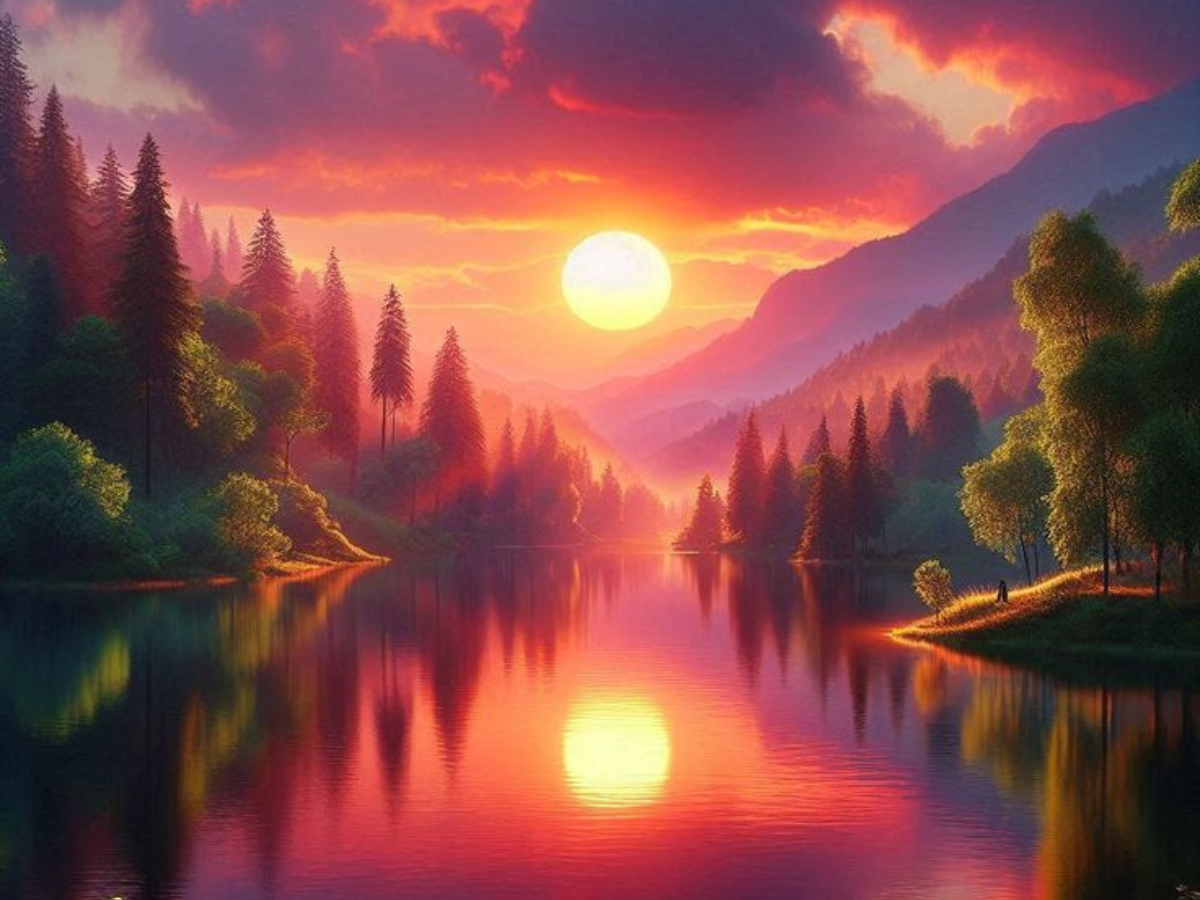
The sunlight appears white it actually consists of all colors visible to the human eye. Shorter wavelengths blue and violet are dispersed more effectively than the longer wavelengths while red and orange when entering into Earth’s atmosphere and colliding with molecules and small particles.
This is popularly referred to as Rayleigh scattering and is primarily applicable to blue light owing to its shorter wavelength hence, the sky looks blue during the day.
Why the Sky Near the Horizon Seems White?
Staring at the horizon the sky around this area looks bleached or whitish excitingly light enters at a lower angle and it will pass through a thicker layer of air. Along this way, more scattering happens and different colors enter the mix when the reflected light from the Earth’s surface interacts with something called Mie scattering caused by larger particles like dust or water droplets and combines all colors into what we see as white or grayish tint.
ALSO READ: Science of Color: How Light, Vision & Brain Create the World we See
Why Sunrise and Sunset Are Orange & Red?
When the sun is very near to the horizon in dawn or dusk it must travel more atmospheric distance to hit the eye. Most of the blue and violet light gets scattered in this longer distance while warm colors such as orange and shades of pink and red remain. The presence of atmospheric particles like dust and pollutants usually enhances the colors impression created by sunsets.
What Causes Red Sunsets?
The reds that appear at sunset is whenever wildfires, volcanic ash or pollution increase the particles in the air. Those particles scatter shorter wavelengths much more vigorously leaving the reds and oranges to predominate with the denser or dirtier the atmosphere the more vivid red becomes.
Why Is not the Sky Violet?
Violet scatters more than blue because we do not see a purple sky that people are sensitive to violet wavelengths. Some of violet light is absorbed by the upper atmosphere and remains a concentration of scattered blue light that human eyes are more suited to detect.
ALSO READ: When the Sky Dances: Science Behind the Northern Lights
How Dust Particles & Pollution Affect the Color of the Sky?
Large particles are those such as dust, ash and smog these scatter all visible light wavelengths relatively evenly. This can lead to dull or white skies with a Mie-scattering effect can be dull in an otherwise vibrant blue sky in urban areas or in parts of the country that are prone to wildfires.
Does Atmospheric Condition Change the Appearance of the Sky?
The humidity, temperature, altitude and what is in the atmosphere determine how light is scattered. That is why the sky is often clearer and bluer after rain with the concentration of particles is less.
What is the Color of the Sky on Other Planets?
The Dust rich in iron which makes the sky seem often dusty red on Mars. The Mars also enjoys blue sunsets while Venus’s sky has a yellow-orange tint from dense sulfuric acid clouds and Titan, Saturn’s moon basks under deep orange skies.
Thick organic haze produces that effect with different atmospheres create entirely different skyscapes, even under the same sun.
ALSO READ: What Happens If Earth Stops Spinning? The Science Behind the Catastrophic Effects