
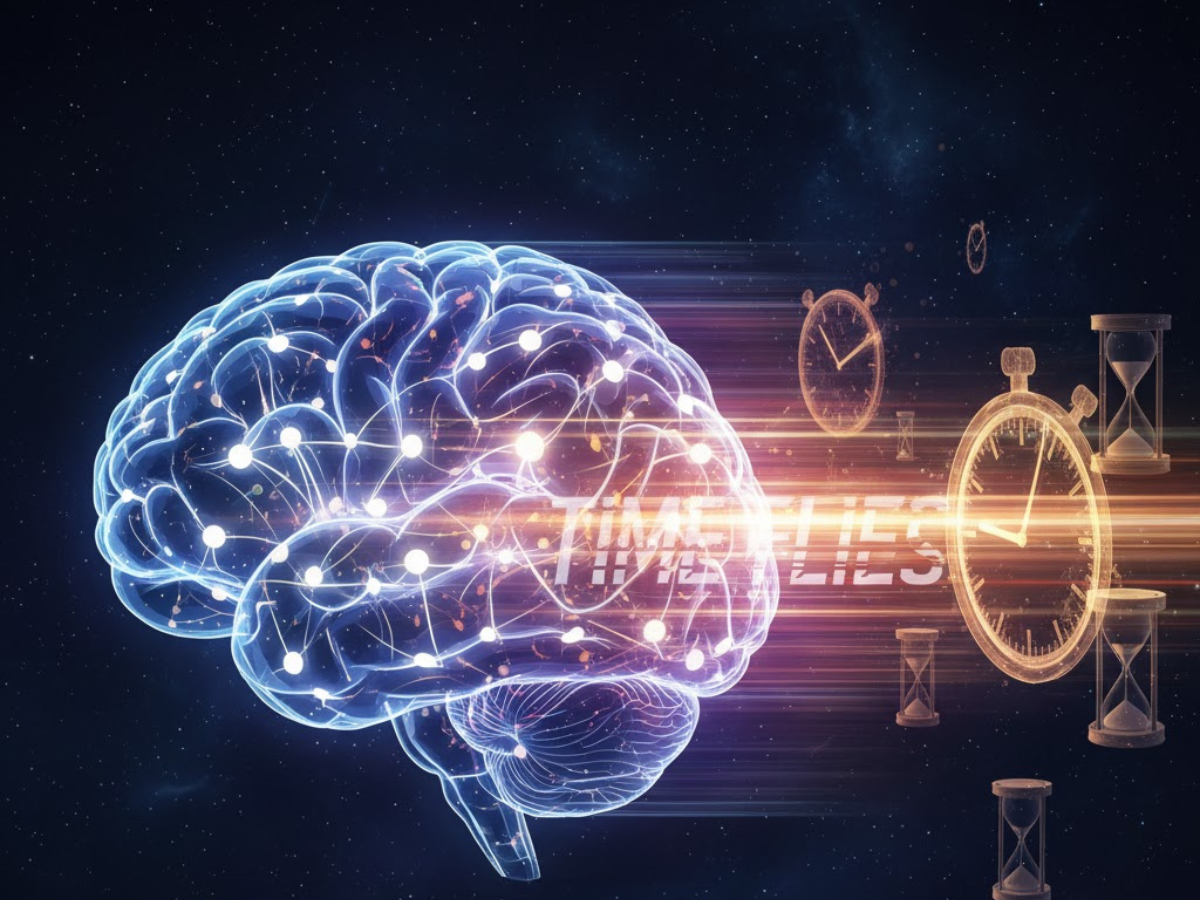
According to the Institute for Frontier Areas of Psychology and Mental Health (IGPP) psychologist, Marc Wittmann, the more novel experiences we experience, the more frequently we create new entries in memory. For children, the newness with which they are surrounded causes them to constantly add new chapters. Adults highlight fewer mental bookmarks in slow but predictable routines that characterize their lives, compressing their time.
What is the Human Brain & Inner Clock
Time passes in our brain, nor using just one clock involving loads of neural signals that transform experiences into perception. The degree of speed subsequently declines with age. The pathways develop a high distance/neural impulse slow perhaps fewer sensory frames per seconds meaning we record more memory per second.
So, the film would move very fast it would look like a film running at lower frame rates. Psychologist Adrian Bejan refers to it as the lowering of perceptual resolution. Early on bright scenes captured in the mind will differ by age as fewer snapshots shrink the time interval.
ALSO READ: Will Aliens Arrive on October 29? Scientists Decode 3I/ATLAS
What Science Reveals on the Hitchcock Experiment
Recent findings from the Cambridge Centre for Ageing and Neuroscience (Cam-CAN) definitely illustrate such feelings. In a 2024 study, 577 subjects aged 18 to 88 viewed an eight-minute excerpt from Alfred Hitchcock Presents Bang You are Dead, while researchers viewed it using MRI to investigate the fluency of transitions from state to state in brain activity.
Younger participants transitioned much more rapidly than older adults, who lingered each time. The fewer transitions meant fewer mental events, effectively shortening subjective time experience.
ALSO READ: Zoho UPI App Launch: How Arattai Could Revolutionize India’s Chat & Pay Platform
How is the Effects of Newness & Routine
Routine is a major time condensing agent from studies comparing holiday perceptions among several cultures, people leading monotonous lives found events like Christmas or Ramadan happening faster every year. Those on the contrary, have diversified be hobbied, traveled and challenged experienced time extended. Novelty stretches time and, thus, the theory introducing unpredictability and exploration into our daily rhythm creates more timestamps on the mind slowing down the internal clock.
Its linear calendar existence as well as within their unreal logarithmic sense of proportion. A year is one-fifth of a five-year-old’s life while it is merely one-fiftieth to a fifty-year-old. Scale makes it possible to feel increasingly smaller when that time passes as we age. Time can still be made longer. Learning something new, traveling to strange places or breaking habits enriches our narrative, all of which help reestablishing what was felt as time-large when toddlers, transforming the linear into the leaping.
ALSO READ: Scientists Unveil Mysterious ‘Interstellar Tunnel’ Linking Our Solar System to Distant
Disclaimer: This editorial summarizes verified scientific findings. Interpretations are for informational purposes and not medical or psychological advice.