A mysterious cosmic visitor is currently passing through our solar system and it has the global astronomy community on high alert. Dubbed 31/ATLAS, this interstellar object marks only the third confirmed visitor from beyond our solar system, following ʻOumuamua in 2017 and Comet Borisov in 2019. Detected in July 2025, 31/ATLAS is now under close observation by four major space based telescopes Hubble, JWST, SPHEREx and TESS and it is already rewriting some of what we thought we knew about comets and interstellar bodies.
What is Interstellar Object 31/ATLAS?
31/ATLAS is not native to our solar system like ʻOumuamua and Borisov before it, it is thought to have originated in another star system and is now making a brief pass through ours. These rare visitors are invaluable to science because they carry the chemical fingerprints of entirely different planetary systems. Although early observations suggest it behaves somewhat like a comet and its properties are far from typical making it a subject of intense scrutiny and speculation.
ALSO READ: Alien Tech or Cosmic Rock? The Mystery of Manhattan Sized Object 3I/ATLAS
A Comet, But with Strange Features
Comets usually develop a coma a cloud of gas and dust with a glowing tail when they approach the Sun. 31/ATLAS has deviated sharply from this pattern. Observations using JWST and SPHEREx revealed that its coma contains an unusually high ratio of carbon dioxide to water the highest ever recorded in any comet like body. This suggests it formed in an environment far colder or chemically distinct from our own solar system challenging conventional models of comet formation.
TESS Data Adds to the Mystery
Adding to the intrigue, archival data from NASA’s Transiting Exoplanet Survey Satellite (TESS) showed that 31/ATLAS began displaying comet-like activity far beyond Jupiter’s orbit, at a distance of six astronomical units from the Sun that is much farther than typical comets become active. This early outgassing indicates a chemical makeup that is far more volatile than those of known solar system comets.
ALSO READ: Will Aliens Arrive on October 29? Scientists Decode 3I/ATLAS
Hubble Space Telescope Captures a Teardrop Cocoon
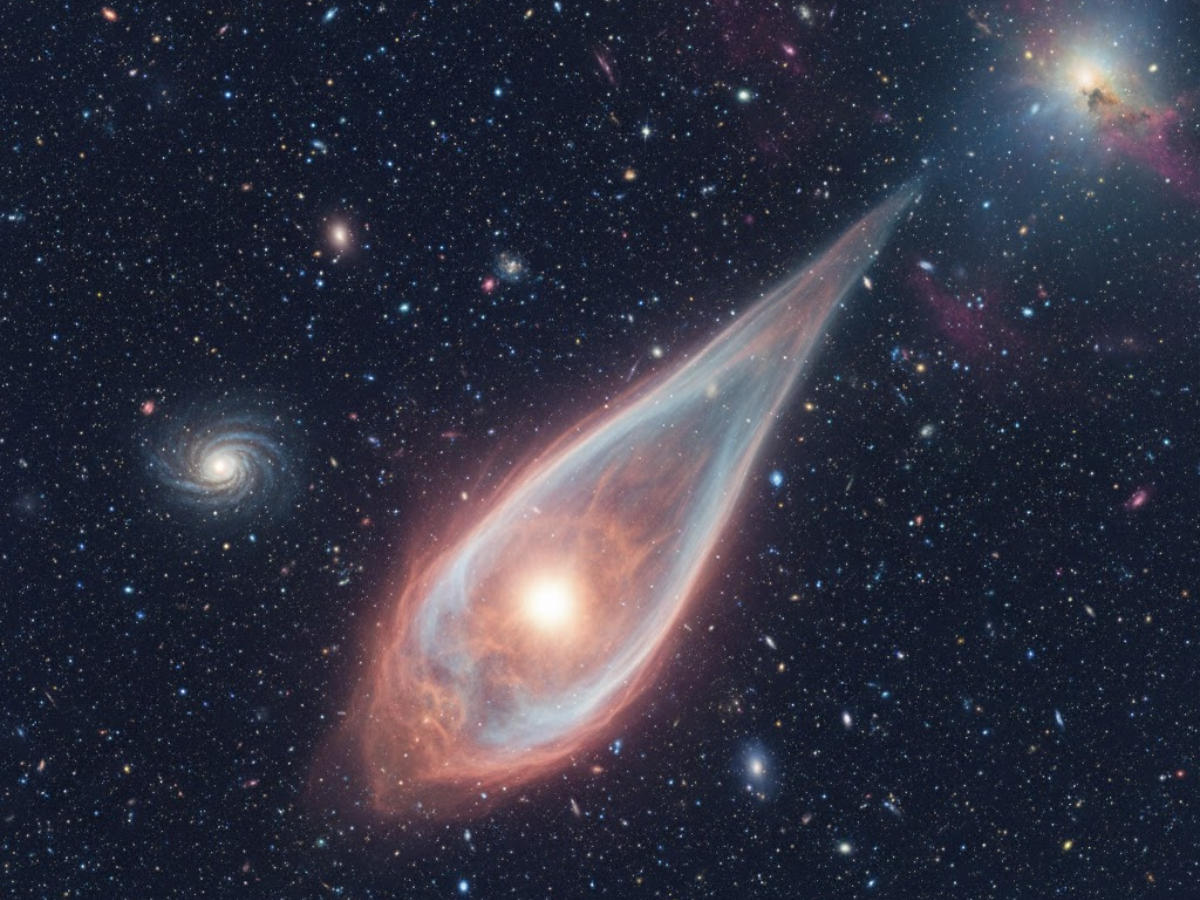
NASA’s Hubble Space Telescope has provided some of the most striking images of 31/ATLAS to date. Instead of the usual comet tail, it shows a teardrop shaped dust cocoon surrounding the nucleus no clear tail is visible. This unusual morphology has sparked new theories and debates with Harvard astronomer Avi Loeb suggesting it may represent an entirely new class of interstellar object though mainstream astronomers maintain it has a natural origin.
31/ATLAS Origins Still Unknown: Scientist Say
Scientists are still uncertain about where 31/ATLAS came from or how it acquired its unique features is a leading hypothesis suggests it may have formed closer to the carbon dioxide ice line in a protoplanetary disk and giving it an unusual chemical signature. Another theory proposes that it may have been exposed to intense radiation in interstellar space, altering its composition. Further observations and analysis will be needed before any conclusions can be drawn.
Flybys of Mars & Jupiter Ahead
Before 31/ATLAS leaves the solar system, it will pass near Mars and later Jupiter, offering rare observational opportunities. The object is expected to pass within 2 million miles of Mars is prompting scientists to suggest that the Mars Reconnaissance Orbiter could attempt close-up imaging. Later, as it moves past Jupiter, NASA’s Juno spacecraft may also capture valuable data. These upcoming encounters may be humanity’s last chance to study this mysterious traveler up close.
With only two confirmed interstellar objects observed before it, 31/ATLAS is a reminder of how little we understand about the wider universe. Its chemical oddities, strange behavior and unknown origins ensure that it will remain a subject of intense scientific focus. As it continues its journey through our solar system, the world’s eyes and telescopes will remain fixed on this remarkable and elusive cosmic visitor.
ALSO READ: What If 31/ATLAS Is an Alien Mothership? How Earth Could Respond
Disclaimer: This article is based on current astronomical observations and theories, which are subject to change as further data becomes available.