
A Dance of Death Across the Universe
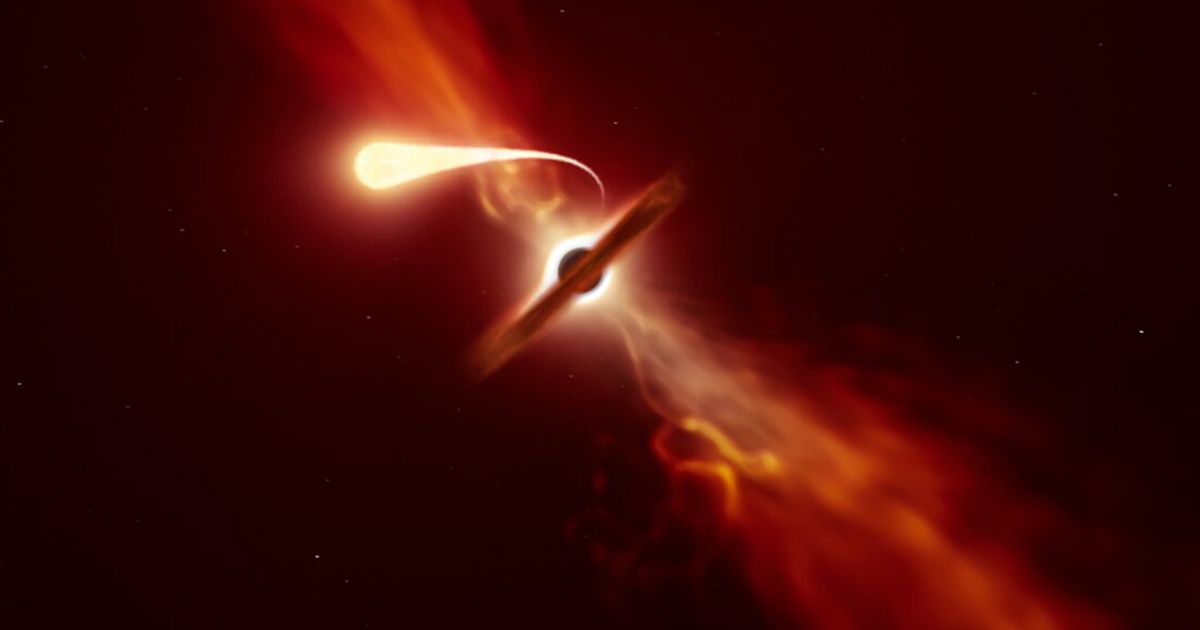
Astronomers have imaged the dramatic demise of a huge star that wed itself into a fatal union with a black hole. The cosmic collision occurred only once in an eternity and resulted in what scientists think is a never-before-seen kind of supernova the explosive fate of a star caused by its gravitationally linked companion.
The tragedy occurred around 700 million light-years away, within a binary system where the star, at least 10 times heavier than our Sun, orbited a black hole of comparable mass. As time passed, they drew closer together. The gravity of the black hole warped the shape of the star, stripping away its outer layers before the ultimate disastrous explosion.
We had a huge star engaged in a deadly tango with a black hole,” explained astrophysicist Alexander Gagliano of the US National Science Foundation’s Institute for AI and Fundamental Interactions at MIT, senior author of the paper published in The Astrophysical Journal.
Star Versus Black Hole: The Mighty Wins
In this lethal waltz, the star was massive but “puffy,” and the black hole was tiny but enormously strong. Although they had close to equal mass, the density and gravity of the black hole placed it in control. As it robbed the star of its matter, it either caused the collapse of the star or entirely dismembered it before the supernova.
The precise process is unknown. “It’s not known whether the distortion causes an instability that leads to the collapse, or if the black hole rips the star apart before it explodes,” said Harvard astrophysicist Ashley Villar, co-author of the paper.
The system initially had two gigantic stars circling each other. One ran out of fuel and then blew up in a supernova, collapsing into a black hole. Its remaining companion would ultimately suffer the same destiny but only after years of gradual, destructive interaction.
How AI Helped Catch the Cosmic Finale
The discovery was enabled by an artificial intelligence program that was programmed to monitor the skies for unusual stellar bursts in real-time. The AI flagged the initial phases of the event, prompting astronomers to begin observations right away. Ground and space telescopes monitored the developing phenomenon, capturing record levels of detail from beginning to end.
Archive data showed that four years prior to the explosion, the star was already in distress. Brighter emissions indicated that the black hole was actively consuming the outer hydrogen layer of the star, stripping away the underlying helium. Following the supernova, scientists detected brighter emissions as the black hole continued to consume remaining stellar leftovers, becoming increasingly massive and robust.
“This event shows that black holes can dramatically shape how massive stars die,” Gagliano said. “It’s a reminder that a star’s fate is deeply influenced by its companions.”
A New Window into Stellar Deaths
The discovery raises new questions regarding how stars engage black holes and how these interactions could be adding to the diversity of supernovae throughout the universe. Stars that are at least eight times as massive as the Sun are fated to die in supernovae, but in cases like this one, the demise could be much stranger and more gruesome than thought before.
As Gagliano concluded, “The fates of stars are not written in solitude. In this instance, a companion resulted in a conclusion far from ordinary.”
ALSO READ: Five Astronauts Start Return Trip to Earth via NASA’s Commercial Crew Program