
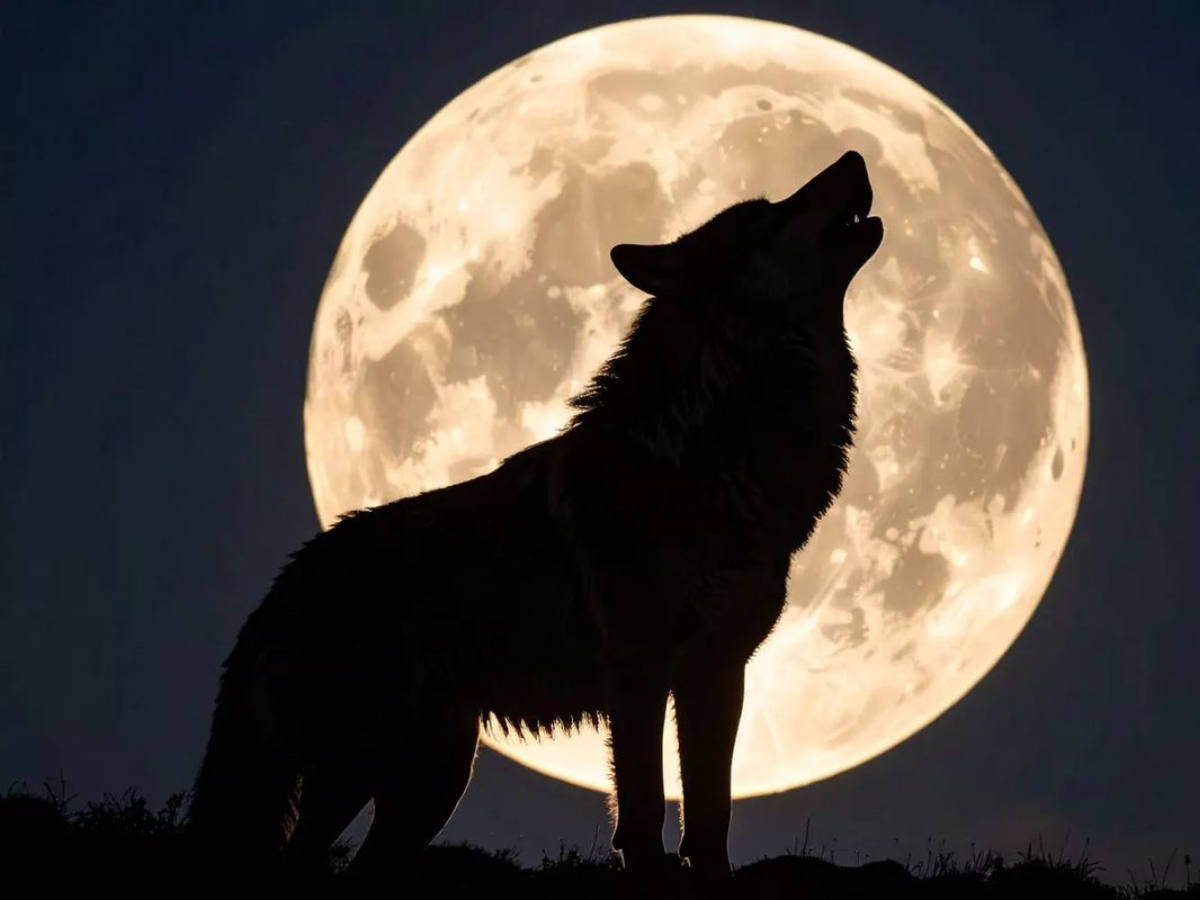
The night sky is opening 2026 with a quiet spectacle that does not demand telescopes or expertise, just a pause and a glance upward. On the first weekend of January, the Moon will rise fuller, brighter and closer than usual offering a moment of shared wonder across continents. It is known as the Wolf Supermoon, it blends astronomy with history and reminds us how closely human life has always followed the lunar cycle.
What is a Supermoon?
A supermoon is not a rare or dramatic anomaly in space. It is a predictable lunar event tied to the shape of the Moon’s orbit around Earth. Instead of following a perfect circle, the Moon travels along an oval path, which means its distance from Earth constantly changes. At its nearest point, the Moon can be roughly 360,000 kilometres away, while at its most distant, it stretches to about 400,000 kilometres.
When a full Moon occurs close to this nearest point, known as perigee, the Moon looks noticeably larger and brighter in the sky. Compared to a full Moon that happens at apogee, its farthest orbital point, a supermoon can appear up to 14% bigger and nearly 30% brighter, making the difference visible even without instruments.
Origin of the Term Supermoon
The word “supermoon” was first introduced in 1979 by astrologer Richard Nolle. The term moved beyond astrology and entered mainstream astronomical conversation, used widely by both skywatchers and scientists for its simplicity. In scientific language, the phenomenon is called a perigee syzygy, referring to the precise alignment of the Sun, Earth and Moon that creates this striking visual effect.
ALSO READ: What Is a Supermoon 2025? The Science Behind the Moon’s Close Approach to Earth
What is Wolf Moon
The Wolf Moon is the traditional name for January’s full Moon. In 2026, it earns attention because it aligns with a supermoon event. This happens when the Moon reaches full phase near perigee and the point in its orbit when it is closest to Earth. The result is a Moon that appears slightly larger and noticeably brighter than an average full Moon, even to an untrained eye.
When to Watch Wolf Moon
The Wolf Supermoon reaches peak illumination on January 3, 2026, at around 10:03 GMT. That said, the most striking views will come earlier, during moonrise on the evenings of January 2 and January 3. As the Moon lifts itself above the eastern horizon at dusk, its size can feel dramatic due to natural visual effects created by the landscape.
Why the Wolf Moon?
Long before printed calendars, full Moons were named to track seasons and survival patterns. The Wolf Moon is tied to midwinter, when food was scarce and wolves were believed to howl more often near human settlements. The name reflects sound, hardship and awareness rather than mythology. Other cultures gave it names linked to cold, ice and endurance, all pointing to the same stark time of year.
ALSO READ: NASA’s James Webb Telescope Discovers Bizarre Lemon-Shaped Exoplanet With Mysterious
How to View a Supermoon
- Choose an open location with a clear view of the eastern horizon such as a rooftop, park or open field
- Start watching around sunset when the Moon is rising and appears largest due to natural visual illusion
- No telescope or binoculars are required, as a supermoon is bright and visible to the naked eye
- Urban areas are suitable, but lower light pollution improves contrast and surface detail
- Allow your eyes a few minutes to adjust to the darkness for a clearer view
- Photographers can use foreground objects like trees or buildings to highlight the Moon’s size
- Check local weather forecasts to avoid cloud cover during moonrise
How Many Supermoons in 2026
- 3 January, 2026: Wolf Supermoon is the first full Moon of the year and closest to the winter solstice
- 24 November, 2026: Second Beaver supermoon appearing larger and brighter than a regular full Moon
- 24 December, 2026: Cold Supermoon is the closest and brightest supermoon of the year
- A total of three supermoons are expected in 2026
- May 2026 will feature a blue Moon, with two full Moons occurring in the same month
- Supermoons happen when a full Moon coincides with its closest approach to Earth
- These events are visible worldwide, with timing and viewing angles varying by location
ALSO READ: Astronomy Calendar 2026: When to See Supermoons, Meteor Showers Solar & Lunar Eclipses
Disclaimer: Astronomical details may vary slightly by location. Viewing conditions depend on weather, horizon visibility and local light levels.