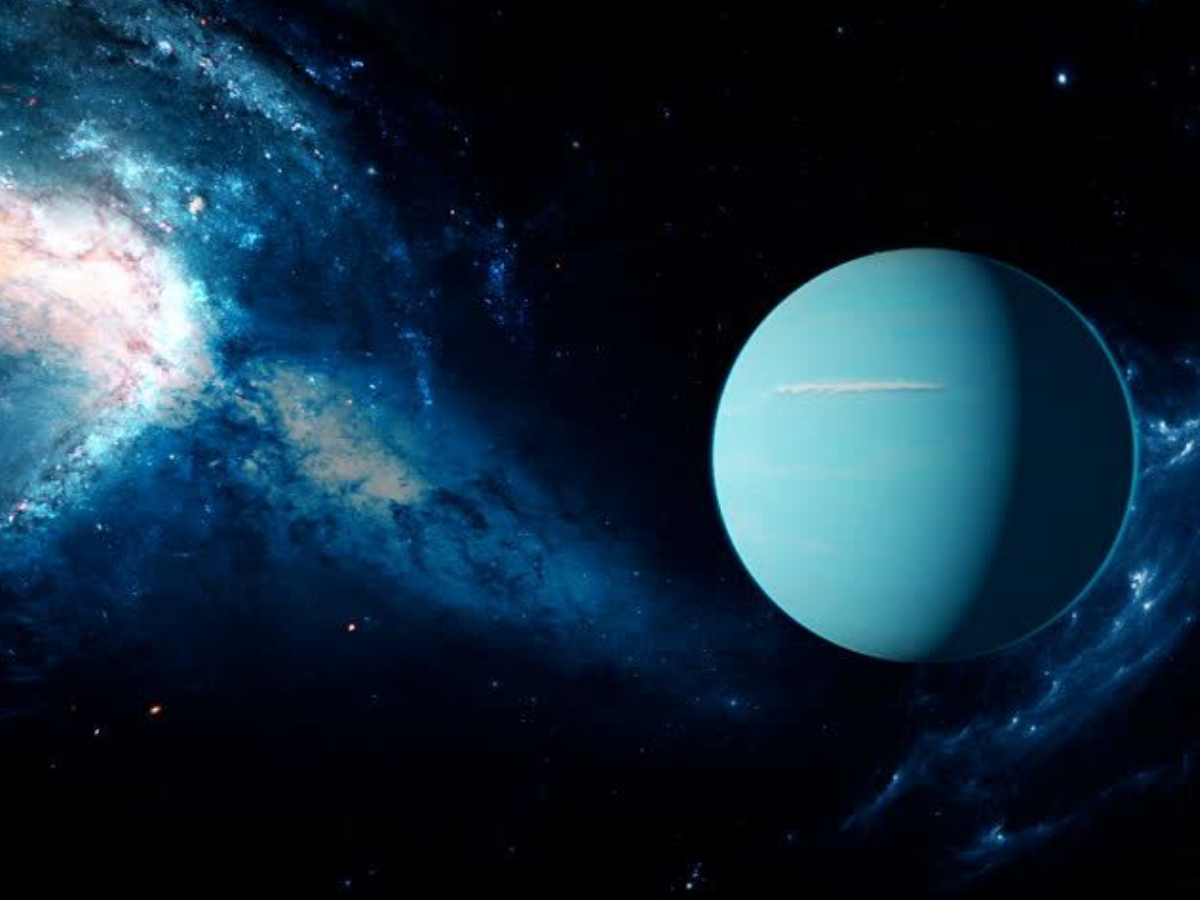
The planet Uranus has been the butt of jokes for a long time, but few actually know just how layered its naming story is. The seventh planet was discovered in 1781 and its addition to the scientific world became an unexpected controversy.
What began as a tribute to royalty soon evolved into a naming dispute that stretched across continents and scientific circles, eventually giving us the name we know today. Beyond the controversy, Uranus remains one of the most unusual worlds in our solar system, spinning on its side and experiencing seasons that last decades.
What is the Planet Once Had a Royal Name
When William Herschel discovered Uranus using his 40-foot Newtonian reflector telescope, he had at his disposal one of the finest instruments available in his time. The telescope itself had been funded by King George III and so Herschel chose to name the new planet after the monarch Georgium Sidus or George’s Star.
ALSO READ: December 2025 Supermoon: When, Where & How to Watch | Last Big Moon of the Year
That decision didn’t go unopposed. Astronomers made the argument that planets needed to be named after figures out of classical mythology, not political leaders. Others pointed out that calling it a star was scientifically incorrect. The backlash grew strong enough that an alternative had to be proposed.
How Uranus Got Its Name
German astronomer Johann Elert Bode recommended naming the planet Uranus-after the ancient Greek sky god. The name made much sense, considering previous naming conventions and appropriately paired with Jupiter and Saturn. Nevertheless, the name gained slow acceptance. It was as late as 1850 that the name Uranus became widely popular.
Today, the naming of the planets adheres to strict international rules. The International Astronomical Union (IAU) approves names for planets, moons, and other celestial bodies. Thus preventing the kind of controversy that arose with Uranus.
ALSO READ: Satellite Images Show Sulphur Dioxide From Ethiopia’s Hayli Gubbi Eruption Reaching India
Planet With an Extreme Tilt
Uranus is notable for yet another reason-it rotates on its side. Its extreme axial tilt, about 98 degrees, may be the result of its being knocked over by a gigantic impact in ancient times.
This results in an extreme season each pole faces the sun for more than four decades uninterruptedly, with at least as long in darkness afterward. Its 84-year orbit means that a Uranian year is longer than most human lifetimes.
World That Still Fascinates
Despite its appearance as a quietly blue object, Uranus remains one of the most intriguing objects in the outer solar system. From its disputed name to its sideways spin, this large planet has continued to challenge assumptions and stir curiosities.
ALSO READ: How to Turn On ChatGPT’s Age-Verified Adult & Erotic Content Features – Full Guide Inside
Disclaimer: This article provides general information for educational purposes and should not be considered scientific or technical guidance.