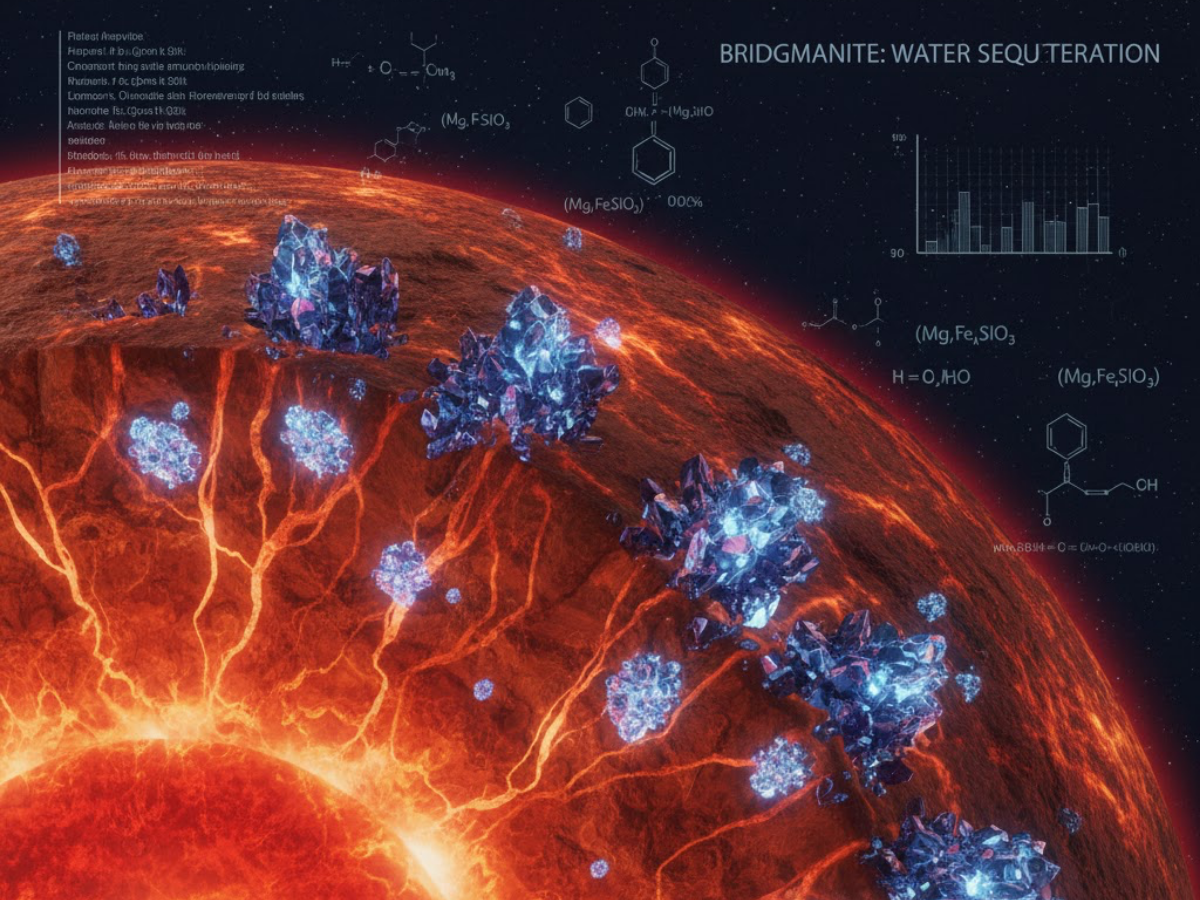
Earth was not always the blue and green planet we know today. Four and a half billion years ago, it was a molten world, constantly bombarded by asteroids with magma covering its surface. Even in this furnace like environment, water somehow survived.
Recent research reveals that Earth’s water was not lost to space but stored deep within its mantle, locked away in minerals that acted as natural reservoirs during the planet’s formative years.
What is the Role of Bridgmanite
Researchers led by Professor Zhixue Du at the Guangzhou Institute of Geochemistry have identified the mineral bridgmanite, abundant in the lower mantle, as a key player in Earth’s water story. This mineral functioned as a microscopic container, holding vast amounts of water even when the planet’s surface was molten.
The discovery overturns earlier assumptions that bridgmanite could store only limited water under cooler conditions.
Unlocking Secrets with High-Pressure Experiments
To understand how water persisted, the team simulated the extreme conditions of the deep mantle. Using a diamond anvil cell with laser heating and high-temperature imaging, they subjected bridgmanite samples to temperatures exceeding 4,100 degrees Celsius and pressures found more than 660 kilometers below the surface.
Their findings revealed that bridgmanite’s capacity to absorb water increased with rising temperatures, making it an efficient water-lock during Earth’s magma ocean phase.
ALSO READ: Bezos’s Blue Origin to Launch First Wheelchair User to Space: When & How to Watch LIVE
From Deep Mantle to Oceans
As the molten surface cooled and solidified, the water stored in bridgmanite gradually migrated toward the surface through volcanic activity and magmatic processes. This deep mantle reservoir played a critical role in transforming a fiery, inhospitable planet into one capable of sustaining oceans and life. Essentially, Earth’s habitability owes much to water that quietly waited in the depths.
Implications for Planetary Science
The discovery reshapes our understanding of planetary formation and water distribution. It suggests that other rocky planets with similar mineral compositions might also harbor hidden water in their mantles.
For Earth, it provides a compelling explanation for how our oceans formed despite intense early heat and asteroid bombardments, highlighting the resilience of planetary water systems over billions of years.
ALSO READ: 3I/ATLAS Comet Live Stream: Watch the Alien Visitor From Beyond Our Solar System
Disclaimer: This article summarizes research findings on Earth’s mantle and water storage; it is for educational purposes and not a substitute for professional advice.