
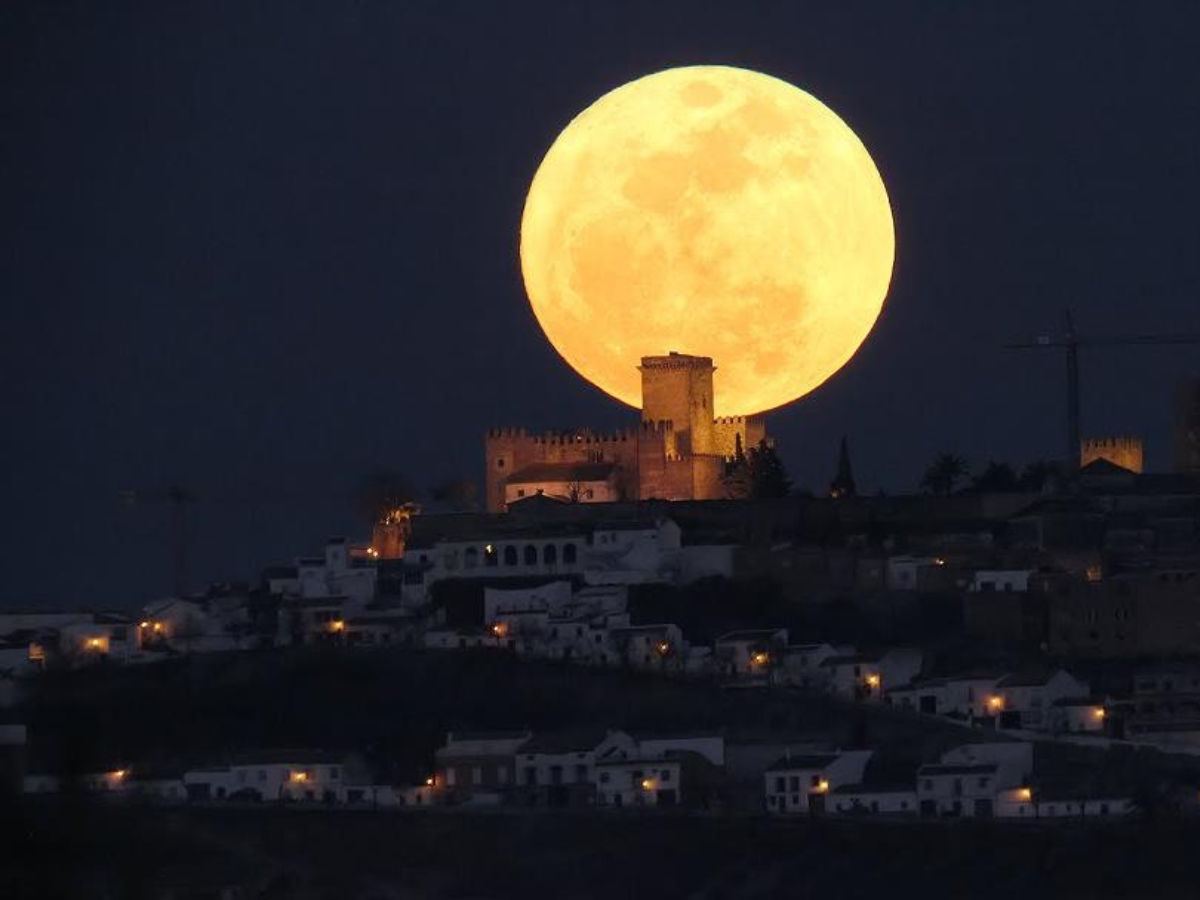
The skies are once again set to dazzle as November brings along the spectacle of a supermoon. A supermoon is a natural occurrence of the full moon coinciding with the Moon’s perigee, meaning the closest point to Earth in its elliptical orbit.
The result is a Moon that appears noticeably larger and brighter than on a typical night and offers a stunning treat for skywatchers around the world.
What Is a Supermoon?
A supermoon isn’t a freak occurrence but simply a once a month regular astronomical event that happens in relation to the Moon’s orbit. The Moon orbits Earth in an elliptical manner, coming as close as 3,60,000 km and going as far away as 4,00,000 km from the planet.
When full moon is at or near perigee, it appears as much as 14 percent bigger and 30 percent brighter than when it is at its farthest distance apogee the point in the orbit when the Moon is farthest from Earth.
Origin of the Term “Supermoon”
The term “supermoon” was coined by astrologer Richard Nolle in 1979, but over the years, it has been adopted by amateur and professional astronomers alike. Scientifically, the event is known as a perigee syzygy moon, describing the alignment of the Sun, Earth and Moon during the event.
ALSO READ: November 2025 Beaver Supermoon: When, Where & How to Watch | Brightest Lunar Show
November Supermoon 2025 Close to Earth
As the Moon comes closer to Earth, the reflection of the Sun’s light off its surface becomes more intense, making the lunar disk shine brighter and dominate the night sky.
This November, the supermoon will be seen by onlookers with its bright luster and larger than life size an opportunity to witness the closest full moon of the year.
Beyond their visual beauty, supermoons also have an impact on Earth’s tides, causing higher high tides and lower low tides, though those tidal effects do depend on local geography and lunar cycles.
For both casual viewers and enthusiasts in astronomy, November’s supermoon will give way to a night of wonder and awe-a perfect reminder of the dynamic celestial dance occurring just above our heads. Make sure to look up and catch this majestic lunar display lighting up the November sky.
ALSO READ: ISRO’s ‘Bahubali’ Rocket Launches India’s Heaviest Satellite CMS-03
Why does a supermoon appear larger and brighter?
A supermoon is larger and brighter because it occurs when the full moon falls at the same time as the Moon’s closest approach to Earth in its elliptical orbit, known as perigee. The Moon can appear up to 14% bigger and 30% brighter than when it is farther away at apogee, its most distant point from Earth. This striking visual effect happens due to the combined factors of the Moon’s orbit shape and reflected sunlight intensity.
When the full moon is at perigee, proximity to Earth increases its apparent size and amplifies the brilliance of its reflected sunlight, which is especially notable in events like the November 2025 supermoon and it works predictably the periods when the Moon is full and closer to Earth, while moving along the oval-shaped path, create a supermoon with spectacle that has fascinated skywatchers around the world.
The increased brightness is further enhanced by the reflection of the Sun’s light more directly off the closer lunar surface and what is known as the moon illusion can make the supermoon appear even larger when viewed near the horizon.
ALSO READ: Why Venus, Earth’s Twin Planet, Is the Solar System’s Hottest Hellscape
Disclaimer: Information is based on available astronomical forecasts. Dates and visibility may vary depending on location and weather conditions.