
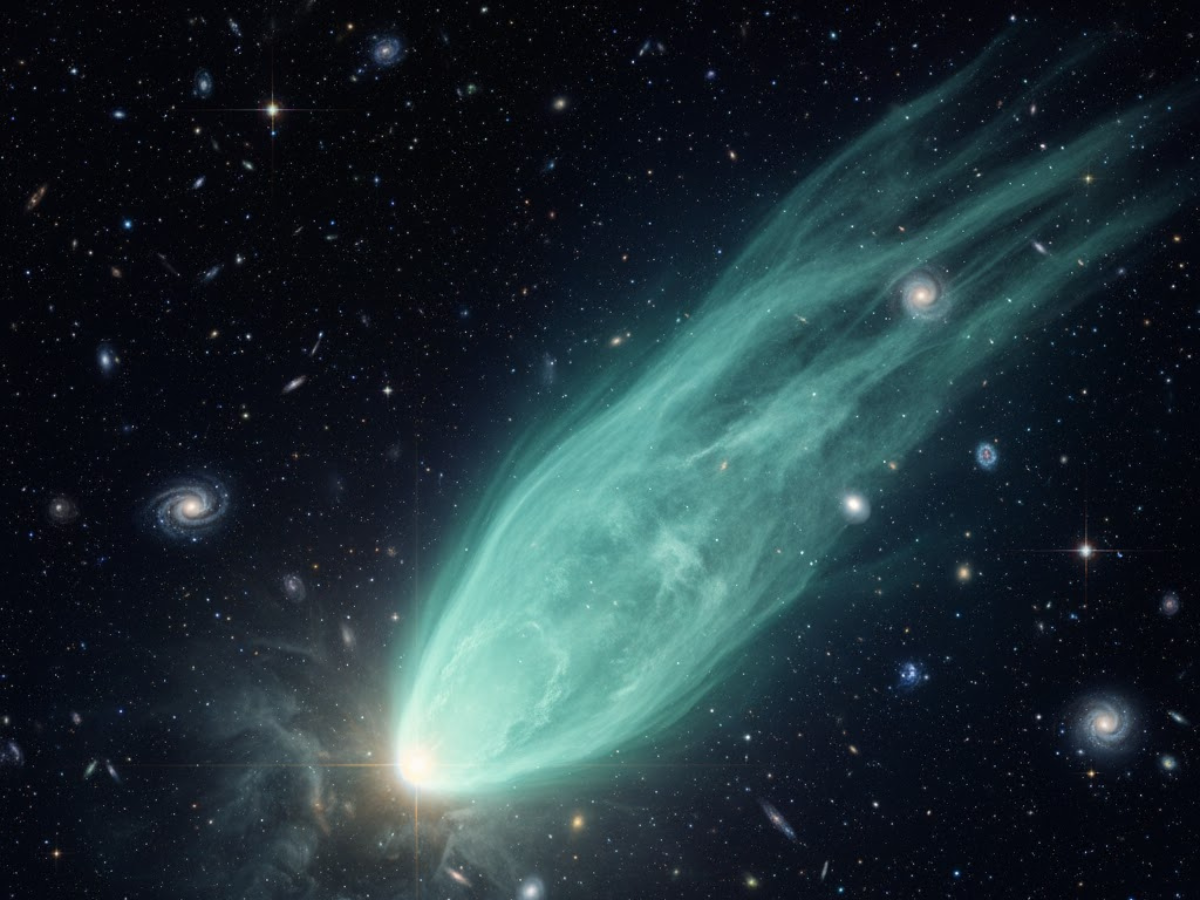
The latest comet discovery, comet 31/ATLAS is causing excitement in the astronomical community since it is one of the few interstellar objects known to visit our solar system. Discovered by ATLAS the Asteroid Terrestrial impact Last Alert System on July 1, 2025 and the coma blazes across the void at a dizzying 210,000 kilometers an hour and has an orbit with an eccentricity greater than 6, confirming it as an object that passes beyond solar borders.
The Interstellar guest `Oumuamua (2017) and Borisov (2019) are rare cosmic journeys alongside this comet from distant planetary systems.
No Risk to Earth Despite Sensationalist Theories
Shortly after its disclosure, social networks exploded with hysteria claiming that 31/ATLAS could cause devastation or that it was, in fact an alien spacecraft. Those misconceptions were brought to light with NASA and the European Space Agency clearing an obstacle by stating that the comet did not jeopardize Earth.
In place of total collision risk of the comet will make a closest approach of roughly 1.8 astronomical units or 270 million kilometers from Earth. Perihelion will be encountered around October 29-30, 2025, at about 1.4 AU from the Sun before continuing outward, across Jupiter’s orbit in March 2026.
ALSO READ: Alien Tech or Cosmic Rock? The Mystery of Manhattan Sized Object 3I/ATLAS
Comet 31/ATLAS into Ancient & Carbon-Rich Origins
Comet 31/ATLAS holds valuable insights for scientists due to its very unusual chemical composition. Observations made by NASA’s James Webb Space Telescope and the SPHEREx mission show that this comet is rich in carbon dioxide and water ice and presents very little carbon monoxide so that its peculiarity suggests that its origin lies in a carbon-rich protoplanetary disk more than 7 billion years ago that is before our solar system.
This imbalance in carbon compounds shows how the comet was intensely heated in its birth system and stripping away volatile carbon monoxide while keeping carbon dioxide.
Coordinated Spacecraft Observations in Progress
An interstellar visitor of this type spurs unprecedented international monitoring efforts pointing at 31/ATLAS. ESA Mars Express and ExoMars Trace Gas Orbiter already delivered data on the target comet as it approached Mars in early October by NASA rovers Perseverance and Curiosity tried to snag a glimpse of the comet from the Martian surface.
In the coming month, ESA’s Jupiter Icy Moons Explorer (JUICE) will keep tracking the comet just as it exhibits its brightest tail in November obtained from NASA’s Europa Clipper, Lucy, Psyche and Juno missions as well as from Earth- and space-based telescopes such as Hubble and Webb.
ALSO READ: What is a Quasi-Moon & Why is 2023 FW13 Silently Orbiting Earth?
Comet 31/ATLAS: Hubble Space Telescope
The Hubble Space Telescope images taken in July capture a tear-shaped coma enveloping a relatively small nucleus which is thought to be between 440 meters and 5.6 kilometers in diameter. The 31/ATLAS emits dust at rates of up to 120 kilograms per second despite its modest size while its early outflow beyond the orbit of Jupiter makes it unusual and likely propelled by the volatile-rich ices found within inhibiting classification as a typical comet originating within our solar system.
Not a Visible Spectacle for the Casual Observer
Comet 31/ATLAS will not be a spectacular event that will attract the attention of casual skywatchers ‘Oumuamua, arousing public interest through its peculiar shape or visible through small telescopes like Borisov with its maximum brightness would reach an estimated magnitude of 12 and would require at least 8 inches of telescope aperture to be clearly seen. The best chance to see the comet will be in December, after it comes out of the Sun’s glare but it will be very difficult to see because it will still mostly be hidden.
Weighing the Scientific Facts Against Speculation
The 31/ATLAS’s peculiarity has prompted speculation regarding alien origins leading advocates such as Avi Loeb of Harvard to suggest that these interstellar objects be artificial probes. The general scientific community is quite skeptical on that and emphasizes that, judging from the data now available it is highly probable that a natural cometary origin is involved. The thrill 3I/ATLAS brings testifies to the inevitable dualism between curious speculation and research grounded in evidence as humanity ventures into these rare visitors in the cosmos.
ALSO READ: Will Aliens Arrive on October 29? Scientists Decode 3I/ATLAS