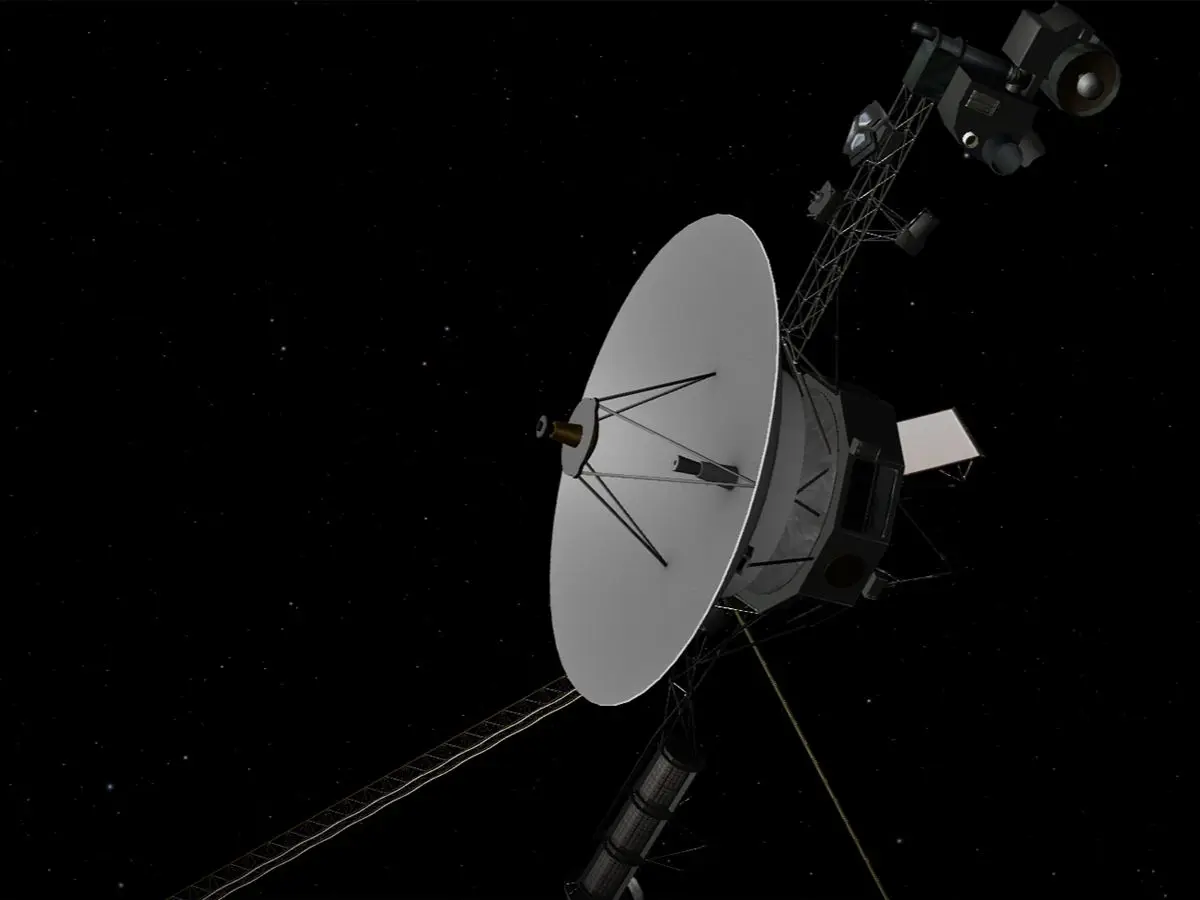
Voyager 2 on August 28, 1989 took the last of its planetary photographs before launching itself out to be grappled by the exterior planetary universe. The camera image was so positioned that it could look on Neptune to the left and the faint moon Triton to the right. Both worlds stood facing the blackness, their daylight behind them, making the image the more spectral and leaving it forever etched on the fabled wall. Voyager 2 was set to disappear and just as soon as one realized Voyager 2 was gone, in nothingness.
Why The Cameras Were Turned off
The very last light signal from a camera the end of photography on Voyager 2 was that past the first recorded face of the stormy atmosphere of Neptune. The following day, NASA shut it down. Power management at such great distances is crucial.
If the optical instruments had not been shut down, there would not have been anything else to power down thus, the spacecraft would have kept transmitting useful scientific information long after the last of its camera’s optics. So, the approach and flyby of Neptune were so special for such reasons and marked a very big milestone for Voyager 2.
ALSO READ: Why September’s Lunar Eclipse Turns Moon an Eerie Dark Red: Shine for 82 Minutes
Revolution of the View of the Outer Planets
Voyager 2 was launched in 1977 to complete a grand tour of the outer planets. Along its path, Voyager 2 revolutionized planetary sciences by disclosing Jupiter’s raging storms, Saturn’s intricate rings, the oddity of Uranus with its tilted axis and Neptune’s supersonic winds.
Looking back at it all, Neptune proved the anchor that took Voyager 2 even deeper step into history, revealing Triton’s nitrogen geysers and confirming Triton’s reverse wheel around Neptune. Every discovery has thus changed the human view of the diversity of the Solar System.
Triton: An Unusual Moon
Among all such wonders, the discovery of the ice cube surfaced with Triton named as one such mysterious moon. Such an abnormality doesn’t linger with the moon at all it was seen orbiting around Neptune in the opposite direction.
ALSO READ: September 2025 Astronomical Events: From Venus Occultation to Solar Eclipse
So, the view was that the moon was most likely captured by Neptune. Voyager 2 grants severe scrutiny of the moon’s icy plains and violent geysers and it was geologically active. This was groundbreaking, for it upended traditional thinking that moons are essentially lifeless fixtures.
Vision Extended Farther than Planets
After saying goodbye to the Neptune flyby, Voyager 2 continued beyond a planetary mission and wandered into the realm of interstellar science. Now that Voyager 2 had made its final camera act, and the instruments could transition into interstellar work to measure the variability of magnetic fields, plasma, cosmic rays, etc. on the outer edge of the Solar System.
In 2018, this spacecraft crossed over into the interstellar medium, joining Voyager 1 as humanity’s ambassadors. Standing on bended knee with ever-weakening powers, these siblings continue fiddling around with unique incoming data about nature’s bridge between our Sun’s isolation bubble and the vagueness beyond.
ALSO READ: WISPIT 2b: Astronomers Capture First Baby Planet Growing Inside a cosmic ring