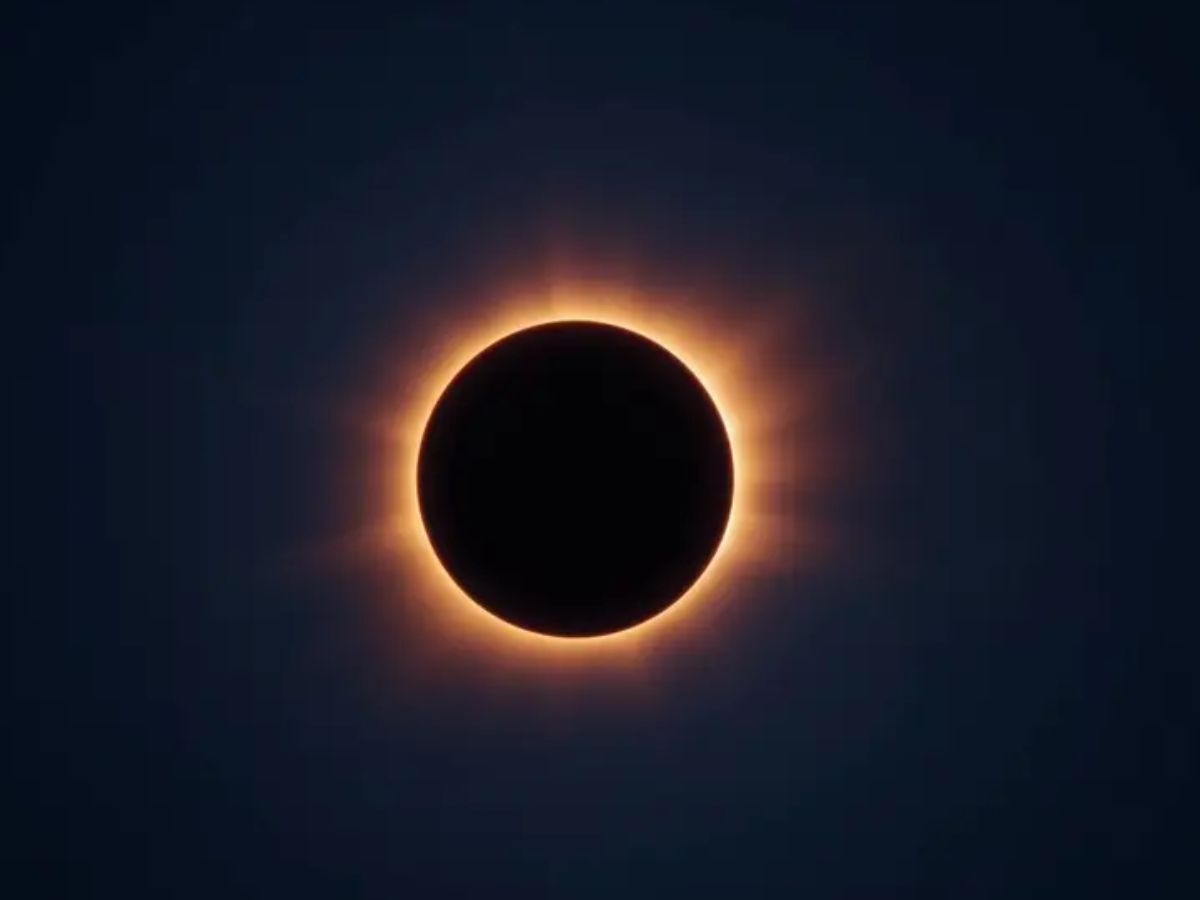
A spectacular celestial show is headed our way on August 2, 2027. Astronomers say Earth will experience one of the longest total solar eclipses of the century, with totality lasting up to 6 minutes and 23 seconds — a rare moment skywatchers may remember for a lifetime. This extraordinary event has generated excitement around the world.
While the path of total darkness will sweep across parts of Europe, North Africa and the Middle East, millions of people in India can still catch a partial eclipse, especially in western and north-western regions.
What is a Total Solar Eclipse?
A total solar eclipse occurs when the Moon passes directly between Earth and the Sun, completely blocking the Sun’s bright disk. The sky briefly turns dark as if at twilight, stars and planets appear above, and temperatures drop. During totality, observers within the path see the Sun’s glowing outer atmosphere — the corona.
The 2027 event is special because the Moon will be near its closest point to Earth (perigee) while Earth is farther from the Sun (aphelion), allowing the Moon to block sunlight for a longer period than usual.
Total Solar Eclipse 2027: When & Where Will It Happen?
The total solar eclipse will occur on August 2, 2027. Its path of totality — where the Moon fully covers the Sun — will begin over the Atlantic and North Africa, moving across:
- Spain and southern Europe
- Morocco, Algeria, Libya and Egypt
- Saudi Arabia, Yemen and parts of the Middle East
- Somalia and the Indian Ocean
In some locations, especially near Luxor, Egypt, the total phase will last up to 6 minutes and 23 seconds — making this the longest total eclipse visible from land in the 21st century.
Will India See the Total Solar Eclipse 2027?
Although the path of totality will not cross India, parts of the country will still witness a partial solar eclipse. Observers in western and north-western India — including Rajasthan, Gujarat, Maharashtra and Goa — can see the Moon cover a portion of the Sun as it sets.
The partial eclipse in India is likely to occur in the late afternoon, starting around 4:00 PM IST and lasting until around 6:00 PM IST, with variations depending on location.
What Makes This Total Solar Eclipse 2027 Special?
The 2027 eclipse stands out because:
- It lasts far longer than most total solar eclipses.
- Its path crosses multiple continents and a large number of populated regions.
- It gives scientists a rare chance to study the Sun’s corona in detail.
Total solar eclipses of this duration are rare. Astronomers note that eclipses so long won’t appear again for decades, with similar events expected in 2045 and later years.
Total Solar Eclipse 2027: Viewing Safety Tips
Viewing any solar eclipse — total or partial — requires proper eye protection. Observers should use only ISO-certified eclipse glasses or indirect viewing methods like pinhole projectors. Looking directly at the Sun without protection, even during partial phases, can cause serious eye injury.
Why This Eclipse Matters?
Beyond its visual spectacle, the 2027 solar eclipse has scientific importance. The extended duration of totality gives astronomers more time to observe the Sun’s corona — a region that remains mysterious and difficult to study. It also inspires public interest in astronomy and space science, connecting everyday observers to cosmic rhythms.