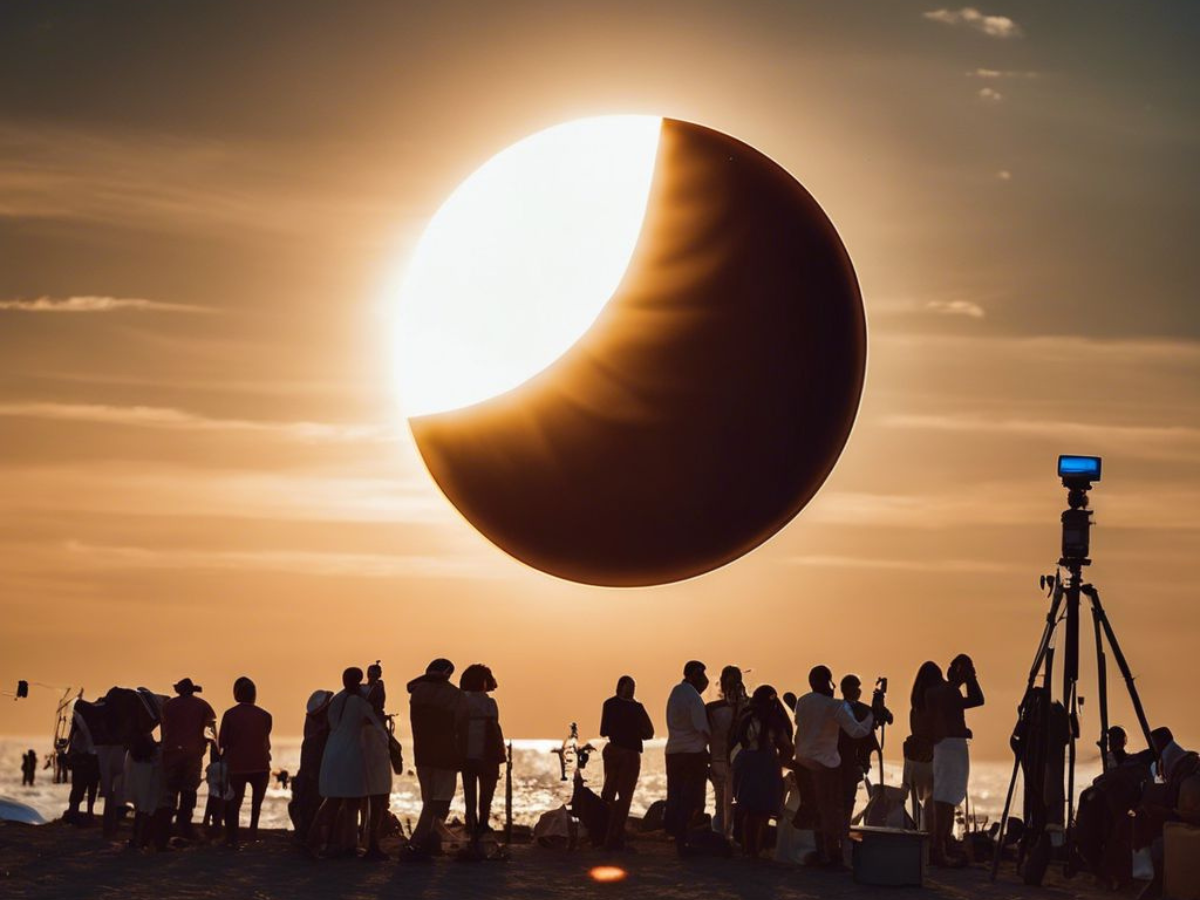
A solar eclipse in astronomy means a celestial phenomenon when the Moon moves directly in front of the Sun from the perspective of Earth, obscuring all or part of its beam. Such an alignment is an extraordinary phenomenon wherein one turns day into a surreal display of cosmic precision.
Solar eclipses are rare because it needs that exact positioning of all the heavenly bodies in a line Earth, Moon and Sun.
What are the Types of Solar Eclipses?
There are three different types of solar eclipses:
- Total Solar Eclipse is the Moon completely eclipses the Sun and shows, unlike the rest of the universe and the halo-like corona of the Sun, throwing darkness on the world temporarily.
- Partial Solar Eclipse is only part of the Sun is hidden, so a crescent-shaped light is formed.
- Annular Solar Eclipse is seen as a Moon smaller than the Sun, turning it into a fiery ring at the edges the ring of fire.
Each type depicts a degree of darkness and visual impact related to the observer’s point of view.
ALSO READ: September 2025 Eclipse: What to Know About the Rare Lunar and Solar Eclipses Coming
Where & How It Was Seen in India-2009
In 2009 total eclipse traced as a dramatic curve across the Indian subcontinent with the shadow which starts near the Gulf of Khambhat in Gujarat and sweeps east into major cities like Surat, Indore, Bhopal, Varanasi and Patna. People began to congregate along the banks of the Ganges, combining their religious rituals and sky-gazing.
Scientists experimented with changes in atmosphere, animal behavior and temperature during eclipses. Southern and western India experienced an eclipse of partial coverage in the northern and eastern states went totally dark for several minutes.
ALSO READ: Concorde 001 Creates History: 74 Minute Longest Solar Eclipse Captured at 2,500 km/h
What is the Celestial spectacle for Which India Went?
A July morning in the year 2009, when millions remember that this was the day India experienced the longest total solar eclipse of the 21st century. At its highest point, this event lasted over six and a half minutes, forming both a scientific miracle and a religious experience.
Day briefly darkens, birds go silent while crowds endlessly gaze at the empty sky and searching for the Sun that has disappeared beyond the Moon. That was a rare alignment which united people of all walks of life in one wonderment.
An Unprecedented Long Eclipse in 2009
The reason behind such an importance history in the happening of eclipse year 2009 was that unique astronomical alignment the Moon was at the nearest point to the earth (perigee), forming an enlarged view of the Moon on the sky and earth was at farthest distance from the sun at aphelion.
This rare combination made it even easier for a longer time to block the Sun completely. The pathway of the eclipse also traversed densely populated regions allowing millions to witness one of the longest total eclipses of modern times right from their doorsteps.
ALSO READ: Surya Grahan 2025: Timings & Best Places to Watch the Solar Eclipse on 21 September
Disclaimer: This article summarizes astronomical events for educational purposes; viewing eclipses requires safety precautions and local timing may vary.