
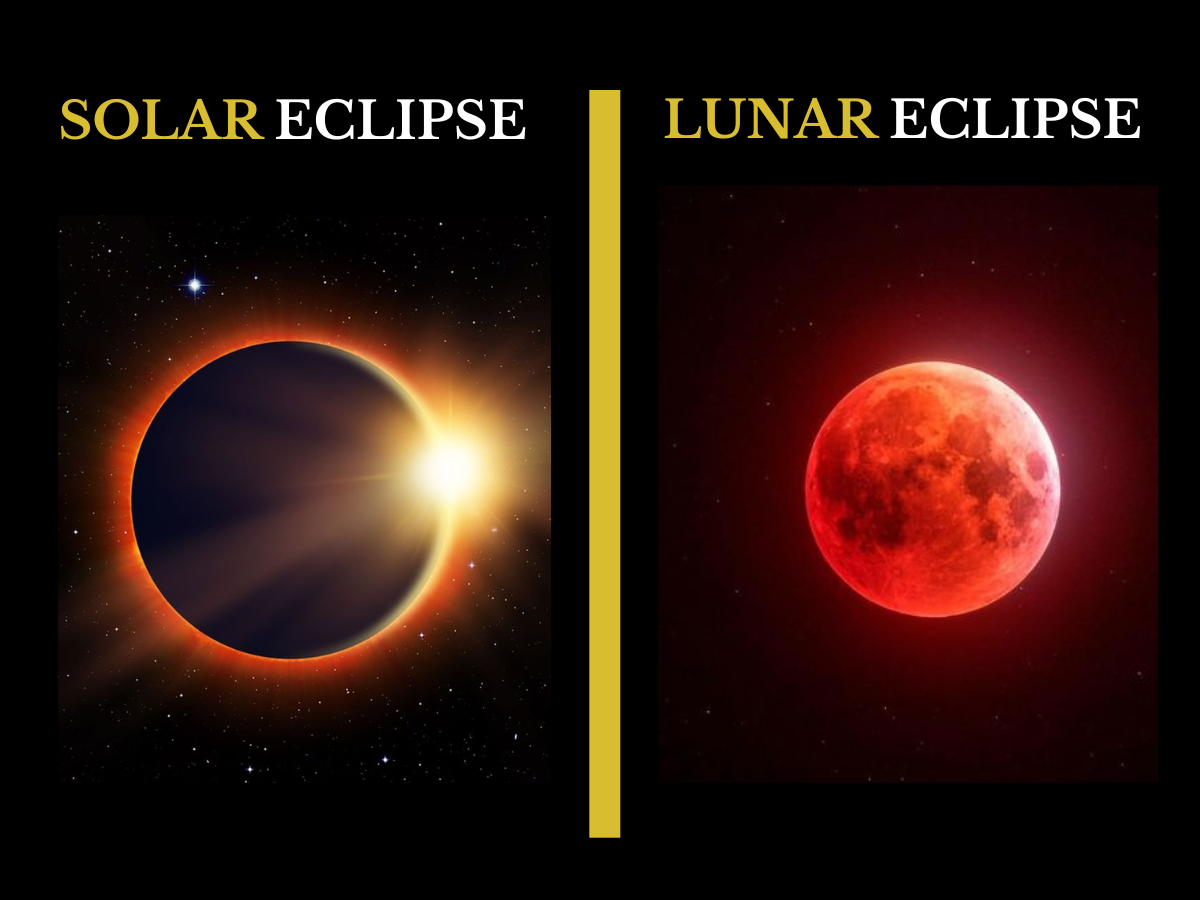
On September 2025, sky watchers worldwide are preparing to behold an inspiring spectacle of a pair of celestial events. The first event to occur on Sunday, September 7, is a total lunar eclipse popularly nicknamed ‘Blood Moon’ two weeks later, followed by a partial solar eclipse.
While they are fairly rare in their own right and seem to almost always come close together.
Here is a deeper look into what makes the spectacle happen, how they are different and when to watch.
What Is a Lunar Eclipse?
Lunar eclipse occurs when Earth passes directly between Sun and Moon casting a shadow on the lunar surface. This can happen only at the time of full moon. Based on the distance to which the Moon enters Earth’s shadow and lunar eclipses are classified into three types:
ALSO READ: Blood Moon on Sept 7: Lunar Eclipse Timings in the US and How to Watch Live
- Total Lunar Eclipse: The Moon is in Earth’s darkest shadow (umbra) and acquiring a reddish hue referred to as a Blood Moon.
- Partial Lunar Eclipse: Only part of the Moon darkens.
- Penumbral Lunar Eclipse: The Moon passes through the outer shadow and gets faintly dimmed.
The total duration of the eclipse on September 7 is more than five hours, out of which the total phase ‘Blood Moon’ will be visible for about 82 minutes. Unlike solar eclipses, lunar eclipses can be safely viewed with the naked eye.
What Are Solar Eclipses?
Solar eclipses occur when the Moon in its path between Earth and the Sun and blocks the sunlight. These can only happen in the new moon phase. The types are:
- Total Solar Eclipse: The Moon completely covers the Sun for a few minutes.
- Partial Solar Eclipse: The Sun is partially obscured.
- Annular Solar Eclipse: The Moon is too small and leaving a ring of fire around the Sun.
ALSO READ: Chandra Grahan 2025: Rituals, Timings & Precautions for the Final Eclipse of the Year
For this reason, on safe days, one should protect his or her eyes when watching the solar eclipses.
What are Upcoming Dates for Eclipses?
Lunar Eclipse: Sept. 7-8, 2025, best seen from Asia, Europe and parts of Africa.
Solar Eclipse: Sept. 21, 2025, seen from sunrise in New Zealand, Antarctica and parts of the Pacific.
Why Eclipses Always Come in Pairs?
Due to the tilt of the Moon’s orbit an eclipse does not occur every full moon or new moon. The Moon only produces an eclipse when it crosses the Earth’s orbital plane at the nodes and is aligned in conjunction with the Sun and the Earth.
Such an alignment has the nature of being very rare and hence mostly occurs in pairs approximately two weeks apart.
ALSO READ: Blood Moon 2025: List of Cities in India to Witness the Rare September Eclipse