
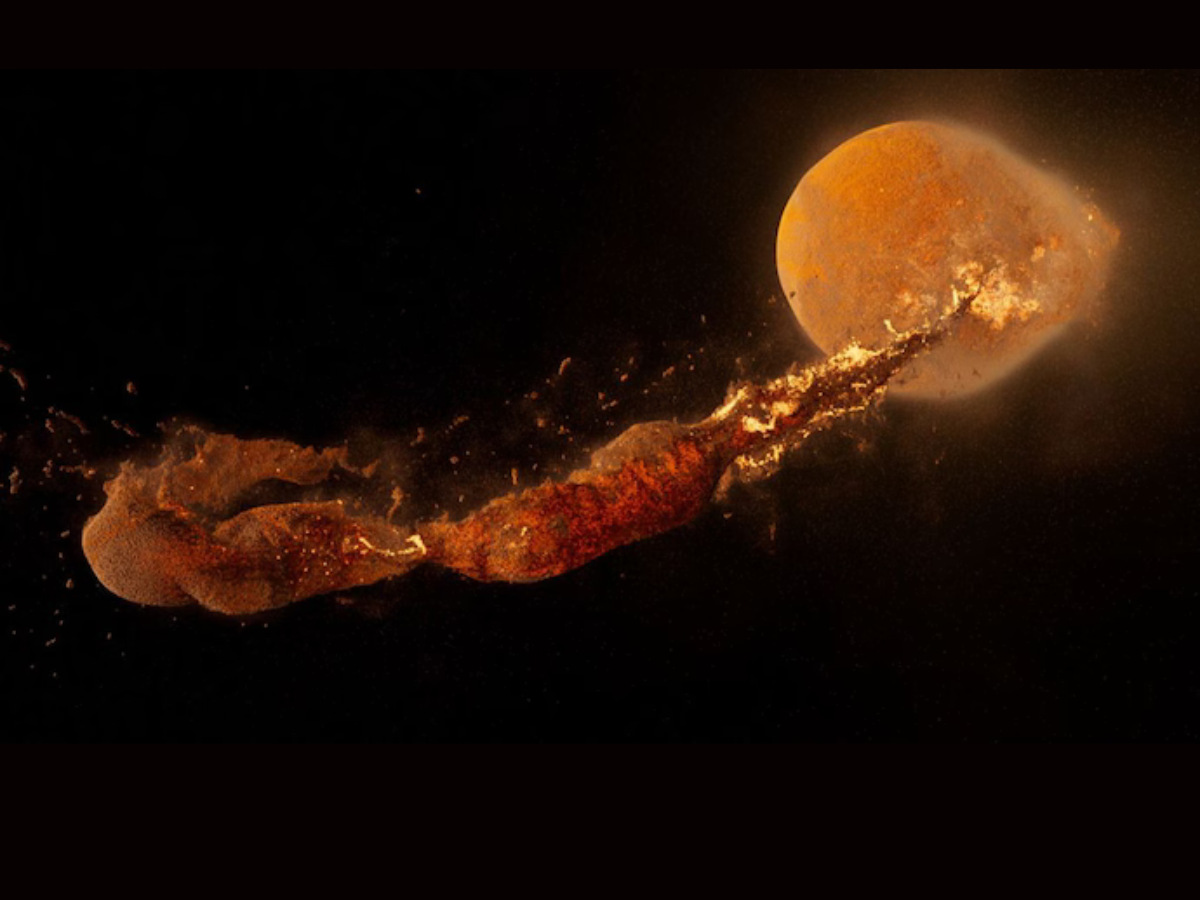
New research is reshaping what we know about the Moon’s violent beginnings. A fresh study puts forth that Theia, the mystery Mars-sized body that crashed into early Earth, was born even closer to the Sun than our own planet. It provides new clarity on how the Moon was born and from what ingredients it was composed.
What is the Giant Impact & the Mystery of Theia
About 4.5 billion years ago, Theia collided with proto-Earth in such a violent way that both bodies were torn asunder. The debris eventually clumped together to form the Moon.
While the Giant Impact Hypothesis is widely accepted, scientists have long struggled to pin down Theia’s origin and composition and how much it contributed to both Earth and the Moon.
What is the Theory of Theia
The theory of Theia, or the giant-impact hypothesis, proposes that the Moon was formed approx 4.5 billion years ago when a Mars-sized protoplanet named Theia collided with the early Earth.
ALSO READ: NASA Finds Strange Mars Rock That Appears Not to Belong There: Aliens on Mars
The impact ejected a significant amount of debris from both bodies into orbit, which eventually coalesced to form the Moon. The impact is also thought to have contributed to Earth’s iron core, potentially explaining unusual structures deep within Earth’s mantle.
New Clues From Isotopes
In order to determine Theia’s identity, scientists at the Max Planck Institute for Solar System Research and the University of Chicago studied isotopes from Earth rocks, Apollo lunar samples and meteorites.
These atomic fingerprints demonstrate that Earth and the Moon both bear non-carbonaceous signatures indicating their construction materials were derived from the inner Solar System. Iron isotopes held particularly important keys, since their distribution is different between inner and outer bodies in the Solar System.
Theia Was Born Closer to the Sun
By reverse-engineering the chemical composition of the samples, the team concluded that Theia most likely formed even closer to the Sun than Earth. This would suggest that it came from a hotter zone with fewer volatile materials.
ALSO READ: Who is Byju Founder Raveendran? Age, Wife, Career, Net Worth & Key Controversies
Some of Theia’s ingredients might even belong to a missing reservoir a type of material that does not exist in any meteorite we’ve sampled so far, and may only survive on planets like Mercury or Venus.
Why the Moon Is Dry
If Theia came from a hotter, volatile-poor region, it helps explain the Moon’s dry composition. Scientists also believe that much of the Moon’s water was boiled away during the colossal impact, which produced global magma oceans on both Earth and the newly forming Moon.
What is the Violent Birth
The study reinforced a view that the Moon had been formed in chaos, rather than in calm. Every new discovery uncovers more and more about the legacy of Theia and allows scientists to piece together how our closest celestial neighbor came into being.
ALSO READ: Who is Marjorie Taylor Greene? Net Worth, Family, Career, Controversy & More
Disclaimer: This article is based on current scientific research and is intended for informational purposes only. Findings may evolve with future studies.