
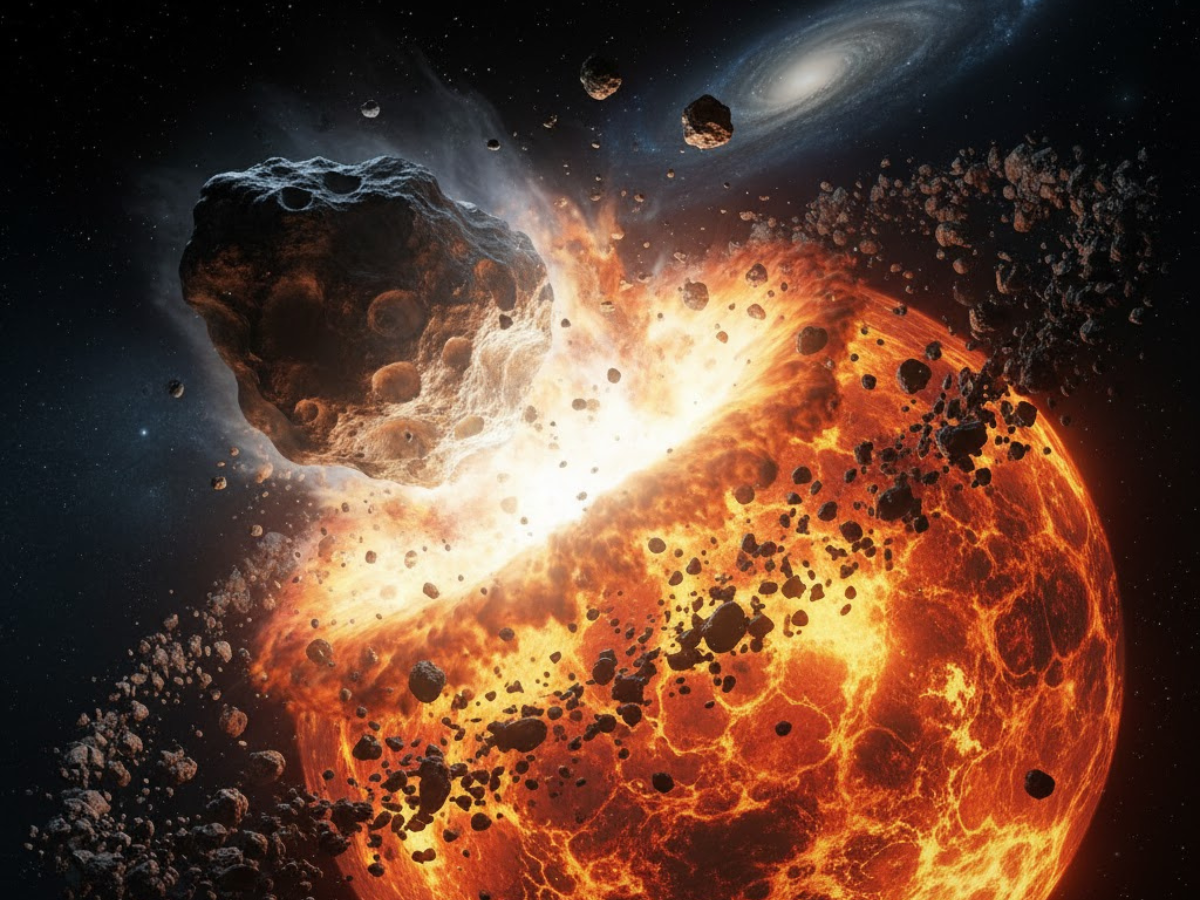
Research has unearthed chemical clues about a vastly older Earth that existed long before the Moon was formed. The evidence came deep down in the crust of our planet and might completely overturned the framework around which we had built our early thinking about how Earth first formed.
Trace Evidence from the Earliest Times in the Earth
Geologists have dug up the chemical signature of rocks originating in Greenland, Canada and Hawaii which are among the oldest areas on the planet. These ancient rocks have an unusual potassium isotope ratio the unusualness has specific reference to potassium 40 isotopes the ratio that characterizes them today is entirely different from what is found in the Earth’s current geological inventory.
In fact, such differences point at a possibility for preservation of material prior to the great impact which shaped modern Earth and formed the Moon.
ALSO READ: What’s Behind the Moon’s Mysterious Flashes? Exploring Transient Lunar Phenomena
Challenging Long California
The view that the world has to take collision with Mars-size, coalescing planet versions for catastrophe during more than 4.5 billion years ago. This super collision must have melted most of the planet and erasing all geochemical animal traits.
But this finding has no such case remains of proto-Earth may still exist in the crust of the Earth postulated as being formed by a major impact event. The research, according to MIT’s Nicol Nie, represents possibly the first hard evidence that pieces of original Earth have somehow made it through billions of years of planetary change.
ALSO READ: Could Life Exist on Mars? Scientists Detect Signs Under Planet’s Ice | Mars Mystery
A window of great insight into the creation of Earth & the Solar System
This is not just a hazy clue about Earth’s formation but even more about the formation of an early solar system. In the ancient chemical fingerprints, scientists are hoping to recreate the conditions leading to the formation of planets and even the explosive events that shaped them.
These 4.5-billion-year-old, untouched signatures are not just geological curiosities. They are time capsules from when the world predated the Moon.
ALSO READ: Will Aliens Arrive on October 29? Scientists Decode 3I/ATLAS
Disclaimer: This article is for educational and informational use only. Scientific interpretations may evolve as further evidence and peer-reviewed research emerges.